Exchange rates (OCR A-Level Economics): Revision Notes
📚Revision Notes
4.2 Exchange rates
4.2.1 Exchange Rates
Definition: An exchange rate is the price of one currency in terms of another currency. It indicates how much of one currency is needed to purchase a unit of another currency.
Note
Types of Exchange Rates:
- Floating Exchange Rate: Determined by the free market forces of supply and demand without direct government intervention.
- Fixed Exchange Rate: Set and maintained by a government or central bank at a certain level against another currency or basket of currencies.
- Managed Float (or Dirty Float): Primarily determined by market forces but with occasional government intervention to stabilise or increase the value of the currency.
Note
Factors Influencing Exchange Rates:
- Interest Rates: Higher interest rates offer lenders a better return relative to other countries, attracting foreign capital and causing the exchange rate to rise.
- Inflation Rates: Lower inflation typically makes a currency more valuable as its purchasing power increases relative to other currencies.
- Political Stability and Economic Performance: Countries with less risk for political turmoil are more attractive to foreign investors.
- Speculation: If investors believe a currency will strengthen in the future, they will buy more of that currency now.
Calculation:
To illustrate how exchange rates are calculated, let's use an example:
Note
Example:
Suppose we want to calculate how many US dollars (USD) we can get for a given amount of British pounds (GBP). Assume the exchange rate is 1 GBP = 1.30 USD.
- Determine the amount in GBP you want to convert: Amount in GBP = 100 GBP
- Use the exchange rate to find the equivalent amount in USD: Amount in USD = Amount in GBP * Exchange Rate Amount in USD = 100 GBP * 1.30 USD/GBP = 130 USD
Summary:
Exchange rates are influenced by various economic factors and can be calculated by multiplying the amount of one currency by the exchange rate. In a floating exchange rate system, the equilibrium exchange rate is determined by the intersection of supply and demand for a currency.
Explanation with the aid of a diagram
4.2.2 Determination of Exchange Rates in Fixed and Floating Exchange Rate Systems
Floating Exchange Rate System
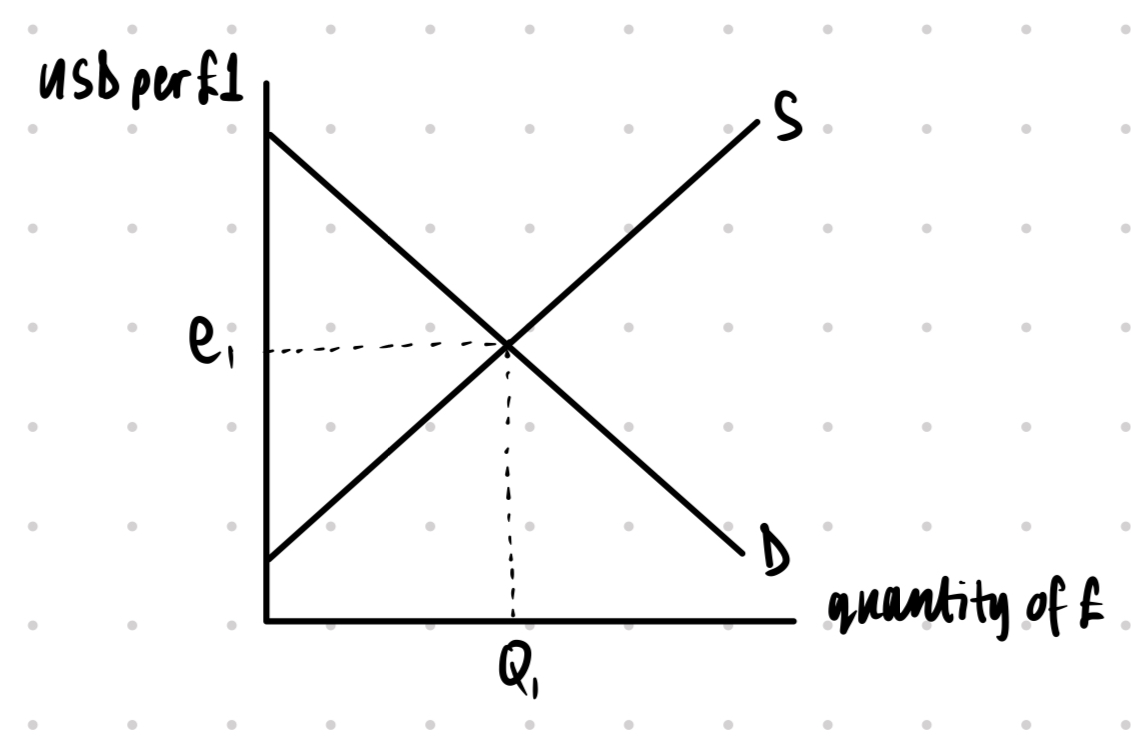
Explanation: In a floating exchange rate system, the value of a currency is determined by the forces of supply and demand in the foreign exchange market without direct government or central bank intervention. The exchange rate fluctuates freely based on these market forces.
Note
- Supply Curve (S): Represents the supply of the currency.
- Demand Curve (D): Represents the demand for the currency.
- Equilibrium Exchange Rate (E1): The point where the supply and demand curves intersect, determining the equilibrium exchange rate and quantity of currency exchanged.
Diagram:
Fixed Exchange Rate System
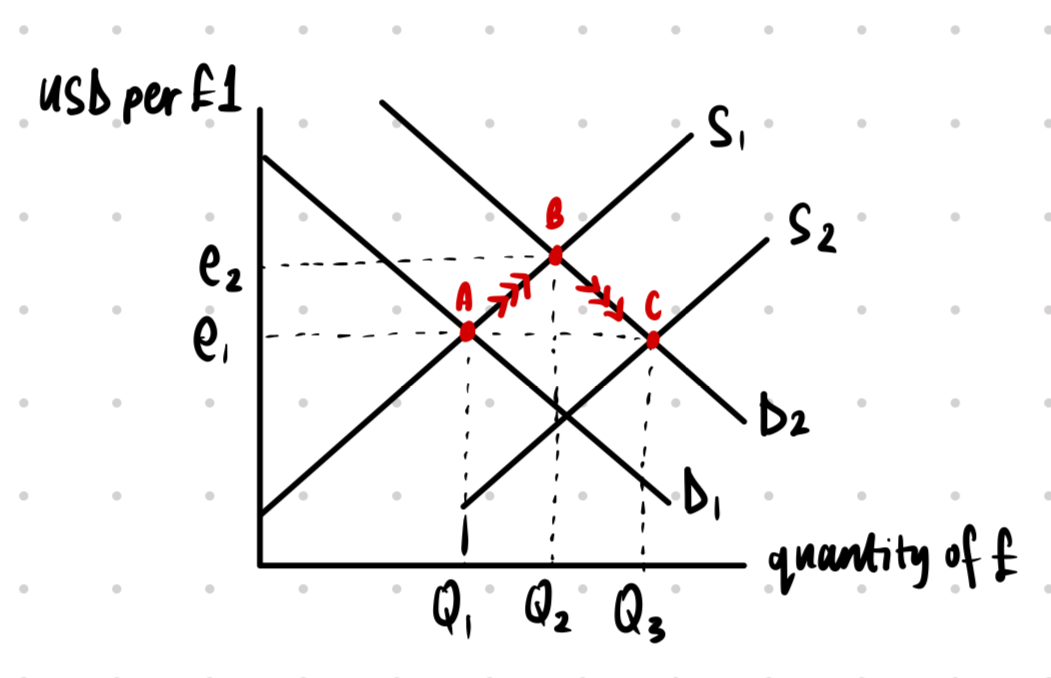
Explanation: In a fixed exchange rate system, the government or central bank sets and maintains a specific exchange rate for the currency. This rate is often pegged to another major currency (e.g., the US dollar) or a basket of currencies. To maintain the fixed rate, the central bank intervenes in the foreign exchange market by buying and selling currencies.
- Fixed Exchange Rate (E1): The government or central bank sets this rate.
- Central Bank Intervention: To maintain the fixed rate, the central bank will buy its own currency using foreign reserves if the currency is undervalued (demand exceeds supply) or sell its currency if it is overvalued (supply exceeds demand).
Note
Key Differences:
- Floating Exchange Rate: Determined by market forces (supply and demand).
- Fixed Exchange Rate: Set by government or central bank intervention.
Note
Examples:
- Floating Exchange Rate: The US dollar (USD), the Euro (EUR), and the British pound (GBP) typically have floating exchange rates.
- Fixed Exchange Rate: The Hong Kong dollar (HKD) is pegged to the US dollar, and the Danish krone (DKK) is pegged to the Euro.