Political developments (OCR A-Level History A): Revision Notes
📚Revision Notes
Political developments
Transition to Socialism, 1952-1962
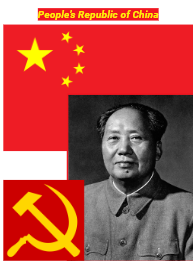
Mao Tse-tung
Hundred Flowers Campaign
In 1956, Mao Tse-tung promoted the Hundred Flowers Campaign. It originated from the poem 'Let a hundred flowers bloom; let a hundred schools of thought contend'.
The campaign aimed to promote the idea that people, specifically the intellectuals, could voice their constructive criticism of the government as opposed to hateful and vengeful criticism. Implicitly, he wanted to prove that the Chinese people were happier with the PRC and socialism compared to the Warring States.
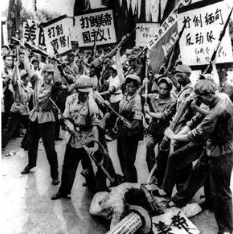
Hundred Flowers Campaign
The campaign began during Mao's speech entitled 'On the Correct Handling of the Contradictions Among the People' published on 27 February 1957. In his words, "Our society cannot back down, it could only progress... criticism of the bureaucracy is pushing the government towards the better".
The country's premier, Zhou Enlai, oversaw the campaign. Noticeably, the people did not heed the campaign for fear that they might be incriminated. At the beginning of the campaign, the government received a small amount of criticism, much of it conservative advice.
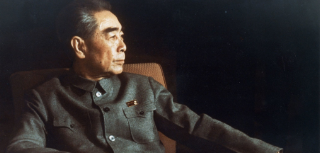
Zhou Enlai
As the government's tone of request for criticism became more demanding, people began to feel secure and, by the spring of 1957, intellectuals began to send assertive suggestions and criticisms. Furthermore, university students and other Chinese citizens even organised meetings and rallies and produced posters and published articles calling for government reform.
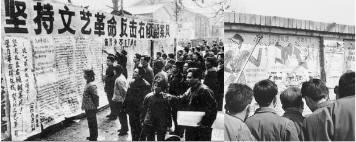
Democratic Wall
From 1 May until 7 June 1957, the premier's office received millions of letters. One example was the students of Peking University, who created a 'Democratic Wall' on which they put posters criticising the government.
Criticisms of the communist rule:
- Opposition to the use of terror against opposing political leaders.
- Lack of intellectual freedom in China as well as freedom of speech and free elections. Moreover, the proscription of foreign literary works.
- Opposition to the Soviet model in which the PRC was being replicated.
- Non-development of science and technology and low standards of living.
- Corruption and the non-observance of economic equality for the CCP members who had a higher standard of living compared to ordinary citizens.
On 8 June 1957, Mao Tse-tung stopped the campaign. Both he and Zhou Enlai did not expect the amount of criticism that poured in against the government. Their expectation was that the people were happier with the establishment of the PRC under the Chinese Communist Party (CCP). Thus, Mao did not see the letters as constructive criticism, rather as a direct threat to the government.
As Mao stated, 'poisonous weeds' should be plucked out from the bed of flowers. They called for the round-up of intellectuals, students and other citizens who criticised the government and forced them to confess that they were part of a conspiracy to overthrow the regime. Many of them were sent to labour camps for 're-education'.
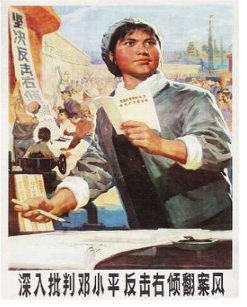
Hundred Flower Campaign poster
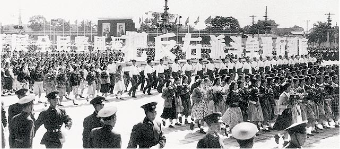
1950s Chinese parade in support of the communist political movement
After the death of Joseph Stalin in 1956, Nikita Khrushchev heavily criticised the old communism exemplified in the Hungarian Uprising. Thus, Mao believed that freedom of speech would be beneficial for the PRC, resulting in the launch of the Hundred Flowers Campaign. Many people were assured that voicing their criticism would not put them in danger. However, the opposite happened.
Anti-Rightist Purge
In July 1957, the Anti-Rightist Movement was launched by the PRC against the Hundred Flowers Campaign critics. It targeted intellectuals and students who boldly participated in the campaign.
Classified as rightists, around three hundred thousand to five hundred thousand people were arrested and sent to laogai camps (labour camps) for re-education on the benefits of communism. Some were forced into hard labour and others were executed.
The campaign's motives were questionable as historians debate whether Mao Tse-tung used it to incriminate citizens who were anti-communist or whether it was really the chairman's willingness to open the country to freedom of expression.
Furthermore, it may also have been a trap for Premier Zhou Enlai, who was popular at the time. Mao probably used him as a scapegoat by blaming him for the failure of the campaign. Hence, he was forced to apologise publicly for its failure. The campaign proved that Mao's government was not open to criticism nor freedom of speech. Since dissidents were sent to forced labour camps or were executed, people feared the government.
Inside the government, 10% of officials were purged as they were believed to have damaged the reputation of the CCP. The legal system was also targeted, during which legal professionals were transferred, and the police were put in charge of it. The movement lasted until 1959 following its second wave during the Great Leap Forwards.
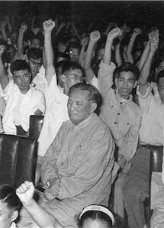
Pak Chit-Man, a victim of the anti-rightist campaign