Asch & Variables for Conformity (OCR A-Level Psychology): Revision Notes
📚Revision Notes
1.1.3 Asch & Variables for Conformity
Solomon Asch's line experiment
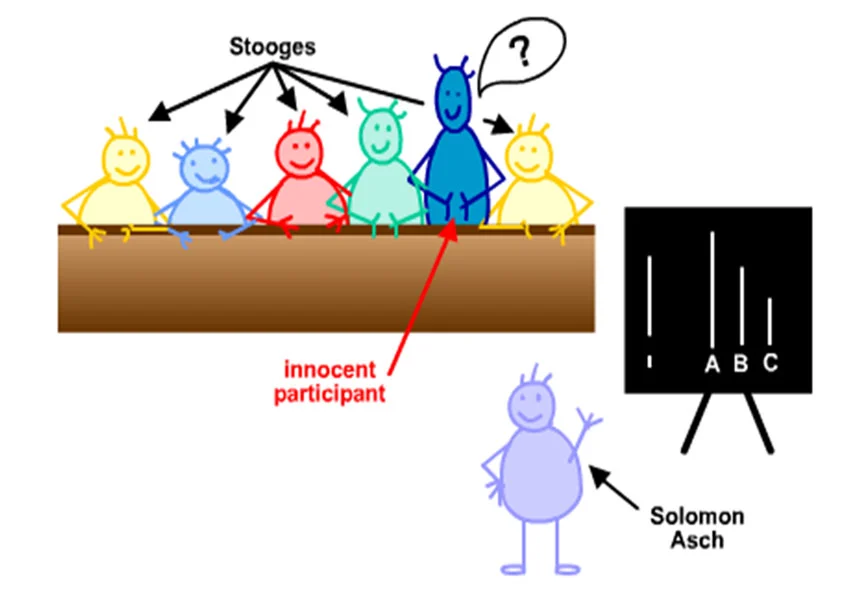
Aim:
To investigate the degree individuals would conform to a majority where the correct answer was obvious.
Participants:
👬 123 American male undergraduates
Procedure:
- Match a standard line to 3 possibilities.
- Groups of 7-9 with 6-8 confederates.
- Confederates gave the wrong answer on 12/18 critical trials
Findings:
- 36.8% of the time participants conformed and gave the wrong answer
- 75% of participants conformed at least once
- 25% of participants never conformed
Variables affecting conformity
Situational variables:
Variables within the environment that affect the results of a study.
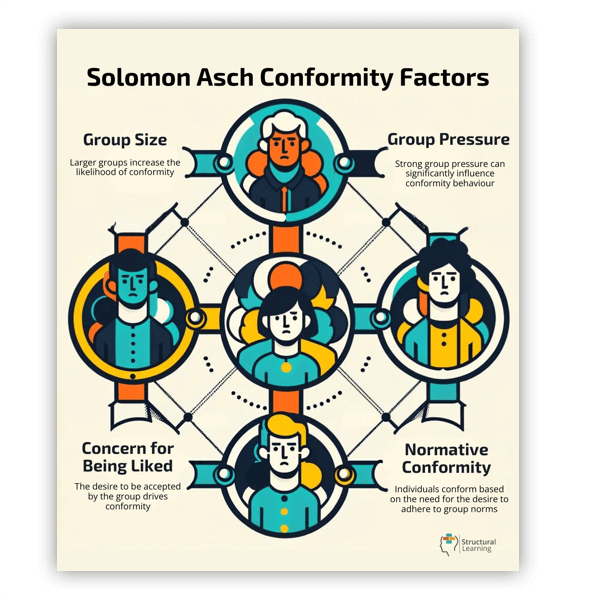
Group size:
- An individual is more likely to conform when in a larger group.
- As the amount of confederates giving the wrong answer increased conformity increased.
- There was a lower conformity rate when the group size of confederates was less than 3 - any more than 3 and the conformity rose by 30%
- A person is more likely to conform if all members of the group are in agreement and give the same answer, this is because it will increase their confidence in the correctness of the group, and decrease their confidence in their own answer.
Unanimity:
- An individual is more likely to conform when the group is unanimous, meaning that they all give the same answer
- When one confederate went against the rest, conformity dropped to around 5.5%
- The more unanimous the group is, the more confidence the participants will have that they are all correct, leading them to be influenced by the majority and give the same answer. They demonstrated an NSI effect as they wanted to fit in with the rest of the group. Task difficulty:
An individual is more likely to conform when the task is difficult.
Note
For example, Asch made the difference between the lines smaller and since it was harder to judge the correct answer conformity increased. When the task is difficult, people are more uncertain of their answer so they look to others for confirmation. The more difficult the task the greater the conformity.
This suggests that informational social influence is a major factor affecting conformity when the situation is unfamiliar and ambiguous so the individual doesn't have enough knowledge of the situation to make an informed decision independently, and therefore has to look towards others.
Conclusion:
People will conform to a majority, despite them knowing the answer is wrong. Demonstrating an NSI effect. participants reported that they conformed to fit in with the group, so it supports the idea of normative influence, which states that people conform to fit in when privately disagreeing with the majority, demonstrating compliance
Note
Evaluation - Asch:
Note
[Positive] As it was a highly controlled lab experiment, there was strict control over confounding and extraneous variables, such as the timing of assessment and the type of task used, giving the experiment high internal validity. It also produced objective data and followed a standardised procedure meaning it can be repeated to look for similar results, therefore, increasing the reliability of the research.
Note
[Positive] Proves Asch's aim that people conform to a majority when faced with group pressure, even if the correct answer is obvious and supports normative social influence.
Note
[Negative] However, it can be argued that because the behaviour was studied under artificial conditions and the task was based on people's perception of lines, it does not reflect the complexity of real-life conformity. As a result, it may not reflect how people behave outside of the lab, meaning the experiment lacks ecological validity. Furthermore, it is not an everyday task people would experience, therefore it lacks mundane realism.
Note
[Negative] However, as the participants were all American male undergraduates, the sample was unrepresentative, resulting in the experiment lacking population validity. The study was also subject to gender bias as it is assumed that findings from male participants can be applied to other groups of people in society such as women or older men, therefore, the findings are ungeneralisable.
Note
[Negative] Furthermore, As the participants were aware that they were taking part in a research study, they could have worked out the aim and conformed because they thought that was what was expected of them, therefore the findings may be a result of demand characteristics.