Minority Influence Including Commitment, Consistency (OCR A-Level Psychology): Revision Notes
📚Revision Notes
1.4.1 Minority Influence Including Commitment, Consistency
Minority Influence
Due to Informational social influence (ISI) and more likely to result in internalisation
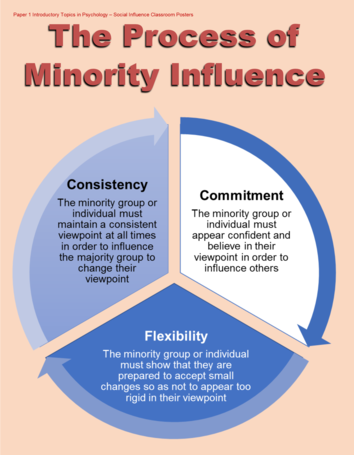
Consistency
- The majority is more likely to be influenced by the minority when the minority is consistent in their views.
- This is because it makes the opposition think that the views of the minority are serious enough to pay attention to (i.e. the augmentation principle), if they are determined to stay consistent.
- If all members share the same views (synchronic consistency), then it can convince the majority that there is something worth agreeing with.
- This is because remaining consistent over time (diachronic consistency) forces the opposition to rethink their own views repeatedly over time and generates more doubt due to the conflicting views, which allows more opportunity to be influenced. Snowball effect:
If the minority remain consistent in their message, more and more people may start to conform. This build-up of converts is known as snowballing.
There are two types of consistency:
- Diachronic consistency is when the group remains consistent over time – they do not change their views over time
- Synchronic consistency is when the group is consistent. Everyone in the group has the same views, and therefore agrees with and supports each other.
Commitment
- The majority is more likely to be influenced by the minority when the minority is committed.
- This is because when the minority have so much passion and confidence in their point of view, it suggests to the majority that their view must somehow be valid.
- This encourages them to explore why; offering more opportunities to be influenced.
Flexibility
The majority is more likely to be influenced by the minority when the minority is flexible.
Being too consistent can suggest that the minority is inflexible, uncompromising and irrational, making their argument less appealing to the majority.
However, if they appear flexible, compromising and rational, they are less likely to be seen as extremists and attention seekers.
This leads to people being more likely to conform to the minority as they are more likely to be seen as reasonable, considerate and cooperative.
Moscovici's study (1969)
Two different conditions
Consistent - confederate answered green on every trial
Inconsistent - confederate sometimes answered green and sometimes answered blue
Participants:
👬 Randomly selected participants and confederates
Aim:
🎯 To observe how minorities can influence a majority
Procedure:
- It was a lab experiment
- Participants were in a group where there were two confederates (the minority) and four participants (the majority).
- Everyone was shown 36 blue slides, each with a different shade of blue.
- They were each asked to say whether the slide was blue or green.
- Confederates deliberately said they were green on two-thirds of the trials, thus producing a consistent minority view.
- The number of times that the real participants reported that the slide was green was observed.
- A control group was also used consisting of participants only – no confederates.
Findings:
- When the confederates were consistent in their answers about 8% of participants said the slides were green.
- However, when the confederates answered inconsistently about 1% of participants said the slides were green. This shows that consistency is crucial for a minority to exert maximum influence on a majority.
- Conform to the minority due to Informational social influence (want to be right).
- Moscovici's study clearly demonstrates the role of consistency in minority influence. The majority is more likely to be influenced by the minority when the minority is consistent in their views.
(Nemeth 1986)
Nemeth conducted a study to explore the role of flexibility in influencing group decisions.
Participants, in groups of four, had to agree on compensation for a victim of a ski-lift accident. In each group, one participant was a Confederate, and there were two conditions.
- The confederate argued for a low compensation and was inflexible
- The confederate was flexible and compromised on a slightly higher amount. Nemeth found that the flexible approach led the majority to be more willing to compromise, while the inflexible approach had little effect. This research suggests that while consistency is important, as shown by Moscovici, flexibility is also crucial for minority influence.
Example
EXAMPLE SITUATION using flexibility, commitment and consistency
How Marcus can persuade his friends to go travelling this summer.
Marcus is more likely to persuade his friends by staying consistent. This is because his friends will see his views as serious enough to pay attention to as he is determined to remain consistent over time (diachronic consistency).
However, being too consistent can suggest he is inflexible, making his argument of going travelling in the summer less appealing.
So, if Marcus appears flexible and rational, perhaps by offering a compromise, his friends are more likely to conform to the minority. Additionally, if Marcus remains committed, showing passion and confidence in his point of view his friends will be encouraged to explore why, offering more opportunities to be influenced.