Baillargeon's Theory (OCR A-Level Psychology): Revision Notes
📚Revision Notes
11.3.1 Baillargeon's Theory
Baillargeon's explanation of early infant abilities
Baillargeon argues that humans are born with core knowledge/an innate physical reasoning system from birth. E.g horses have the innate ability to walk immediately after being born, and humans have an innate ability to understand the physical world. Baillargeon's violation of expectations study supports this.

Violation of Expectations study
Baillargeon conducted several studies using the violation of expectation procedure to demonstrate that infants under 8 months know the physical world.
- The idea is that infants will look at things that don't fit with their understanding of the physical world (things that go against their expectations) for longer than they will look at things that do fit with their understanding of the physical world (that are in line with their expectations).
🔖One example of this is Baillargeon and Graber 1987
Infants between 5 months and 6 months were shown a rabbit travelling along a track and disappearing behind a wall with a hole in it:
- Scenario 1 (possible event): The rabbit is shorter than the lower edge of the window and so can't be seen in the hole in the wall
- Scenario 2 (impossible event): The rabbit is taller than the lower edge of the window but doesn't appear in the hole in the wall
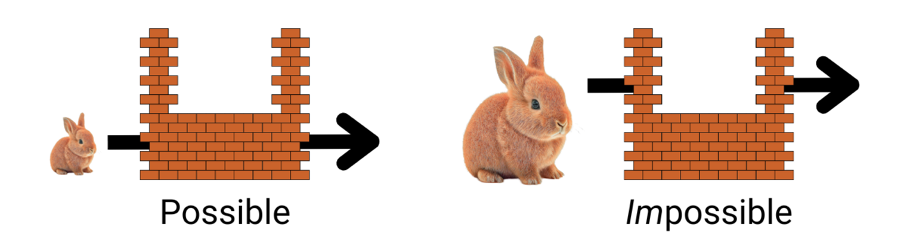
You would expect to see the tall rabbit's head and ears over the top of the wall but scenario 2 (the impossible event) violates expectations.
- Baillargeon and Graber saw that, on average, infants looked at the impossible event for much longer than they looked at the possible event (33.07 seconds vs. 25.11 seconds). This suggests that the infants expected the tall rabbit to appear in the gap in the wall and were surprised when it didn't. Therefore, suggesting that they had an understanding of object permanence.
Comparison: This contradicts Piaget's claim that infants do not understand object permanence before 8 months of age.
Evaluation:
(1)
Note
P: Baillargeon's findings may have limited generalisability.
Note
E: Most studies are conducted in controlled lab environments with a specific demographic, which might not represent all infants.
Note
E: As a result, the findings might not apply to infants from diverse backgrounds or natural settings.
(2)
Note
P: Baillargeon's studies provide empirical evidence for early cognitive abilities.
Note
E: Her research shows that infants as young as 5-6 months look longer at impossible events, indicating an understanding of object permanence and physical properties.
Note
E: This supports the idea that infants have an innate physical reasoning system, challenging Piaget's claim that such abilities develop later.
(3)
Note
P: The controlled nature of Baillargeon's experiments enhances replicability.
Note
E: Precise control over variables allows for clear interpretation of results and replication by other researchers.
Note
E: This strengthens the reliability of her findings and supports the robustness of the violation of expectation paradigm.