Neural & Hormonal Mechanisms in Aggression (OCR A-Level Psychology): Revision Notes
📚Revision Notes
15.1.1 Neural & Hormonal Mechanisms in Aggression
Aggression:
Aggression: A physical or non-physical behaviour that is threatening or to harm other people or objects
Neural and hormonal mechanisms in aggression
The Limbic system:
The Limbic system is made up of the hypothalamus, amygdala and hippocampus
These three brain regions work together to produce aggression
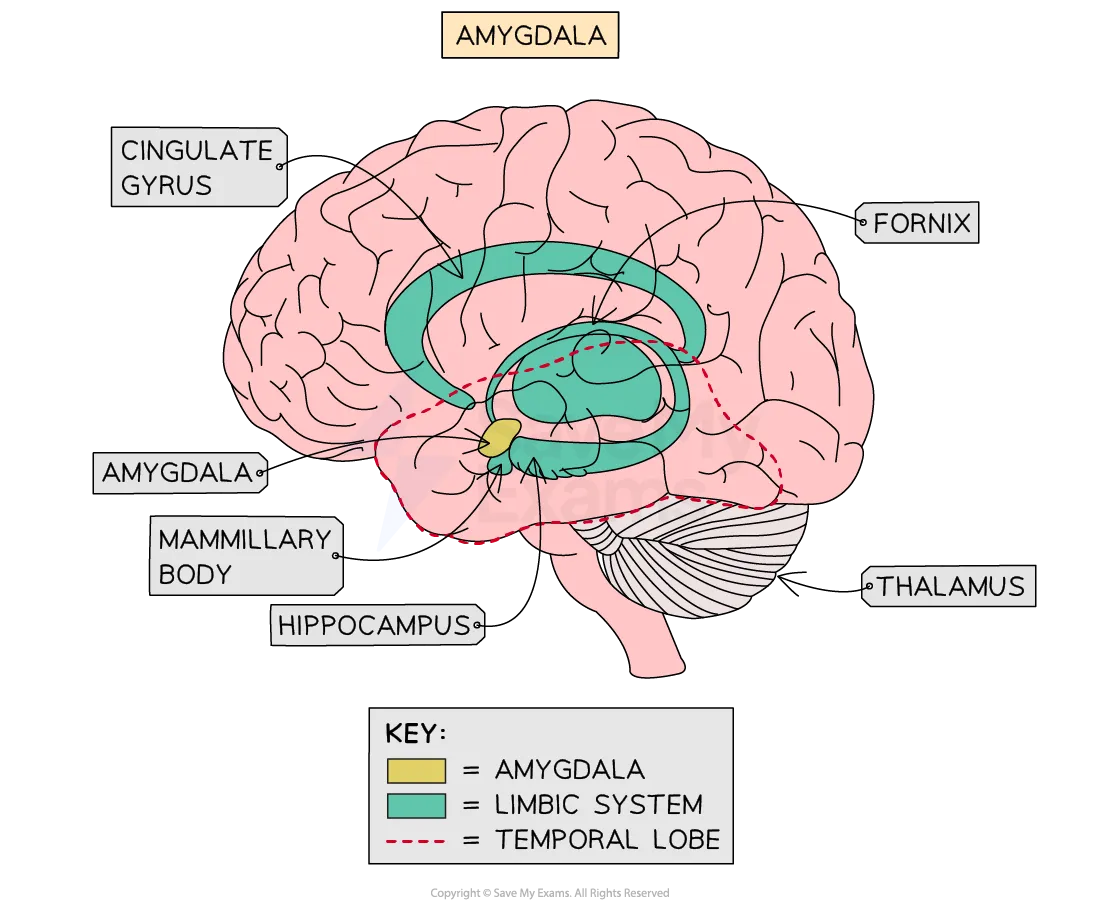
Limbic system structures that are implicated in aggressive behaviour.
The role of the hypothalamus in aggression:
Hypothalamus: Produces aggression
Amygdala: Decides whether an event in the environment is good or bad
The amygdala helps the hypothalamus to detect danger by determining the emotional meaning of events in the environment (whether an event is good or bad).
- If an event is perceived as dangerous, the amygdala sends nerve impulses to the hypothalamus, causing it to produce aggressive behaviour
Evaluation - the Amygdala:
(1)
Note
P: There is research support to suggest that the amygdala plays a role in levels of aggressive behaviour
Note
E: Studies show that patients with too much activity in their amygdala, which results in more nerve impulses being sent to their hypothalamus, has caused them to be overly aggressive, but when they've had their amygdala removed (amygdalotomy) their aggressive behaviour is reduced from 33-100%
Note
E: This provides strong evidence for the role of the amygdala in producing aggression as for some patients the amygdalotomy completely prevented their aggressive behaviour.
(2)
Note
P: The study support only provides limited evidence into the role of the amygdala in levels of aggressive behaviour
Note
E: This is because the results of the studies haven't always been consistent. For instance, although some studies have found that a damaged amygdala Is associated with a decrease in aggression, others have reported an increase in aggression.
Note
E: This suggests that the role of the amygdala may be more complicated than researchers first thought and may differ depending on the sub-region of the amygdala.
The role of the hippocampus in aggression:
Hippocampus: Accesses memories to decide whether an event is threatening
The hippocampus stores long-term memories. When something happens nearby in our environment, the hippocampus sends information about relevant memories via nerve impulses to the amygdala.
This information helps the amygdala decide the emotional meaning of the event.
- If an event is perceived as dangerous, the amygdala sends nerve impulses to the hypothalamus, causing it to produce aggressive behaviour
The role of the frontal cortex in aggression:
Frontal cortex: Stops aggression in inappropriate situations
It does this by sending electrical signals that inhibit neurons in the amygdala, causing them to generate fewer nerve impulses, which stops the amygdala from sending nerve impulses to the hypothalamus, preventing aggressive behaviour.
E.g. If someone's frontal cortex is damaged, neurons in their amygdala will not be inhibited, so will continue sending signals to the hypothalamus. Thus, they are more likely to be aggressive.
The role of neurotransmitters in aggression - Serotonin:
Serotonin: A neurotransmitter that reduces aggression
Serotonin inhibits neurons in the amygdala, so it reduces nerve impulses sent to the hypothalamus. Thus, serotonin reduces aggressive behaviour
E.g.
- The more serotonin we have, the less likely we are to be aggressive
- The less serotonin we have, the more likely we are to be aggressive
Evaluation – Serotonin:
Note
P: There is research support to suggest that serotonin reduces aggressive behaviour
Note
E: Crocket gave participants a drug that increased or decreased their serotonin levels, finding that participants with increased serotonin behaved less aggressively.
Note
Research shows that drugs that increase serotonin activity also reduce levels of aggressive behaviour
Note
E: This supports the idea that serotonin reduces aggressive behaviour
The role of hormones in aggression - Testosterone:
Testosterone: A hormone that increases our tendency to be aggressive
Hormones are chemical messengers released by glands into the bloodstream.
E.g. The more testosterone that is released, the more aggressive you are.
- Testosterone is released by the adrenal glands and sex glands (testes and ovaries)
- Men produce more testosterone than women so they are more likely to display aggression than women
Evaluation – Testosterone:
(1)
Note
P: There is research support for the role of testosterone in aggression
Note
E: Studies have found that prison inmates who commit more violent acts display higher levels of testosterone
Note
E: This demonstrates that there is a positive correlation between the level of testosterone and the level of violence, providing support for the explanation.
(2)
Note
P: There is also further research support
Note
E: Studies are showing that men, who have higher levels of testosterone, display more aggression than women
Note
E: This supports the explanation as it provides evidence for testosterone-increasing aggression.
(3)
Note
P: The research studies are correlational
Note
E: This means that it's possible for another variable to have caused their aggression. Thus, it doesn't show that high levels of testosterone cause the higher levels of aggression in prison inmates
Note
E: As a result, a cause-and-effect relationship between levels of testosterone and aggression can't be established
Evaluation – Neural and hormonal explanation
Note
P: Ignores non-biological factors that contribute to aggression
Note
E: For example, differences in levels of aggression between men and women could occur due to differences in the ways they are raised e.g. girls being discouraged from playfighting.
Note
E: Thus, there may be other explanations of aggression that the neural and hormonal explanations don't consider such as social and environmental factors contributing to aggression