The Effects of Computer Games on Aggression (OCR A-Level Psychology): Revision Notes
📚Revision Notes
15.5.1 The Effects of Computer Games on Aggression
Cultivation Theory and Aggression
Cultivation Theory (Gerbner, 1969):
- Suggests that extensive exposure to mass media (including computer games) distorts reality perception.
- Regular gaming can lead to beliefs such as:
- The world is more violent and hostile.
- Overestimating the likelihood of personal involvement in violence.
- Developing stereotyped views of women, minorities, and law enforcement.
Mean World Syndrome:
- A cognitive bias where the world is perceived as more dangerous than it is.
- Gerbner's theory originally focused on TV but applied to computer games, especially MMORPGs.
Reversing Distorted Perceptions:
-
Real-life interactions with diverse social groups can help correct these distorted perceptions (White, 2012). Research Findings:
-
Williams (2006): Found that one month of playing violent games altered perceptions of real-world dangers.
-
Fox & Potocki (2015): Surveyed 351 adults and found a link between gaming, aggression, and hostile sexism.
Desensitisation and Aggression
Desensitisation:
-
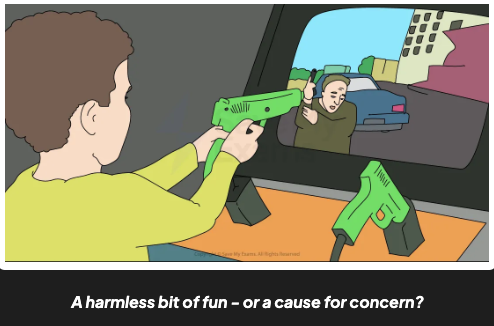
The process where repeated exposure to violent games reduces sensitivity to violence.
-
Physiological desensitisation involves a reduced sympathetic nervous response (e.g., lower heart rate, less adrenaline). Impact of Desensitisation:
-
Decreased emotional response to violence.
-
Reduced empathy and sympathy for victims of violence.
-
Potential link to real-life violence, such as mass shootings (Cantor, 2003). Research Findings:
-
Brockmyer (2021): Concluded that violent games increase desensitisation, potentially leading to increased aggression.
-
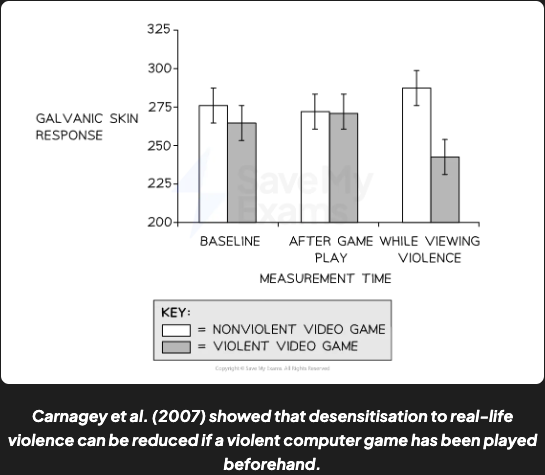
Carnagey et al. (2007): Found that violent game players had lower physiological responses to real-life violence compared to non-violent game players.
Evaluation of Computer Games' Impact on Aggression
Note
Strengths:
- Theories can guide intervention strategies to reduce aggressive behaviour, such as CBT.
- Research, like Williams (2006), provides reliable and valid evidence.
Note
Weaknesses:
- Not all research supports desensitisation; e.g., Gao et al. (2017) found no difference in empathy-related brain activity between violent game players and non-players.
- Cultivation theory does not account for individual differences in susceptibility to violent media.