The Multi-Store Model of Memory (OCR A-Level Psychology): Revision Notes
📚Revision Notes
2.1.4 Multi-Store Model of Memory
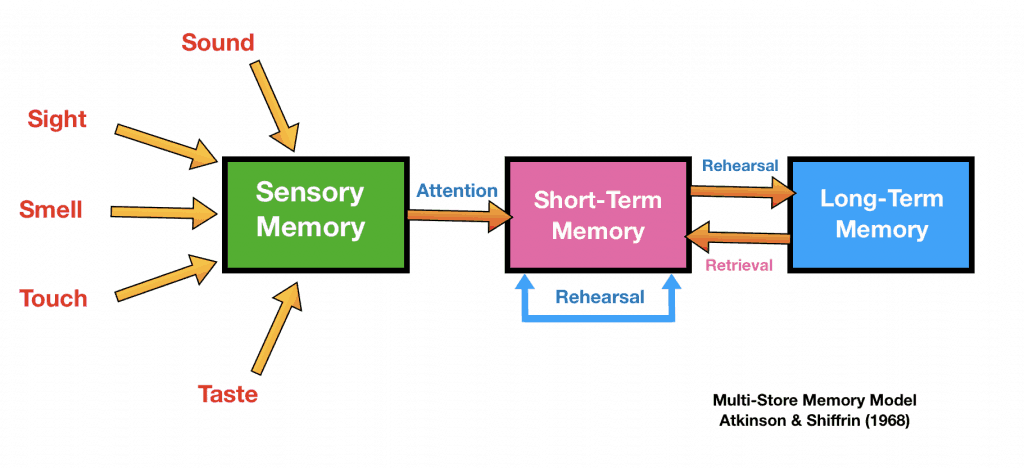
The Multi-Store Model
Developed by Atkinson and Shiffrin to explain how we transfer information across memory stores
-
There are three different memory stores
-
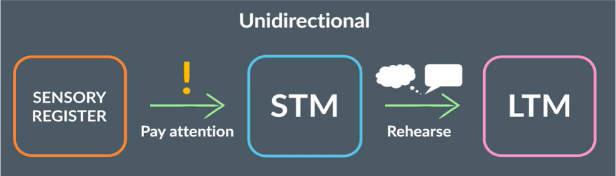
The flow of information is unidirectional, meaning that it travels in one direction.
-
Information must pass through previous stores to move on to the next. E.g., must pass through the sensory register to get to short-term memory. Must pass through the sensory register and short-term memory to reach long-term memory
-
To transfer information from the sensory register to short-term memory we must pay attention to it
-
To transfer information from short-term memory to long-term memory we must repeat it, this is called rehearsal.
-
In order to remember information, retrieval must occur, which is when information is transferred back into the STM from the LTM and will continue to pass through the maintenance loop afterwards.
-
If the long-term memory is damaged, information can still be stored in the sensory register and short-term memory.
-
If the short-term memory is damaged, new long-term memories can't be formed The frontal cortex is associated with STM
-
The hippocampus is associated with LTM
Evaluation of the multi-store model:
Strengths
1:
Note
P: Case studies provide support for the multi-store model
Note
E: For example, the case study of HM showed that his long-term memory store could be damaged without affecting his ability to retain information in short-term memory
Note
E: Therefore, this supports the idea that we have separate stores for long and short-term memory which can be damaged independently, as predicted by the multi-store model
2:
Note
P: Brain imaging studies provide support for the multi-store model
Note
E: Imaging studies show that different parts of the brain are active during short and long-term memory tasks
Note
E: Therefore, this supports the idea that we have separate stores for long and short-term memory as predicted by the multi-store model
3:
Note
P: Brain imaging studies have shown that the hippocampus is associated with long-term memory
Note
E: HM had his hippocampus removed, which caused him to have damage to his long-term memory
Note
E: Supports the idea that different parts of the brain are associated with short and long-term memories and thus supports the idea that we have separate stores for short and long-term memories
Weaknesses
1:
Note
P: Predicts that damage to short-term memory leads to damage to long-term memory
Note
E: However, case studies of patient KF show that he had damage to his short-term memory store but his long-term memory was intact
Note
E: This was not predicted by the multi-store model, thus, it isn't supported by all findings from case studies
2:
Note
P: Predicts that there is only one short-term memory store
Note
E: Observations of patient KF demonstrated that he had impaired verbal short-term memory but intact visual short-term memory
Note
E: This suggests that the multi-store model is oversimplified as the case study of patient KF suggests that there may be different types of short-term memory
3:
Note
P: Rehearsal is not how we transfer all information to long-term memory
Note
E: Some things we may not actively try to remember, but stay in our head anyway such as a TV advert
Note
E: Therefore, the multi-store model puts too much emphasis on the role of rehearsal in the transfer of information to long-term memory
Types of long-term memory
Tulving - Argues that the multi-store model was too simplistic and suggested that we have three long-term memory stores
Types of long-term memory store:
- Episodic memory
- Semantic memory
- Procedural memory
Memories
Declarative memories - have to consciously recall
Episodic memory: A detailed memory from a specific event that we have experienced in our own lives, containing personal information about the actual experience
e.g., what happened, when, where and how we felt.
Semantic memory: Knowledge of facts and definitions that we accumulate in our lives, which may include facts about ourselves
Non-declarative memories - don't have to consciously recall
Procedural memory: Memory of how to perform actions and skills