Memory Stores (OCR A-Level Psychology): Revision Notes
📚Revision Notes
2.1.1 Memory Stores
Memory
The process of maintaining information from past experiences over time in order to use this information in the present
Memory encoding = Transforming information to put it into memory
Memory storage = Maintaining information in our minds
Memory retrieval = Taking information out of memory storage
Memory recall = Consciously re-accessing a memory without having to be reminded of it first
Memory recognition = Ability to retrieve a memory after being shown it again, due to it feeling familiar
Introduction to the Multi-store model
The multi-store memory model (MSM) represents how memory is stored, transferred between the different stores, retrieved and forgotten.
There are 3 stores: the sensory register, short-term memory and long-term memory.
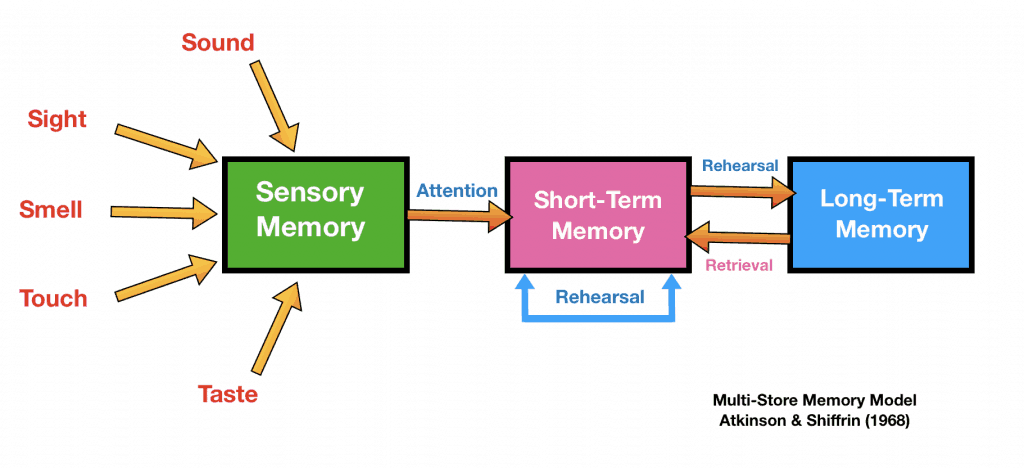
The three properties in which memory stores can vary:
- Coding
- Capacity
- Duration Capacity = How much information can be stored
Duration = How long information can be stored for
Coding = What format information is stored in
Types of coding - Information can be coded in a sensory code or a semantic code:
Sensory coding = Storing sensory information
Types:
Acoustic code = Storing information as sound
Visual code = Storing information as images
Semantic coding = Storing information by its meaning
The sensory register
= Holds information for a very short duration whilst we process it
- Short duration of 1-2 seconds (Sperling)
- Large capacity as it receives information from all of our senses (Sperling) The coding is sensory
Key study:
Sperling - Conducted a lab experiment investigating the capacity of the sensory register
Procedure:
Presented participants with a 4 x3 grid of letters for 50 milliseconds and immediately tested their recall of the letters
Two conditions:
-
Participants were asked to recall as many letters as possible
-
Participants were asked to recall just one row of letters after having seen the grid
Results:
In 1 condition where participants had to recall the entire grid, they usually recalled around 4-7 letters. When participants were asked to recall only one of the rows, they usually recalled around 3 letters
Conclusion:
The sensory register has a very short duration of 1-2 seconds, which gets worse with age, but a large capacity since it receives information from all of our senses
- Therefore, information will only pass from the sensory register to the short-term memory store if we pay attention to it.
Note
Summary paragraph: The sensory register is coded in a sensory code. It has a short duration of 1-2 seconds, as discovered by Sperling. This can get worse with age, but a large capacity as it receives information from all of our senses.