Working Memory Model (OCR A-Level Psychology): Revision Notes
📚Revision Notes
2.2.1 Working Memory Model
Baddeley and Hitch
Features:
- Short-term memory, which is seen as being an active store that holds information whilst it's being worked on and enables us to manipulate pieces of information
- There are multiple different components to short-term memory which store different types of memories (Short-term memory is the same as working memory)
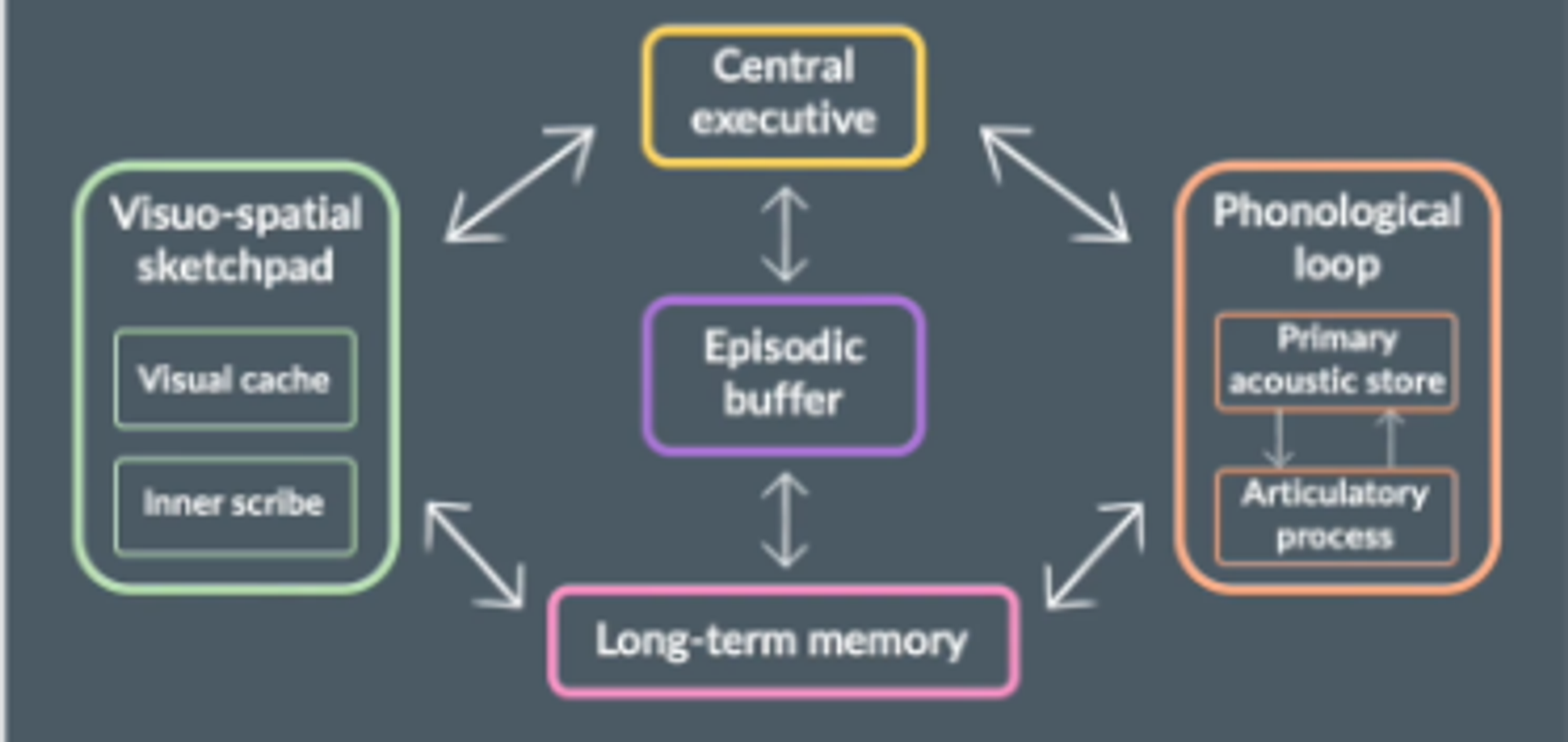
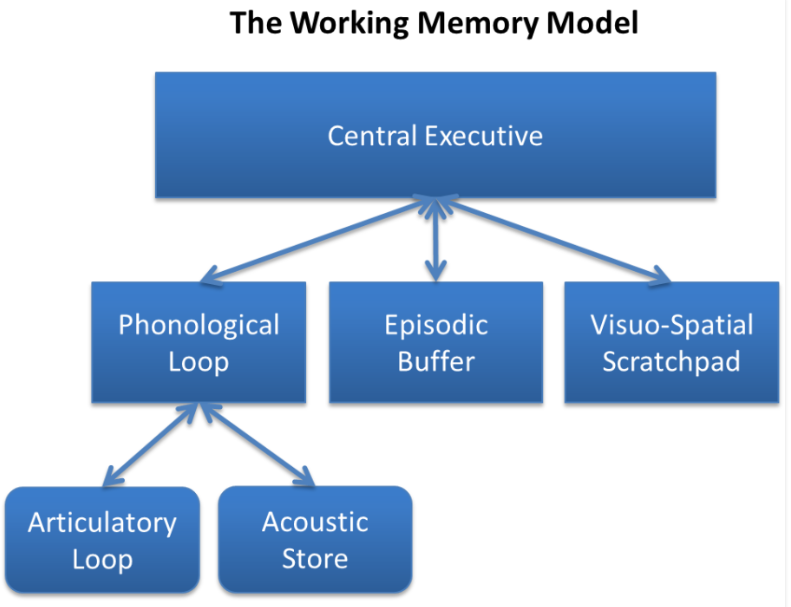
Central executive: The "Control centre" which coordinates processes within the system
Visuo-spatial sketchpad: Processes visual and spatial information
Episodic buffer: Integrates information across the other components of the WMM
Phonological loop: The component of working memory that stores auditory and verbal information and remembers the order it is presented. It also stores verbal information that is presented visually through subvocal rehearsal.
Subcomponents of the phonological loop:
- Primary acoustic store
- Articulatory process The primary acoustic store - Stores auditory information for 1-2 seconds whilst we process it. It also philtres out everything that we don't want to store for longer. When it refreshes, all information is filtered out.
If information needs to be stored for more than 1-2 seconds it is transferred to the second sub-component which is…
The articulatory process - Stores useful information in working memory for longer, while we need it for an ongoing task.
Another example diagram:
t is more difficult to perform two visual tasks at the same time because they interfere with each other and performance is reduced. The same applies to performing two verbal tasks at the same time. This supports the view that the phonological loop and the sketchpad are separate systems within working memory.
Evaluation:
(1)
Note
P: The working memory model is supported by research
Note
E: For instance, the case study of patient KF showed that after suffering from brain damage, he struggled with verbal information, but his memory for visual information was largely unaffected
Note
E: This supports the working memory model as it suggests that there are separate STM components for visual information (VSS) and verbal information (phonological loop)
(2)
Note
P: Brain imaging studies provide support for there being different types of STM
Note
E: This is because they have shown that different areas of the brain are active when performing tasks involving different types of STM
Note
E: This supports the working-memory model as it suggests that there are separate systems at work, as predicted by Baddeley and Hitch
(3)
Note
P: The working memory model can be criticised for being too vague.
Note
E: For instance, the central executive has not been precisely defined and has very little experimental support, making it unclear what the central executive's exact role is.
Note
E: This is a weakness of the working memory model as the central executive may be more complex than the working memory model suggests.
(4)
Note
P: There is research support from studies of dual-task performance
Note
E: These studies have shown that it isn't possible to perform two tasks using the same system (phonological loop and VSS) due to separate capacities
Note
E: This supports the idea that there are separate stores in short-term memory, providing support for the working memory model