Classical & Operant Conditioning (OCR A-Level Psychology): Revision Notes
📚Revision Notes
5.1.2 Classical & Operant Conditioning
Explanations for behaviour
Classical conditioning - Pavlov (1897) - Learning through association. Pavlov's dogs
Before conditioning:
Unconditioned stimulus → Unconditioned response
(Food) (Salivation)
Neutral stimulus → Neutral response
(Bell) (Nothing)
During conditioning:
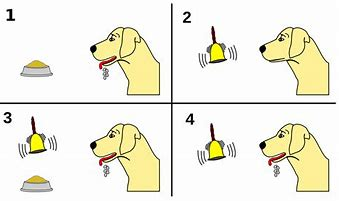
Demonstrated how classical conditioning works using dogs.
Unconditioned stimulus + Neutral stimulus = Unconditioned response
(Food) (Bell) (Salivation)
After conditioning
Conditioned stimulus = Conditioned response
(Bell+Food) (Salivation)
Operant conditioning - Skinner (1938) - Learning through consequences.
Demonstrated how positive and negative reinforcement work using rats in a 'Skinner box'.
Lever activated = Food (positive reinforcement)
Lever activated = Stopped electric shock (negative reinforcement)
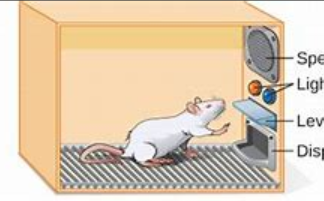
Rats quickly learnt to go to the lever
- Reinforcement increases the likelihood of the behaviour being repeated.
- Punishment decreases the likelihood of the behaviour being repeated.
Positive reinforcement = Giving something pleasurable in response to a behaviour.
Negative reinforcement = Removing something nasty or uncomfortable in response to a behaviour.
Punishment = Consequences after doing something you're not supposed to.
Positive evaluation
Note
P: There is real-life application of behaviourist ideas.
Note
E: For instance, operant conditioning has led to the development of token economies, which are often used to help manage schizophrenia by using positive reinforcement to promote good behaviour but have also been used in prisons. Additionally, the idea of classical conditioning has been successfully applied to the treatment of phobias in the form of flooding, which has helped to better people's lives by extinguishing their phobias.
Note
E: This is a strength as it has proven to be applicable to real-life situations, improving the overall validity of the approach.
Note
P: Research done in highly controlled lab experiments.
Note
E: Emphasises the importance of objectivity, replication, and reliability.
Note
E: Gave psychology scientific credibility.
Negative evaluation
Note
P: Argues that all of our behaviour is learnt from previous experiences and the environment.
Note
E: This neglects the influence of free will.
Note
E: Meaning that many critics argue that behaviourism is deterministic.
Note
P: Pavlov and Skinner used lab experiments during their research.
Note
E: This means the behaviour is studied under artificial conditions.
Note
E: Therefore, these experiments have low ecological validity.
Note
P: Both Pavlov and Skinner's experiments were done on animals.
Note
E: Firstly, there are ethical issues surrounding animal studies, as researchers are less concerned about protection from harm for non-human participants. Despite this not reducing the quality of research in terms of validity and reliability, a cost-benefit analysis should be conducted to see if the benefits of improved knowledge in this area outweigh the ethical costs. Furthermore, there are issues with the generalisability of findings from animal studies to human behaviour as animals and humans are different cognitively and physiologically.
Note
E: Therefore, human thought processing can have an influence on behaviour, resulting in humans and animals behaving differently and therefore it is difficult to extrapolate findings from animal studies to human behaviour
Note
P: Ignores biological factors such as emotion and thought processing.
Note
E: This is because they are internal mental processes which cannot be observed.
Note
E: Therefore, it could be argued that the behaviourist theory is reductionist.