Bandura’s Research (OCR A-Level Psychology): Revision Notes
📚Revision Notes
5.1.5 Bandura's Research
The Bobo doll study - Bandura et al (1961)
A controlled lab experiment on observational learning
Aim:
🎯 To investigate if social behaviours (e.g. aggression) can be acquired through observation and imitation.
Procedure:
- Children observed an aggressive or non-aggressive model and were then tested for imitative learning in the absence of the model (modelling).
- Children were then taken to a room with attractive toys and told not to play with them (aggression arousal).
- Children were then taken individually to a room containing a Bobo doll, and aggressive and non-aggressive toys.
Results:
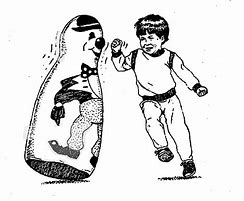
🎈The children who had observed the aggressive model were more aggressive than the children who had observed the non-aggressive model.
🎈The boys imitated more physically aggressive acts than the girls.
Conclusion:
This supports SLT as it shows that children imitate the behaviour of role models even if the behaviour is aggressive.
Note
SLT favours objective, quantitative approaches and uses experimental methods where possible.
Note
Identification = Associating yourself with someone else and unconsciously trying to pattern your behaviour with theirs.
The Bobo doll study - Bandura and Walters (1963)
Experiment was repeated
Procedure:
One group saw the model praised, another saw them punished and another saw them get no consequence for their aggressive behaviour.
Results:
🎈 When left on their own to play, the children who saw the model praised showed the most aggression followed by the children who saw the model receive no consequence.
🎈 Children who saw the model punished were the least aggressive
Conclusion:
This shows that imitation is more likely to occur if the model is positively reinforced, demonstrating the significance of vicarious reinforcement.
Positive evaluation:
Note
P: SLT is a more complete explanation of human behaviour than conditioning.
Note
E: Recognises an element of choice as to whether we imitate a behaviour.
Note
E: Therefore SLT is less deterministic than behaviourism.
Note
P: SLT is supported by research from Bandura et al and Bandura and Walters.
Note
E: They both followed a standardised procedure that can be repeated to look for similar results.
Note
E: Therefore, making the research reliable.
Negative evaluation:
Note
P: As the children observed aggressive behaviour.
Note
E: They may have thought that the aggressive behaviour is what the adults expected of them.
Note
E: Therefore the results could be based on demand characteristics.
Note
P: Bandura's studies took place in a lab setting.
Note
E: This makes the study hard to generalise to the whole population.
Note
E: Therefore the study lacks ecological validity as the situation was not natural.
Note
P: SLT makes little reference to biological factors.
Note
E: Therefore it doesn't explain why boys imitated more physically aggressive than girls.
Note
E: Biological factors may be involved, such as testosterone,