The Process of Synaptic Transmission (OCR A-Level Psychology): Revision Notes
📚Revision Notes
6.1.3 The Process of Synaptic Transmission
Synaptic transmission
Structure of a synapse
Process of synaptic transmission
- An action potential arrives at the pre-synaptic terminal, causing synaptic vesicles to travel towards the pre-synaptic membrane
- Synaptic vesicles and the pre-synaptic membrane fuse, causing neurotransmitters to be released into the synaptic cleft
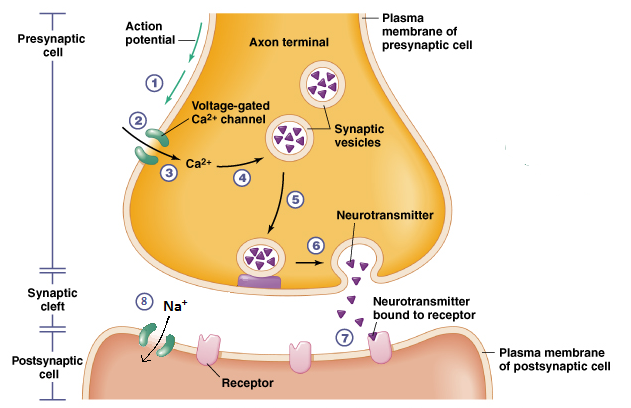
- Neurotransmitters diffuse across the synaptic cleft, towards the post-synaptic terminal and bind to receptors on the post-synaptic membrane
- When the neurotransmitters bind to the receptors, it will either produce an excitatory post-synaptic potential, or an inhibitory post-synaptic potential
- Neurotransmitters are released back into the synaptic cleft and removed through the process of re-uptake
Neurotransmitters can only travel in one direction because:
- Synaptic vesicles containing neurotransmitters are only found on the pre-synaptic membrane
- Receptor cells that neurotransmitters bind to are only found on the post-synaptic membrane
- Neurotransmitters diffusing across the synaptic cleft mean they can only travel from a high to low concentration, so from the pre-synaptic neuron to the post-synaptic neuron
Neurotransmitters
Chemical messengers found in neurons
Excitatory and inhibitory neurotransmitters:
Excitatory neurotransmitters:
- Cause positively charged particles to enter the post-synaptic neuron
- Make nerve impulses more likely to occur
- Create excitatory post-synaptic potentials (EPSP's)
Inhibitory neurotransmitters:
- Cause negatively charged particles to enter the post-synaptic neuron
- Make a nerve impulse less likely to occur
- Create inhibitory post-synaptic potentials (IPSP's) Summation: For a nerve impulse to occur the net effect needs to be excitatory, so there needs to be more excitatory neurotransmitters released than inhibitory neurotransmitters, if the net effect is inhibitory a nerve impulse won't occur
Types of neurotransmitters:
Acetylcholine: Used to control our muscles. (Excitatory)
Adrenaline: Triggers the body's fight or flight response (Excitatory)
GABA: Used in the brain. (Inhibitory)
Serotonin: Controls our response to mood. (Inhibitory)
Dopamine: Controls our response to reward. (Inhibitory)