Structure & Function (AQA GCSE Biology): Revision Notes
📚Revision Notes
5.1.1 Structure & Function
Note
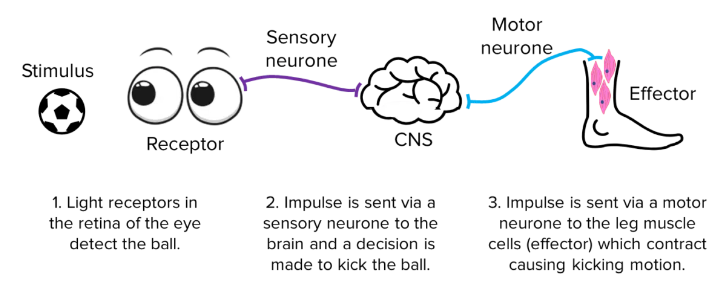
The nervous system allows us to react to our surroundings, and coordinate actions in response to stimuli.
- Receptor cells convert a stimulus into an electrical impulse.
- This electrical impulse travels along cells called sensory neurons to the central nervous system (CNS).
- Here, the information is processed and the appropriate response is coordinated, resulting in an electrical impulse being sent along motor neurones to effectors.
- The effectors carry out the response (this may be muscles contracting or glands secreting hormones).
Automatic responses which take place before you have time to think are called reflexes. They are important as they prevent the individual from getting hurt. This because the information travels down a pathway called a reflex arc , allowing vital responses to take place quickly. This pathway is different from the usual response to stimuli because the impulse does not pass through the conscious areas of your brain.
- A stimulus is detected by receptors.
- Impulses are sent along a sensory neuron.
- In the CNS the impulse passes to a relay neuron .
- Impulses are sent along a motor neuron.
- The impulse reaches an effector resulting in the appropriate response. Examples of reflex arcs are: pupils getting smaller to avoid damage from bright lights, moving your hand from a hot surface to prevent damage.
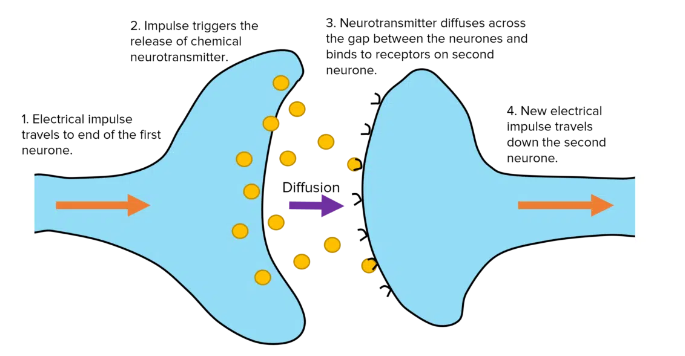
Synapses are the gaps between two neurons.
- When the impulse reaches the end of the first neuron, a chemical is released into the synapse.
- This chemical diffuses across the synapse.
- When the chemical reaches the second neuron, it triggers the impulse to begin again in the next neuron.
Your reaction time is how long it takes you to respond to a stimulus. It can be measured with the ruler drop test.