Vaccination (AQA GCSE Biology): Revision Notes
📚Revision Notes
3.1.7 Vaccination
Note
Vaccinations involve making an individual immune to a certain disease- they are protected against it before they have been infected. By immunising a large proportion of the population, the spread of the pathogen is reduced as there are less people to catch the disease from (called herd immunity).
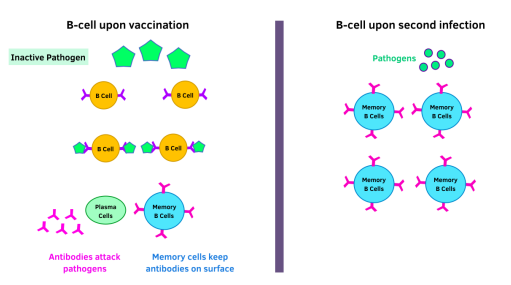
Naturally, when you are infected with a pathogen, you feel ill until white blood cells manufacture the correct specific antibody to combat it. Upon a secondary infection, the antibodies can be produced much quicker, so the pathogen can be destroyed and the symptoms are not felt. Vaccinations replicate the first infection so that when the person is exposed to the real disease they do not feel any symptoms, just like in a secondary infection.
- The vaccine contains a dead or inactivated form of the pathogen
- This stimulates white blood cells to produce antibodies complementary to the antigens on the pathogen
| Advantages of vaccination | Disadvantages of vaccination |
|---|---|
| They have eradicated many diseases so Far (e.g smallpox) and reduced the occurrence of many (e.g rubella). | They are not always effective in providing immunity. |
| Epidemics (lots of cases in an area) can be prevented through herd immunity. | Bad reactions (such as fevers) can occur in response to vaccines (although very rare). |