Globalisation (AQA GCSE Business): Revision Notes
📚Revision Notes
Globalisation
What is globalisation?
Globalisation describes how our world has become increasingly connected, creating what is essentially one giant marketplace. Thanks to advances in technology, better economic development, and improved travel options, businesses today can sell their products and services anywhere in the world. This has transformed how companies operate, with many now conducting business across multiple countries rather than just in their home market.
This global connectivity has led to more international trade than ever before, with countries signing free trade agreements to make it easier to do business together. Many companies now use outsourcing, where they have parts of their production done in other countries to take advantage of lower costs or specialised skills.
Note
Key Definition: Globalisation is the process by which the world becomes increasingly interconnected through trade, technology, and cultural exchange, creating a single global marketplace where businesses can operate internationally.
Understanding the impact of globalisation
Globalisation brings both exciting opportunities and significant challenges for businesses. While it opens up enormous new markets and possibilities, it also creates intense competition and economic uncertainties that companies must navigate carefully.
Benefits of globalisation
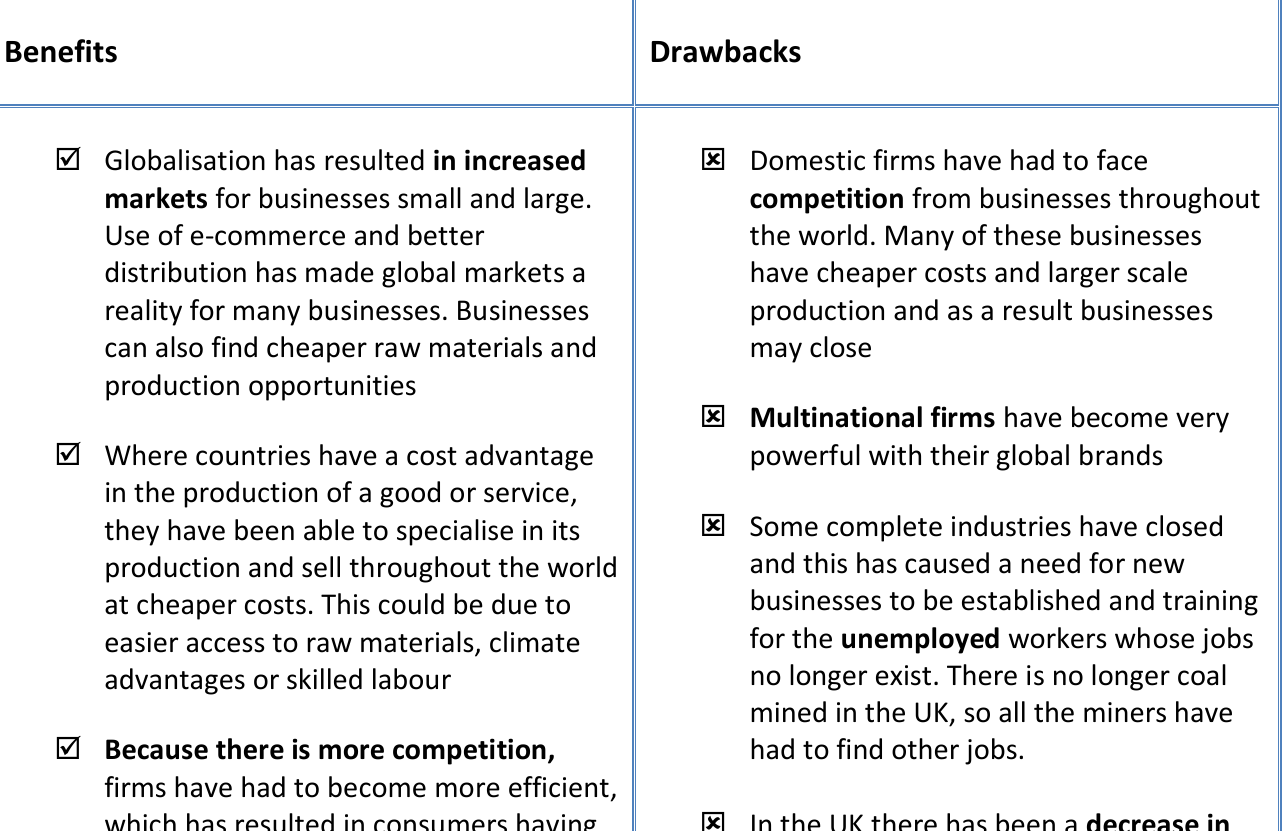
The advantages of globalisation are substantial for many businesses. Companies now have access to vastly expanded markets, allowing even small businesses to reach customers worldwide through improved distribution networks and e-commerce platforms. This global reach means businesses can find cheaper raw materials and production opportunities in different countries, helping them reduce costs and improve profitability.
Countries can now specialise in producing goods and services where they have natural advantages, whether that's access to raw materials, skilled workers, or favourable climate conditions. This specialisation allows them to sell these products globally at competitive prices, benefiting both producers and consumers.
Note
Market Access Benefits: Globalisation has transformed how businesses reach customers. Even small companies can now access international markets through e-commerce platforms, while larger firms can establish global supply chains to reduce costs and improve efficiency.
Competition has increased dramatically, which ultimately benefits consumers through lower prices, better quality products, and more choice. The pressure to compete globally has forced many companies to become more efficient and innovative in their operations.
International cooperation has also led to increased sharing of knowledge, skills, and technology transfer between countries. This transfer of expertise has resulted in more efficient production methods and technological advances that benefit businesses worldwide.
Drawbacks of globalisation
However, globalisation also presents significant challenges. Domestic businesses now face intense competition from international companies that may have lower costs or larger scale operations. This can force local businesses to close if they cannot compete effectively.
Multinational corporations have become extremely powerful through their global operations, sometimes wielding more influence than local governments. This concentration of power can lead to concerns about corporate control over markets and economic policies.
Important
Industry Vulnerability: Entire industries can disappear from countries when production moves to locations with lower costs. This pattern of industry closure can lead to unemployment and economic decline in affected regions, requiring government intervention and retraining programmes.
Example
Real-World Impact: UK Coal Mining
The UK coal mining industry provides a clear example of how globalisation can affect domestic industries:
- Coal production became uneconomical compared to cheaper imports
- Mines closed across the country, particularly affecting regions like Wales and Northern England
- Former miners needed retraining for new employment opportunities
- Communities that depended on mining faced long-term economic challenges
The UK has experienced a shift away from skilled manufacturing jobs towards service sector employment, often involving lower-skilled, lower-paid positions. This transition has changed the nature of work for many people.
Perhaps most concerning is that globalisation makes economies vulnerable to economic problems in other countries. If one major economy experiences difficulties, the effects can quickly spread to other nations through reduced trade and investment.
Impact on UK businesses
UK businesses face both opportunities and challenges in the global marketplace. The Brexit vote has added complexity to this situation, as traditional trading relationships with the EU will change when the UK leaves. This affects both UK companies that export to EU countries and those that compete with imports from the EU.
Note
Brexit Implications: While Brexit creates uncertainty for UK businesses, it may also open up new trading opportunities with non-EU countries. However, new companies will likely enter UK markets, creating additional competition for existing British businesses.
While Brexit creates uncertainty, it may also open up new trading opportunities with non-EU countries. However, new companies will likely enter UK markets, creating additional competition for existing British businesses.
UK's competitive advantages
Despite the challenges, the UK maintains strong positions in several key industries where innovation and expertise are crucial. The country has built a worldwide reputation for quality products and has developed cost-effective, internationally competitive capabilities in many sectors.
The UK excels in automotive manufacturing, particularly in high-quality car design and innovative production methods. British companies lead in developing environmentally friendly vehicle technologies and maintaining high productivity in manufacturing.
In aerospace, the UK benefits from world-class university research and development, with British companies having excellent reputations in air and defence industries. The country's strengths include wing design, engine development and manufacturing, advanced materials, and sophisticated system design.
Note
Research Excellence: The UK's competitive advantage in aerospace and chemicals stems from its world-class university research networks and sustained investment in research and development, creating a skilled workforce and innovative technologies.
The chemicals and pharmaceuticals sector has a long tradition of world-leading status, supported by highly advanced university networks and top-tier research and development. The UK is also emerging as a global leader in biotechnology applications.
The agri-food industry represents another area of strength, with the UK excelling in high-tech farming methods, productive food manufacturing, and strong retail supply chains. British food and drink brands are known for constant innovation and development of new product ranges, particularly in specialised areas like health foods and ready meals.
Green technology and environmental services showcase the UK's expertise across multiple areas. The country demonstrates strong innovation in environmentally friendly manufacturing, alternative energy sources, and tidal power technologies, while maintaining high standards in environmental consultancy and carbon trading initiatives.
Finally, knowledge-intensive industries represent a particular strength, with the UK leading globally on a per-capita basis. The financial services sector gives the UK the world's largest market share, while the country also excels in insurance, computing, and information services.
Summary
Key Points to Remember:
- Globalisation creates a worldwide marketplace where businesses can sell anywhere, but also face competition from everywhere
- Benefits include larger markets, lower costs, more choice for consumers, and technology sharing between countries
- Drawbacks include intense competition, powerful multinational corporations, industry closures, and economic vulnerability
- Brexit adds complexity for UK businesses but may create new opportunities outside the EU
- The UK maintains competitive advantages in high-skill sectors like automotive, aerospace, pharmaceuticals, and financial services