Factors that Affect the Rate of Reaction (AQA GCSE Chemistry Combined Science): Revision Notes
📚Revision Notes
6.1.5 Factors that Affect the Rate of Reaction
Rates of Reaction:
Note
The rate of a chemical reaction describes how fast or slow the reaction occurs. The speed of a reaction is influenced by several factors. The main conditions that affect the rate of reaction are temperature, pressure, and concentration.
- Additionally, two other crucial factors include the surface area of the reactants and the presence of a catalyst.
- The effects of these factors can be understood through collision theory, which explains how the frequency and energy of collisions between particles determine the rate of reaction.
1. Temperature:
How Does Temperature Affect the Rate of Reaction?
- Increasing Temperature: When you increase the temperature, the particles in the reaction move faster because they have more energy. Faster-moving particles collide more often and with greater force. This leads to more successful collisions, which increases the rate of reaction.
- Decreasing Temperature: If you lower the temperature, the particles move more slowly. This means they collide less often and with less energy, leading to fewer successful collisions and a slower reaction rate.
2. Pressure (for reactions involving gases):
How Does Pressure Affect the Rate of Reaction?
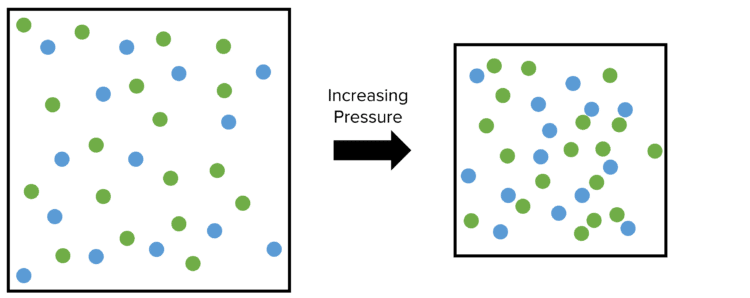
- Increasing Pressure: In a gas, increasing the pressure means squeezing the particles closer together in a smaller space. When particles are closer together, they collide more frequently, leading to more successful collisions and a faster reaction rate.
- Decreasing Pressure: Lowering the pressure gives the particles more space to move around, so they collide less often, slowing down the reaction.
3. Concentration:
How Does Concentration Affect the Rate of Reaction?
- Increasing Concentration: In a solution, increasing the concentration of reactants means there are more particles in the same volume. With more particles present, the likelihood of collisions increases, leading to more successful collisions and a faster reaction.
- Decreasing Concentration: If you decrease the concentration, there are fewer particles available to collide, which slows down the reaction.

4. Surface Area (for reactions involving solids):
How Does Surface Area Affect the Rate of Reaction?
-
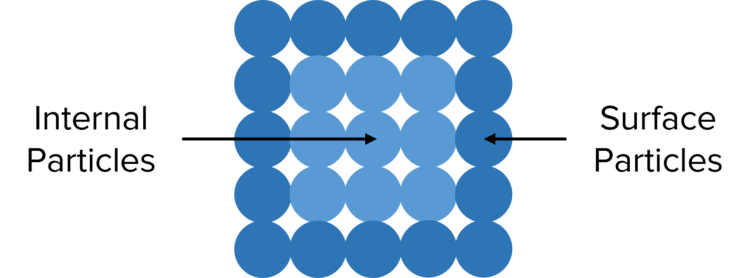
Surface Area and Reaction Rate: In reactions involving solids, only the particles on the surface can collide with other reactants. If the solid is in large chunks, fewer particles are exposed, leading to a slower reaction.
-
Increasing Surface Area: If you break the solid into smaller pieces or crush it into a powder, you increase its surface area. More particles are exposed on the surface, leading to more frequent collisions and a faster reaction rate.

-
Surface Area-to-Volume Ratio: This ratio tells us how much of the solid is exposed on the surface compared to how much is inside. A higher surface area-to-volume ratio means more particles are available for collisions, which speeds up the reaction.
Catalysts:
Role of Catalysts:
- Catalysts speed up reactions by providing an alternative reaction pathway with a lower activation energy.
- This increases the number of successful collisions without being consumed in the reaction, making the process more efficient.