The Reactivity Series (AQA GCSE Chemistry): Revision Notes
📚Revision Notes
4.1.2 The Reactivity Series
Note
The Reactivity Series is a list that ranks metals according to their reactivity, from the most reactive to the least reactive. This series is crucial for understanding how different metals will behave in chemical reactions, particularly with acids and water.
Reactivity Trends in the Periodic Table
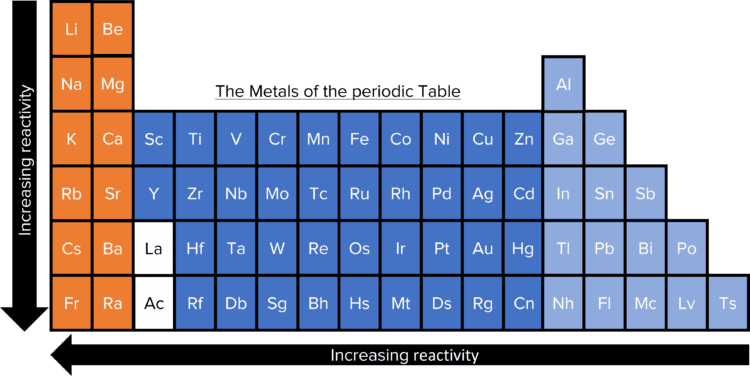
- Down a Group: In the periodic table, as you move down a group (a vertical column), the reactivity of metals increases. This trend is especially clear in Groups 1 and 2. For example, lithium (Li) and beryllium (Be), which are at the top of their respective groups, are less reactive than francium (Fr) and radium (Ra), which are at the bottom.
- Across a Period: Moving from right to left across a period (a horizontal row) also increases metal reactivity. Metals on the left, such as sodium (Na) and potassium (K), are more reactive compared to those on the right, like platinum (Pt).
Note
Cesium (Cs) is one of the most reactive naturally occurring metals, while platinum (Pt) is one of the least reactive. Francium (Fr), although extremely rare and radioactive, is the most reactive metal overall.
Understanding Reactivity
Note
The reactivity of a metal is closely related to its ability to lose electrons and form positive ions. Metals lose electrons to achieve a stable electron configuration, similar to that of a noble gas. The easier it is for a metal to lose its outer electrons, the more reactive it is:
- Highly reactive metals lose electrons readily, making them very reactive. For example, sodium and potassium react explosively with water.
- Less reactive metals hold onto their electrons more tightly, making them less likely to react. Gold (Au), for example, does not react with water or dilute acids.
The Reactivity Series in Practice
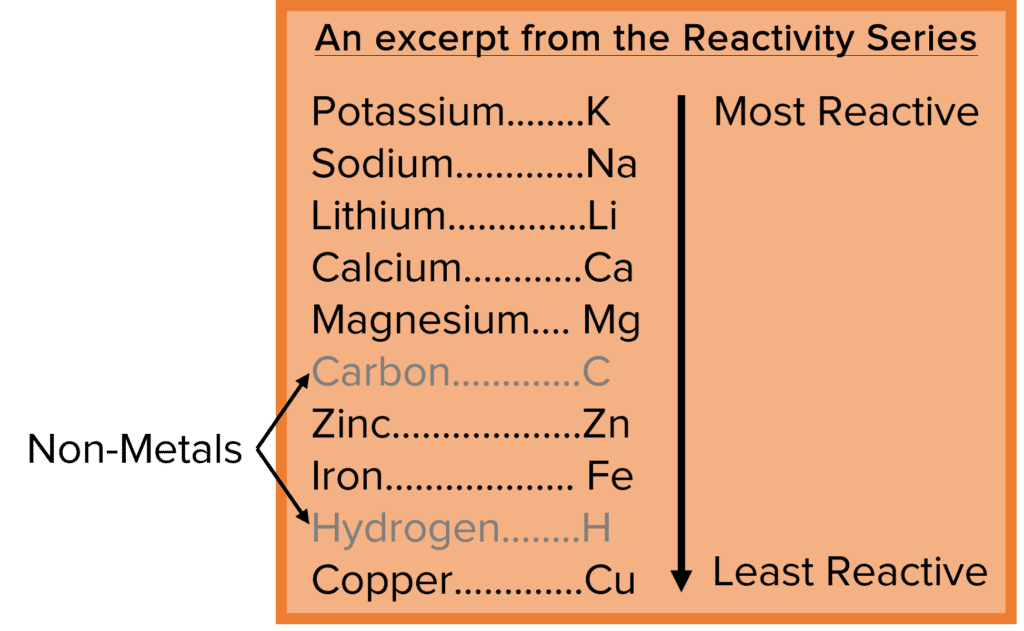
Scientists have arranged metals in the Reactivity Series by observing their reactions with water and acids. The higher a metal is in the series, the more vigorously it reacts:
- Top of the series: Metals like potassium, sodium, and calcium react strongly with water and acids, producing hydrogen gas and a salt.
- Bottom of the series: Metals like silver, gold, and platinum show little to no reaction under the same conditions. This series also includes some non-metals, such as carbon and hydrogen, which helps determine how metals can be extracted from their ores.