Required Practical: Strong Acid & Strong Alkali Titration (AQA GCSE Chemistry): Revision Notes
📚Revision Notes
4.2.9 Required Practical: Strong Acid & Strong Alkali Titration
Note
Acid-Base Titrations are a fundamental technique in chemistry used to determine the concentration of an acid or an alkali by neutralising one with the other. This practical involves titrating a strong acid, hydrochloric acid (HCl), with a strong alkali, sodium hydroxide (NaOH), to observe the neutralisation reaction and measure the exact amount of alkali required to neutralise a known volume of acid.
Note
Method: Step-by-Step Procedure
- Prepare the Acid Solution:
- Measure 25 cm³ of 0.1 mol dm⁻³ HCl using a pipette and pour it into a clean conical flask.
- Add a few drops of phenolphthalein indicator to the HCl solution in the flask. The solution should be colourless because phenolphthalein is colourless in acidic conditions.
- Prepare the Burette:
- Rinse the burette with 0.5 mol dm⁻³ NaOH to ensure accuracy. It's essential to make sure the jet space (the section below the tap) is filled with the NaOH solution to avoid any measurement errors.
- Fill the burette with NaOH until the bottom of the meniscus aligns with the 0 cm³ mark.
- Set Up the Titration:
- Clamp the burette securely so that the jet is positioned above the conical flask containing the acid and indicator.
- Place a white tile under the conical flask. This helps to see the colour change more clearly during the titration.
- Perform the Titration:
- Slowly open the burette tap to allow NaOH to flow into the HCl solution while swirling the conical flask continuously.
- As NaOH is added, the solution will remain colourless until near the endpoint, where the first permanent pink colour appears. This pink colour indicates that the acid has been neutralised by the alkali.
- Record the Volume of NaOH:
- As soon as the solution turns pink, close the tap immediately. This indicates the endpoint of the titration.
- Record the volume of NaOH used (known as the titre) by reading from the bottom of the meniscus on the burette scale.
- Repeat for Accuracy:
- Repeat the titration process until you obtain at least three concordant titres (titres that are within 0.20 cm³ of each other). This ensures the reliability of your results.
- Repeat the experiment with different concentrations of HCl, but keep the concentration of NaOH constant.
Note
Analysis of Results
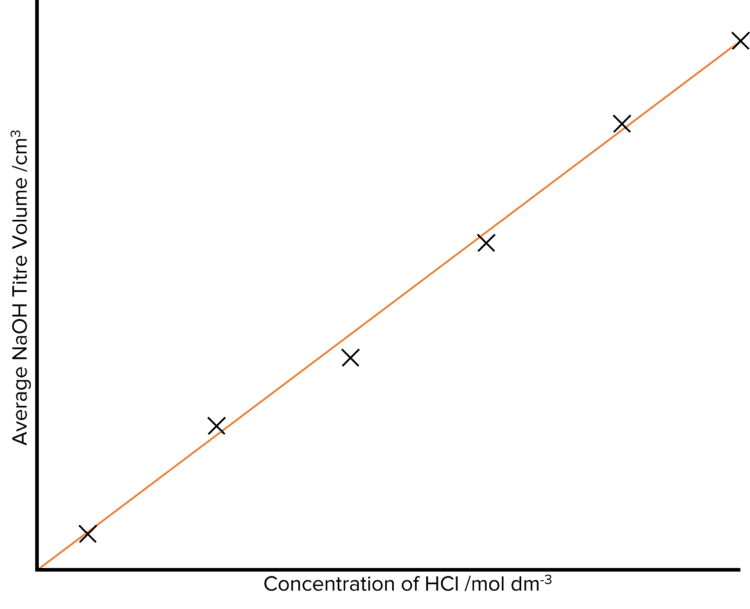
After performing the titrations, you will have a set of average titre values corresponding to each concentration of HCl. These values can be plotted on a graph:
- X-Axis: Concentration of HCl (mol dm⁻³)
- Y-Axis: Volume of NaOH required (titre) to neutralise the HCl (cm³) As the concentration of HCl increases, the amount of NaOH needed to neutralise the acid also increases. This is because a higher concentration of acid requires more alkali to achieve neutralisation, reflected in an increasing volume of titre on the graph.
The graph should show a positive correlation between the concentration of HCl and the volume of NaOH required. The shape of the graph would typically be a straight line if the relationship between concentration and volume is directly proportional.
Note
Key Concepts
- Neutralisation: The reaction between an acid and an alkali to form water and a salt.
- Phenolphthalein Indicator: An indicator that changes from colourless in acidic conditions to pink in alkaline conditions. The colour change signals the endpoint of the titration.
- Concordant Titres: Consistent titration results within a small margin of error (0.20 cm³), indicating accurate and precise measurements.