The work of other designers (AQA GCSE Design and Technology): Revision Notes
📚Revision Notes
The work of other designers
Understanding the work of influential designers from past and present is essential for informing your own research and design practice. By studying how different designers approached problems, developed their unique styles, and contributed to various design movements, you can gain valuable insights to apply to your own creative work.
Note
Studying design history isn't just about memorising names and dates - it's about understanding the design thinking process and how context, materials, and cultural movements shape creative solutions.
Early influential designers (19th - early 20th century)
William Morris (1834-1896)
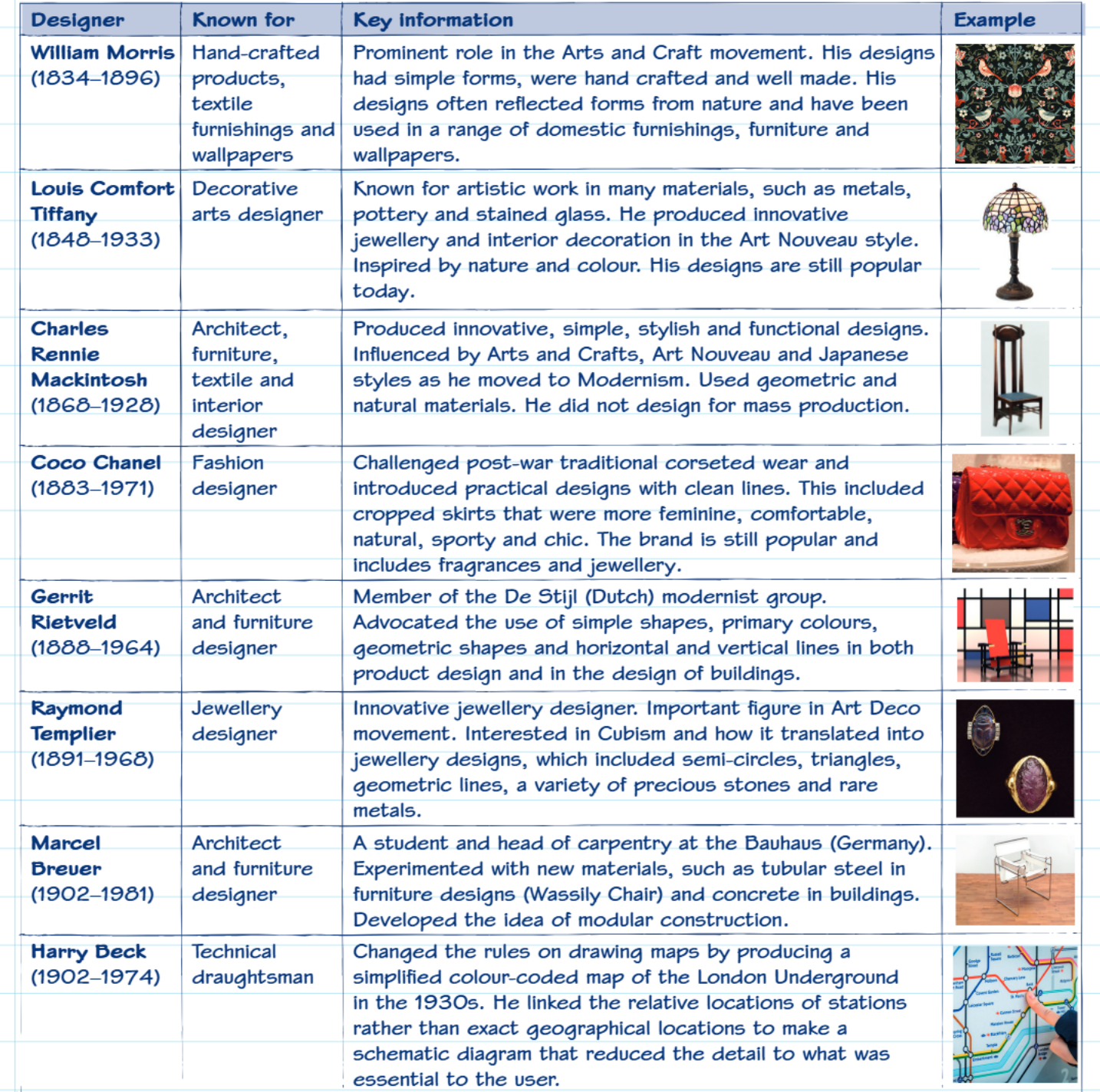
Morris played a prominent role in the Arts and Crafts movement, creating hand-crafted products including textiles, furnishings and wallpapers. His designs featured simple forms that were carefully hand-crafted and well-made. Morris often drew inspiration from forms found in nature, and his patterns have been widely used in domestic furnishings, furniture and wallpapers that remain popular today.
Note
Morris's philosophy of "beauty in everyday objects" challenged the mass-produced, poor-quality goods of the Industrial Revolution. His belief that good design should be accessible to everyone influenced generations of designers who followed.
 Louis Comfort Tiffany (1848-1933)
Known as a decorative arts designer, Tiffany became famous for his artistic work across many materials including metals, pottery and stained glass. He developed innovative techniques for creating jewellery and interior decoration in the Art Nouveau style. His designs were inspired by nature and colour, creating pieces that captured the organic, flowing characteristics of this artistic movement.
Charles Rennie Mackintosh (1868-1928)
Working as an architect, furniture designer, and textile and interior designer, Mackintosh produced innovative, simple, stylish and functional designs. His work was influenced by Arts and Crafts, Art Nouveau and Japanese styles as he evolved towards Modernism. Mackintosh preferred using geometric and natural materials, though importantly, he did not design for mass production, focusing instead on unique, crafted pieces.
Important
Mackintosh's approach of combining geometric forms with natural materials became a key characteristic of early Modernist design, bridging the gap between decorative arts and functional design.
Fashion and lifestyle innovators
Coco Chanel (1883-1971)
Chanel revolutionised fashion design by challenging post-war traditional corseted wear and introducing practical designs with clean lines. Her innovations included cropped skirts that were more feminine, comfortable, natural, sporty and chic. The Chanel brand continues to be popular today and includes fragrances and jewellery alongside clothing, demonstrating the lasting impact of her design philosophy.
Important
Chanel's philosophy that "luxury must be comfortable, otherwise it is not luxury" fundamentally changed how we think about fashion design, prioritising the wearer's experience over restrictive traditional forms.
Mary Quant (1934-present)
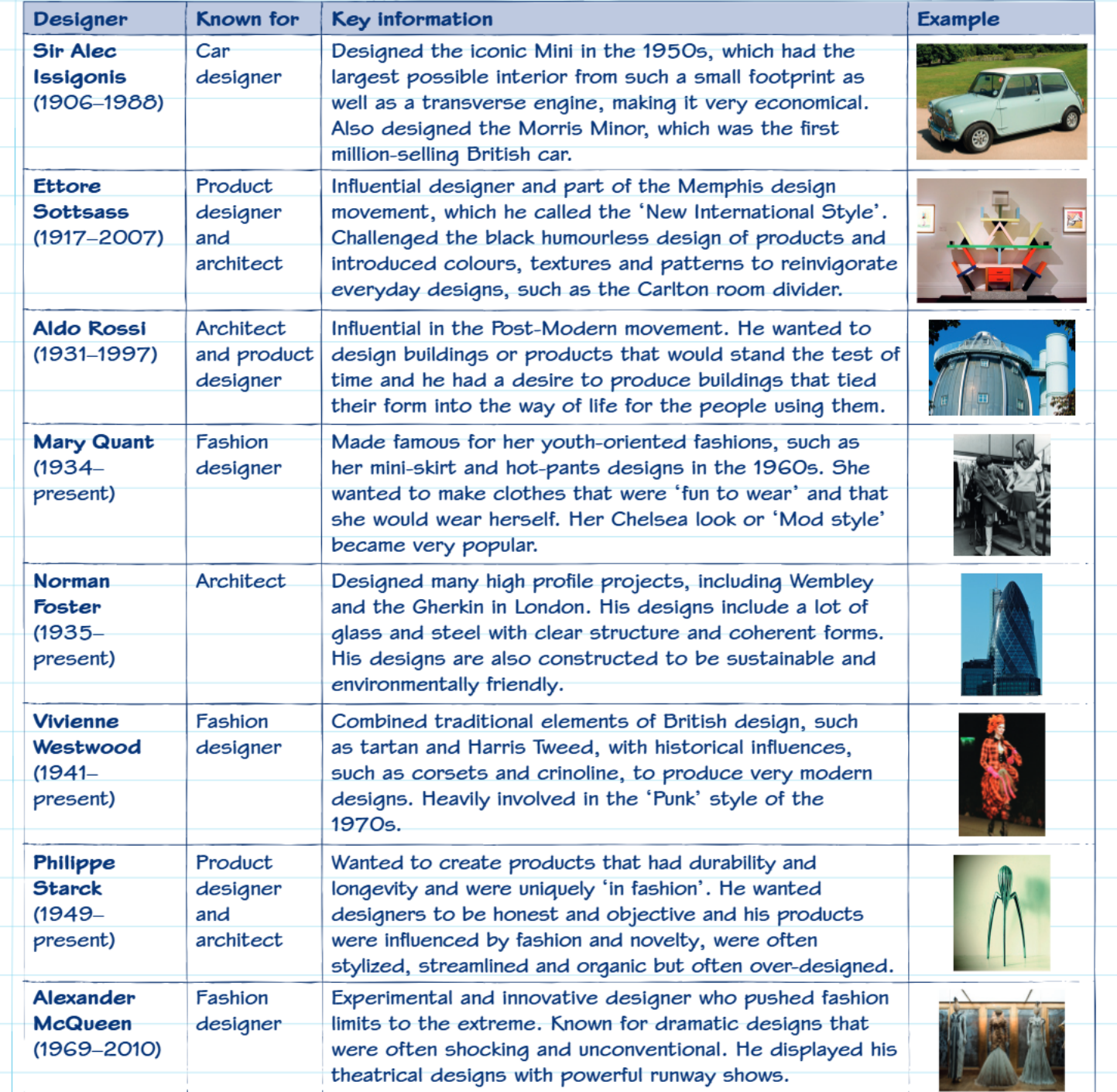
This fashion designer became famous for her youth-oriented fashions, particularly her mini-skirt and hot-pants designs in the 1960s. Quant wanted to create clothes that were 'fun to wear' and that she would wear herself. Her Chelsea look or 'Mod style' became very popular and helped define the fashion of an entire generation.
Modernist and Bauhaus movement
Gerrit Rietveld (1888-1964)
As an architect and furniture designer, Rietveld was a member of the De Stijl (Dutch) modernist group. He promoted the use of simple shapes, primary colours, geometric shapes and horizontal and vertical lines in both product design and architecture. His approach emphasised clarity and mathematical precision in design.
Note
The De Stijl movement believed that art and design could achieve universal harmony through the reduction of forms to their most basic elements - a philosophy that deeply influenced modern design principles.
Marcel Breuer (1902-1981)
A student and head of carpentry at the Bauhaus in Germany, Breuer experimented with new materials such as tubular steel in furniture designs and concrete in buildings. He developed the concept of modular construction and created iconic pieces like the Wassily Chair, which demonstrated how industrial materials could be used to create elegant, functional furniture.
Important
Breuer's innovation of using industrial materials in domestic furniture broke down the barrier between mass production and craftsmanship, showing that machine-made objects could be both beautiful and functional.
Technical and automotive design
Harry Beck (1902-1974)
Working as a technical draughtsman, Beck revolutionised map design by creating a simplified colour-coded map of the London Underground in the 1930s. He linked the relative locations of stations rather than showing exact geographical locations, creating a schematic diagram that reduced unnecessary detail while focusing on what was essential to the user.
Important
Beck's approach of prioritizing user needs over geographical accuracy became a fundamental principle in information design, influencing everything from transit maps to user interface design.
Sir Alec Issigonis (1906-1988)
This car designer created the iconic Mini in the 1950s, which featured the largest possible interior despite having a small footprint, along with a transverse engine that made it very economical. He also designed the Morris Minor, which became the first million-selling British car, demonstrating how good design could achieve commercial success.
Note
Issigonis's space-efficient design solutions for the Mini influenced automotive design for decades, proving that innovative engineering could create both functional and commercially successful products.
Contemporary and post-modern designers
Ettore Sottsass (1917-2007)
As a product designer and architect, Sottsass was influential in the Memphis design movement, which he called the 'New International Style'. He challenged the black and colourless design of products by introducing colours, textures and patterns to reinvigorate everyday designs, such as the Carlton room divider.
Norman Foster (1935-present)
This architect has designed many high-profile projects including Wembley and the Gherkin in London. His designs feature extensive use of glass and steel with clear structure and coherent forms. Foster's architectural approach emphasises sustainability and environmental friendliness, showing how modern design can address contemporary concerns.
Note
Foster's integration of environmental considerations into high-profile architecture helped establish sustainability as a core principle of contemporary design, not just an optional add-on.
Philippe Starck (1949-present)
Working as a product designer and architect, Starck aimed to create products that combined durability and longevity while being uniquely 'in fashion'. He believed designers should be honest and objective, and his products were influenced by fashion and novelty while often being stylized, streamlined and organic, though sometimes criticised as over-designed.
Important
Starck's philosophy demonstrates the ongoing tension in design between functionality and aesthetic appeal - a balance that every designer must navigate in their own work.
Key aspects to research when studying designers
When investigating, analysing and evaluating the work of other designers, focus on gathering specific and relevant information including:
Note
Essential Research Framework
- Design specialization: What area of design they were famous for
- Historical context: The chronology of their work and life
- Notable examples: Specific pieces that demonstrate their style and approach
- Design philosophy: Their personal style and underlying beliefs
- Movement connections: What design movements they were involved in and influenced by
Understanding these elements will help you appreciate how different designers approached creative challenges and developed their distinctive contributions to design history.
Summary
Key Points to Remember:
- Design movements shape individual work: Designers like Morris (Arts and Crafts), Rietveld (De Stijl), and Breuer (Bauhaus) were influenced by broader artistic movements that informed their design principles
- Innovation often comes from challenging conventions: Designers like Chanel, Beck, and Sottsass achieved recognition by rejecting existing approaches and creating new solutions
- Materials and technology influence design possibilities: Breuer's use of tubular steel and Foster's use of glass and steel show how new materials enable new design approaches
- Good design balances function and aesthetics: Successful designers from Mackintosh to Starck have found ways to make their work both beautiful and practical
- Understanding design history informs contemporary practice: Studying past designers helps you understand design principles, recognise influences, and develop your own creative approach