Commercial processes (AQA GCSE Design and Technology): Revision Notes
📚Revision Notes
Commercial processes
Commercial processes are large-scale manufacturing methods used to produce printed materials efficiently and cost-effectively. These processes are essential for creating books, magazines, packaging, and posters in high volumes while maintaining consistent quality.
Offset lithography
Offset lithography is a popular commercial printing technique specifically designed for long printing runs. This method is highly efficient when producing thousands of copies because it maintains excellent print quality while being cost-effective for large quantities.
Understanding the offset printing process
The key feature of offset lithography is that the printing plate never directly touches the paper. Instead, the image transfers through an intermediate step, which helps preserve the printing plate and ensures consistent results throughout long production runs.
Note
The indirect transfer method is what makes offset printing "offset" - the image is offset from the plate to a blanket cylinder before reaching the paper.
The process begins with a litho-printing plate cylinder that contains a relief image. This means the areas that will print stand out slightly from the plate surface. These plates are manufactured from flexible materials like polymers or aluminium, allowing them to wrap around the cylindrical printing mechanism effectively.
During the printing sequence, the litho-printing plate is first dampened with water to repel ink from non-printing areas. Ink is then applied to the rotating plate, adhering only to the raised image sections. This inked image transfers from the plate cylinder to a blanket cylinder, and finally from the blanket cylinder onto the paper or card material.
Important
Only one colour can be printed during each pass through the machine. This means multiple printing cycles are necessary to achieve full-color results.
Colour models in commercial printing
Commercial printing relies on specific colour systems to achieve accurate and consistent colour reproduction across different materials and production runs.
The CMYK colour model serves as the foundation for most commercial printing applications. This system combines four distinct ink colours: cyan, magenta, yellow, and key (black). These coloured inks function by partially or completely reducing the amount of light reflected from lighter backgrounds, particularly white paper. By layering these inks in various combinations and concentrations, printers can create an extensive range of colours and visual effects.
The RGB colour model operates differently by adding layers of three primary colours - red, green, and blue - to generate a wide spectrum of colours. While this model is more commonly associated with digital displays and electronic media, understanding both systems helps explain how colours translate between different mediums.
Note
CMYK vs RGB Applications:
- CMYK: Used for printed materials (subtractive colour - removes light)
- RGB: Used for digital displays (additive colour - adds light)
Die cutting
After completing the printing process, printed materials typically require precise cutting to achieve their final shape and size. Die cutting is the commercial finishing process that accomplishes this accurate cutting using specialised equipment and tools.
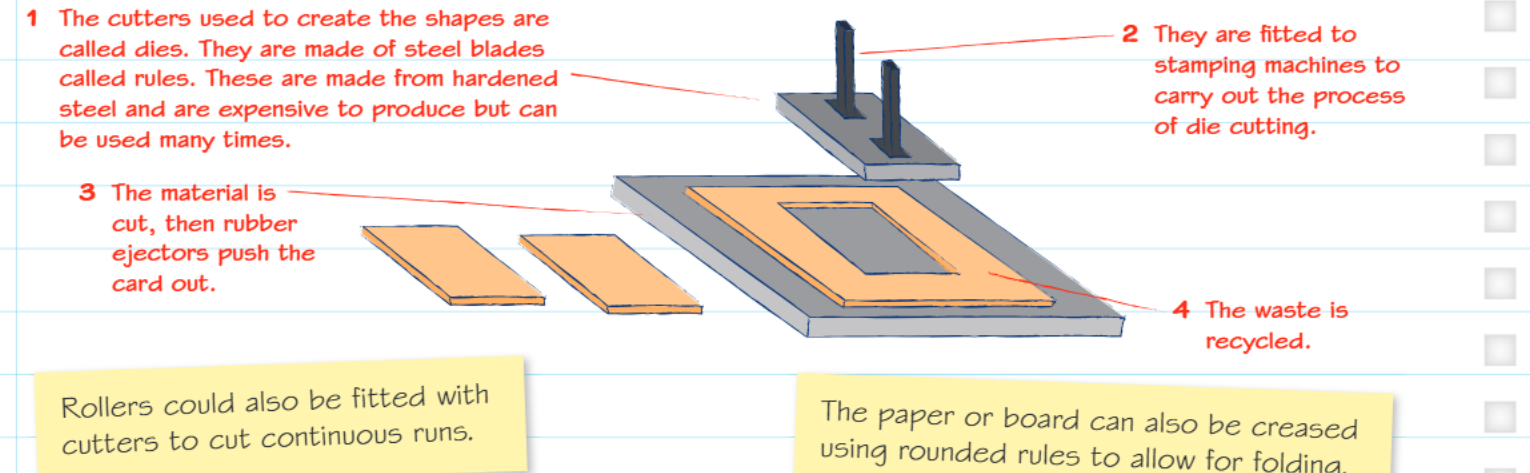 The die cutting mechanism
Die cutting employs specially designed cutting tools called dies, which incorporate steel blades known as rules. These rules are manufactured from hardened steel, making them relatively expensive to produce initially. However, their durability allows for repeated use across many production runs, making them economically viable for large-scale operations.
Note
While dies are expensive to create initially, their reusability across thousands of cutting operations makes them cost-effective for commercial production.
The cutting process begins by fitting the dies into stamping machines designed to carry out the cutting operation. When material is properly positioned, the stamping machine applies significant downward pressure, forcing the die through the material to create clean, precise cuts.
Following the cutting action, rubber ejectors activate to push the cut pieces away from the die, effectively separating the finished products from any surrounding waste material. The waste material is typically collected and sent for recycling, supporting environmentally responsible manufacturing practices.
Enhanced die cutting capabilities
Modern die cutting systems offer functionality beyond basic cutting operations. Rollers can be equipped with cutting tools to process continuous runs of material, significantly improving efficiency for high-volume production scenarios.
The die cutting process can also create precise creases in paper or board materials by substituting rounded rules for sharp cutting blades. This creasing capability enables accurate folding applications, which proves essential for packaging design and book binding operations.
CMYK effectiveness on white paper
The CMYK colour model demonstrates particular effectiveness when printing on white paper because it strategically uses individual colours to block varying amounts of the white background. This layering technique creates images that appear as full-color to human perception, despite using only four distinct ink colours applied in carefully calculated combinations.
Summary
Key Points to Remember:
- Offset lithography uses indirect transfer from plate to blanket cylinder to paper, making it perfect for high-volume printing runs
- Each printing pass can only apply one colour, requiring multiple cycles for full-color printing projects
- CMYK colour model combines cyan, magenta, yellow, and black inks to create full-color images by controlling light reflexion
- Die cutting employs hardened steel blade dies in stamping machines to cut printed materials into precise shapes and sizes
- Advanced die cutting systems can create creases for folding applications and process continuous material runs using roller mechanisms