Wastage (AQA GCSE Design and Technology): Revision Notes
📚Revision Notes
Wastage
What is wastage?
Wastage refers to various cutting and shaping techniques used when creating prototypes and working with papers, cards, and board materials. These methods include cutting, shearing, and perforating, which help designers and manufacturers create precise shapes and forms during the development process.
Note
Wastage techniques are fundamental skills in design and manufacturing, forming the foundation for creating everything from simple prototypes to complex packaging solutions.
Hand tools for cutting materials
When working with paper, card, and board materials, several specialised tools can help you achieve clean, accurate cuts:
Paper shears are designed with long blades that create straight cuts using a shearing action. The extended blade length allows for smooth, continuous cuts across larger sheets of material.
Craft knives and scalpels feature extremely sharp blades that excel at detailed cutting and scoring work. These tools give you excellent control for intricate cuts and allow you to create precise lines and curves.
Rotary cutting tools are specialised for creating perforations or cut lines that enable easy tearing or folding. These tools are particularly useful when you need materials to separate cleanly along predetermined lines.
Steel safety rulers serve a dual purpose - they provide accurate measurement while keeping your fingers safely away from sharp cutting blades. The metal edge ensures clean, straight cuts when used as a cutting guide.
Cutting mats protect your work surface and provide a self-healing, non-slip surface for cutting operations. The polymer material prevents damage to blades and tables while offering excellent grip.
Desktop paper cutters are designed to trim paper and thin card materials accurately. These tools often include measurement guides and can handle multiple sheets simultaneously, making them ideal for production work.
Important
Always maintain sharp blades for clean cuts and replace them regularly. Dull blades require more pressure and can lead to accidents or poor-quality cuts.
Die cutting processes
Die cutting represents a more industrial approach to cutting paper and board materials. This method uses specially formed tools called dies, which are made from sharpened steel strips known as 'rules'. These rules are shaped to match the exact outline of the desired cut and then pressed or rolled against the material to create the shape.
The main advantage of die cutting is its ability to cut through multiple layers of material simultaneously. The thickness you can cut depends on both the sharpness of the blade and the amount of pressure applied during the cutting process.
Die cutting works particularly well for creating products like greeting cards and food packaging, where consistent shapes and clean edges are essential. The process can also incorporate creasing, allowing for fold lines to be created simultaneously with cutting operations.
Note
Die cutting is especially cost-effective for large production runs, as the initial investment in creating the dies is offset by the speed and consistency of the cutting process.
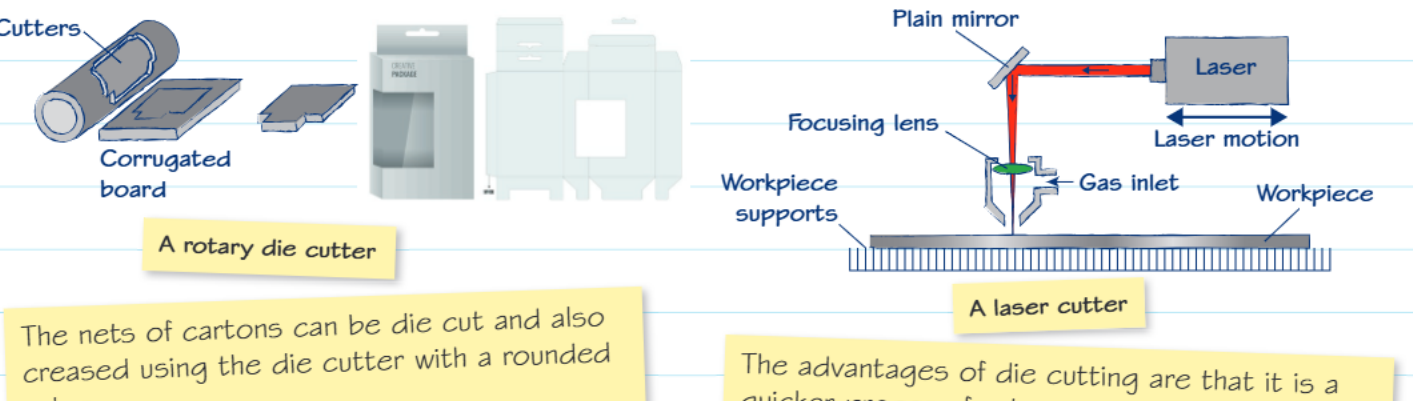 For carton production, dies can be designed with rounded edges and creasing capabilities, enabling the creation of complex three-dimensional shapes from flat materials. This makes die cutting especially valuable for packaging applications where precise folding is required.
Laser cutting and engraving
Laser cutting represents a relatively modern technology that has become increasingly common in educational and professional settings. This process uses a focused laser beam to cut through paper and board materials with exceptional precision.
The laser cutting process offers several significant advantages over traditional cutting methods. The work pieces do not need to be physically held during cutting, reducing the risk of movement or distortion. The cuts produced are extremely precise, often more accurate than hand-cutting methods. Additionally, laser systems can be used for both cutting completely through materials and scoring surface lines for folding.
Important
One of the greatest benefits of laser cutting is the enhanced safety compared to using traditional cutting tools. There are no exposed sharp blades, and the automated nature of the process reduces the risk of injury.
The laser cutting system includes several key components: a laser unit that generates the cutting beam, mirrors that direct the beam to the correct location, a focusing lens that concentrates the beam for maximum cutting power, and gas inlets that help clear debris from the cutting area. The workpiece sits on supports that allow the laser to move freely around the cutting area.
Laser cutting technology is particularly valuable because it can handle complex shapes that would be difficult or impossible to achieve with traditional die cutting methods. Each piece can have a unique design without requiring the creation of expensive custom dies.
Note
The flexibility of laser cutting makes it ideal for prototyping and small-batch production, where design changes are common and tooling costs need to be minimised.
Comparing cutting methods
When choosing between different cutting methods, several factors should be considered. Hand tools offer maximum flexibility and control but require skill and time to achieve professional results. They are ideal for prototyping and small-scale work where precision and customisation are more important than speed.
Die cutting excels in production environments where the same shape needs to be cut repeatedly. While there is an initial cost to create the dies, the process becomes very efficient for large quantities. The method also ensures consistent quality across all pieces.
Laser cutting provides the best combination of precision and flexibility. It can create complex shapes without tooling costs and offers excellent repeatability. However, the technology requires specialised equipment and may have limitations based on material thickness and type.
Note
The choice of cutting method often depends on factors such as production volume, complexity of shapes, budget constraints, and required precision levels. Consider these factors carefully when planning your project.
Summary
Key Points to Remember:
-
Wastage techniques involve cutting, shearing, and perforating materials to create prototypes and finished products
-
Hand tools like craft knives, paper shears, and rotary cutters offer flexibility and control for detailed work
-
Die cutting uses formed steel rules to cut multiple layers efficiently, making it ideal for production runs
-
Laser cutting provides exceptional precision and safety while handling complex shapes without requiring custom tooling
-
Safety considerations are important with all cutting methods, from proper blade handling to understanding laser safety protocols