Finding the equation of a line (AQA GCSE Further Maths): Revision Notes
📚Revision Notes
Finding the equation of a line
Finding the equation of a straight line is one of the most important skills in coordinate geometry. The method you use depends on what information you're given about the line. There are three main scenarios you'll encounter, each with its own approach.
Note
Three Main Scenarios: Understanding which method to use depends on the information given:
- When you know the gradient and y-intercept
- When you know the gradient and one point on the line
- When you know two points on the line
Method 1: When you know the gradient and y-intercept
This is the simplest case. When you know both the gradient (slope) and where the line crosses the y-axis, you can write the equation directly using the slope-intercept form.
The slope-intercept form:
In this formula:
- m represents the gradient (how steep the line is)
- c represents the y-intercept (where the line crosses the y-axis)
- x and y are the coordinates of any point on the line
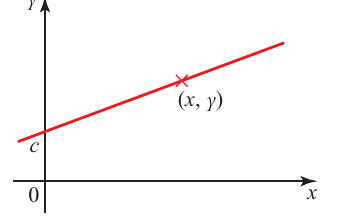
The diagram shows how a line with gradient m intersects the y-axis at point c. Any point (x, y) on this line satisfies the equation .
Method 2: When you know the gradient and one point on the line
When you have the gradient and the coordinates of any point on the line, you can use the point-slope form to find the equation.
The point-slope form:
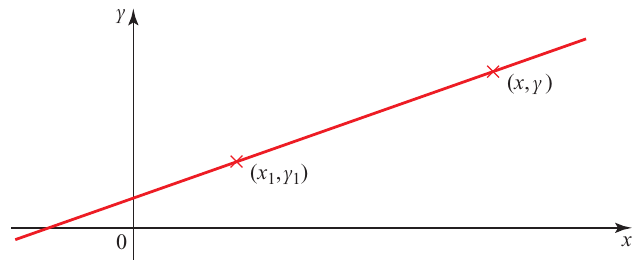
This formula comes from the basic definition of gradient. If you know:
- The gradient is m
- The line passes through point (x₁, y₁)
- You want to find the relationship for any point (x, y) on the line
Then the gradient between these two points must equal m:
Rearranging this gives us:
Example
Worked Example: Finding equation with gradient and point
Let's find the equation of a line with gradient 2 that passes through the point (-1, 3).
Solution: Using the point-slope form:
Substituting our values:
The equation is y = 2x + 5.
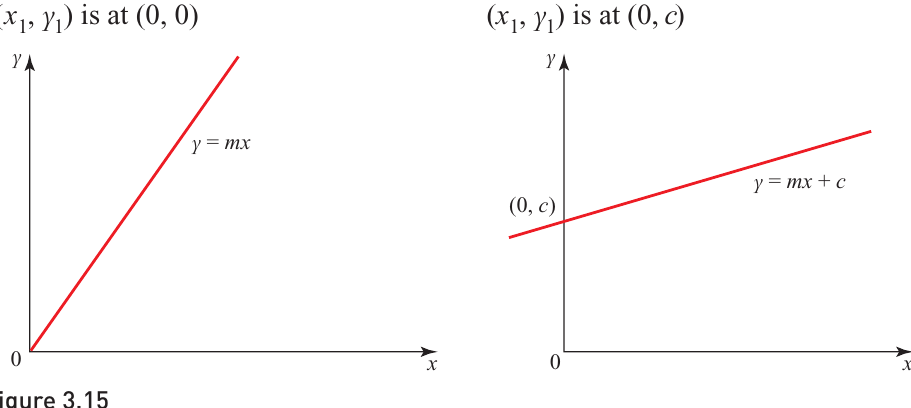
This diagram illustrates an important concept: when a line passes through the origin (0, 0), its equation is simply . When the same line is shifted vertically by amount c, it becomes .
Method 3: When you know two points on the line
This is often the most challenging method, but it's very systematic once you understand the steps.
The two-point method
When you know two points on a line, you need to:
- Calculate the gradient using the two points
- Use the point-slope form with either point
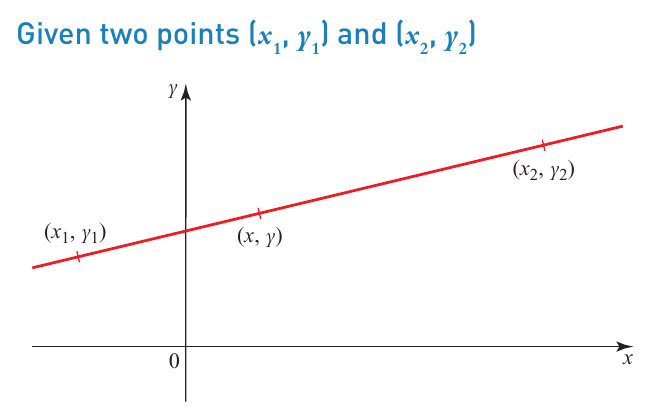
The gradient between two points and is:
Once you have the gradient, you can use either point with the point-slope form.
Alternative two-point formula
There's also a direct formula that doesn't require you to calculate the gradient separately:
This formula comes from the fact that the ratio of vertical change to horizontal change must be the same for any segment of a straight line.
Example
Worked Example: Finding equation from two points
Find the equation of the line joining (-1, 4) to (2, -3).
Solution: Let and
Using the ratio formula:
Substituting our values:
Cross-multiplying:
The equation is 7x + 3y - 5 = 0.
Applying the different techniques
Let's look at some practical examples that show how these methods work with different types of lines.
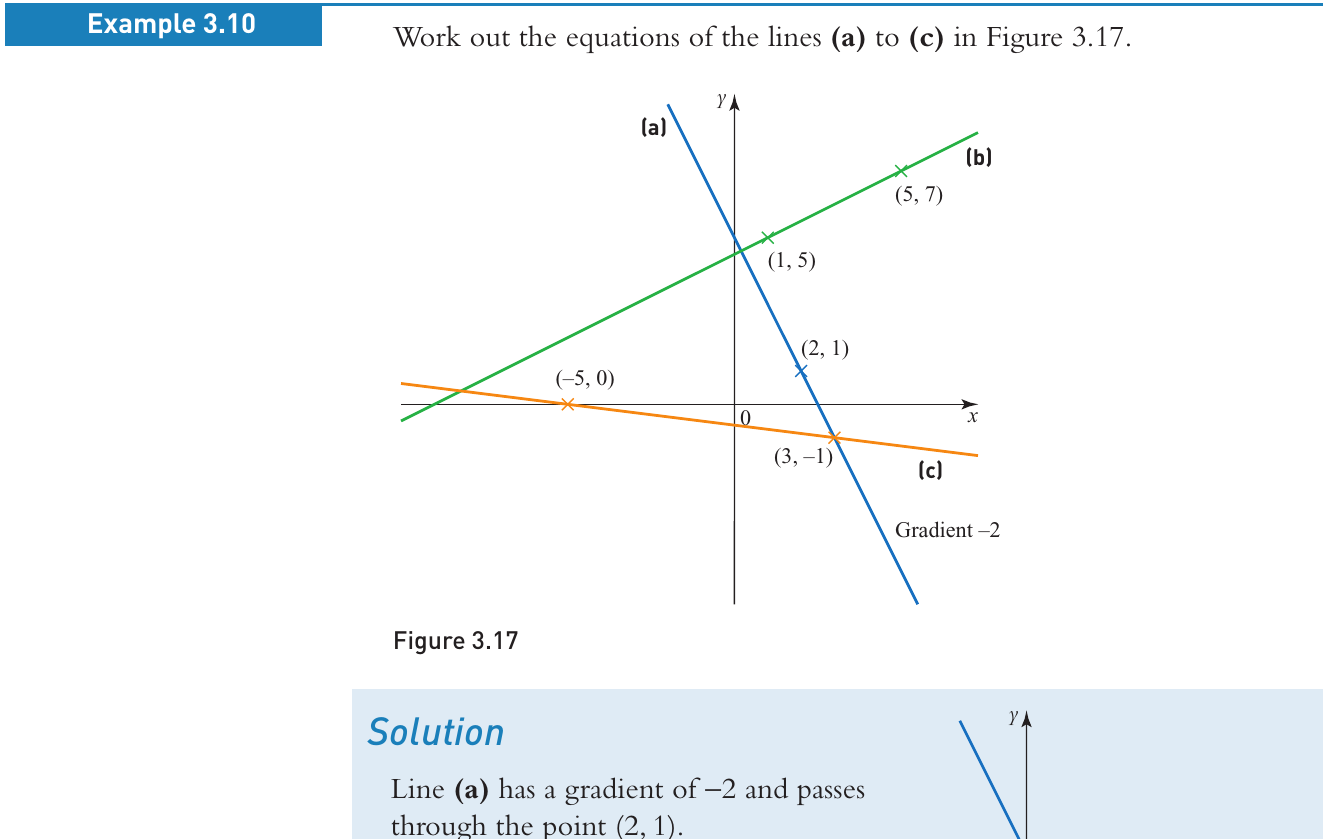
This graph shows three different lines labelled (a), (b), and (c). Each requires a different approach:
Example
Line (a): Steep negative slope
Line (a) has a gradient of -2 and passes through point (2, 1).
Using point-slope form:
Alternative forms: This could also be written as or .
Example
Line (b): Gentle positive slope
Line (b) passes through points (1, 5) and (5, 7).
First, find the gradient:
Using point-slope form with (1, 5):
Note: To avoid decimals, this could be written as or .
Example
Line (c): Nearly horizontal line
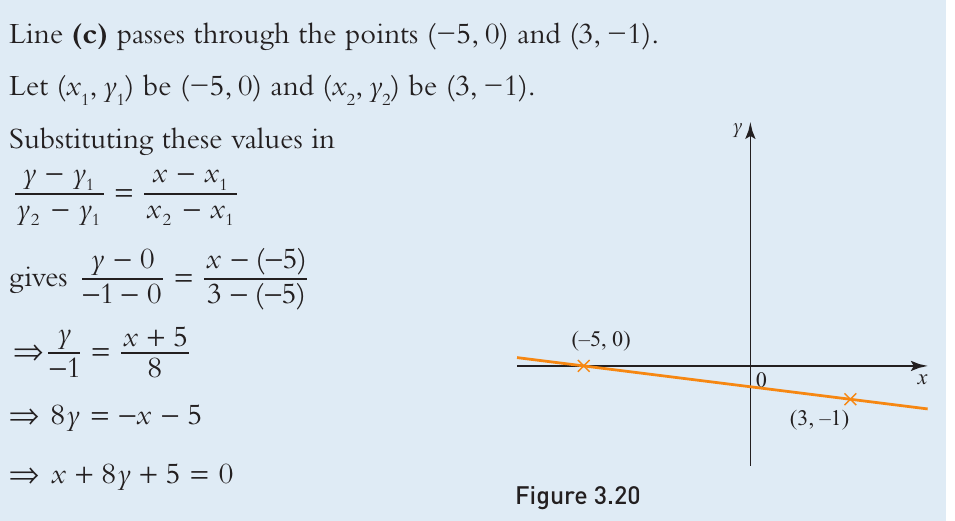
Line (c) passes through points (-5, 0) and (3, -1).
This detailed solution shows the complete working for line (c). The key steps are:
- Calculate gradient:
- Use point-slope form
- Rearrange to standard form:
Important exam tips
Understanding the different approaches to finding line equations will help you tackle any problem confidently.
Different forms of linear equations
You might be asked to give your answer in different forms:
- Slope-intercept form:
- Standard form:
- Point-slope form:
Important
Common mistakes to avoid:
- Sign errors when substituting negative coordinates
- Forgetting to simplify fractions in gradients
- Mixing up x and y coordinates
- Not showing your working clearly
Note
Problem-solving strategy:
- Identify what information you have
- Choose the appropriate method
- Calculate the gradient if needed
- Apply the point-slope formula
- Rearrange to the required form
- Check your answer makes sense
Summary
Key Points to Remember:
- y = mx + c is your go-to formula when you know the gradient and y-intercept
- y - y₁ = m(x - x₁) is perfect when you have a gradient and any point on the line
- m = (y₂ - y₁)/(x₂ - x₁) helps you find the gradient from two points
- Always double-check your signs, especially with negative coordinates
- Your final answer can be written in different forms - choose the one that looks simplest or matches what the question asks for