Coastal Landforms - Caused by Erosion (AQA GCSE Geography): Revision Notes
📚Revision Notes
3.2.2 Coastal Landforms - Caused by Erosion
Wave Cut Platform
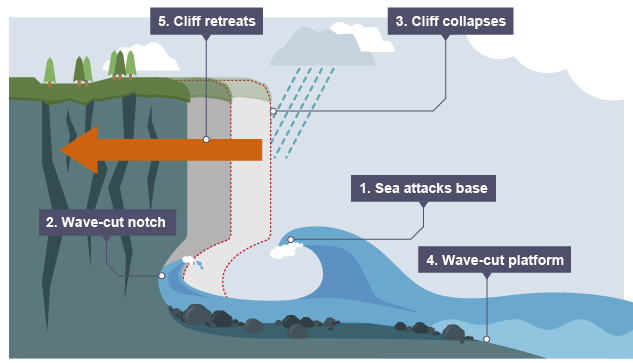
Wave Cut Platform
Note
- Waves cause the most erosion at the foot of a cliff.
- This forms a wave-cut notch, which enlarges as erosion continues.
- The rock above the notch becomes unstable and eventually collapses.
- Collapsed material is washed away and a new wave-cut notch starts to form.
- Repeated collapsing results in the cliff retreating.
- A wave-cut platform is the platform left behind as the cliff retreats.
Headlands & Bays
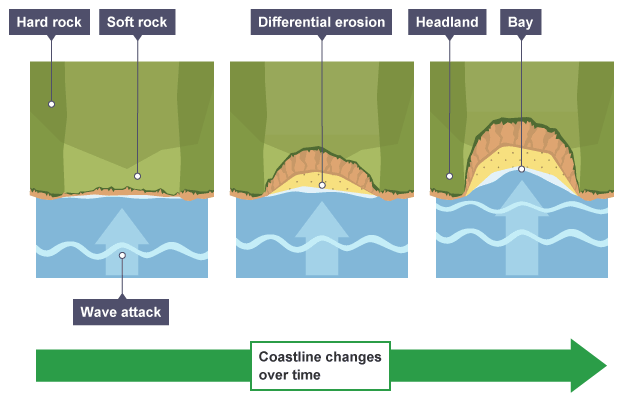
Headlands & Bays
Soft Rock
- Bands of soft rock such as clay and sand are weaker and can be eroded quickly, forming bays. Bay = An inlet of the sea where the land curves inward, usually with a beach.
Hard Rock
- Rock such as chalk is more resistant to erosion processes.
- When softer rock is eroded inwards, the hard rock sticks out into the sea, forming a headland.
Note
Headlands and bays form where there are alternating bands of resistant and less resistant rock along a coastline.
Caves, Arches & Stacks

Caves, arches, stacks and stumps are erosional features that are commonly found on a headland.
Note
- Cracks
- Cracks are widened in the headland through the erosional processes of hydraulic action and abrasion.
- Caves
- As waves continue to grind away at the crack, it begins to open up to form a cave.
- The cave becomes larger and eventually breaks through the headland to form an arch.
- Arches
- The base of the arch is continually widened by further erosion until its roof becomes too heavy and collapses into the sea.
- This leaves a stack (an isolated column of rock).
- Stacks
- The stack is undercut at the base until it collapses to form a stump.