Coastal Management: Lyme Regis - Case Study (AQA GCSE Geography): Revision Notes
📚Revision Notes
3.2.5 Coastal Management: Lyme Regis - Case Study
Coastal Management Strategies
Note
Hard Engineering Involves using artificial structures to manage coastal erosion.
Note
Soft Engineering Does not involve building artificial structures. But takes a more sustainable and natural approach to managing the coast.
| Defence | What is it | Benefits | Costs |
|---|---|---|---|
| SEA WALL | A wall is made out of hard material like concrete that reflects wave energy back to sea | It prevents erosion of the coast. It also acts as a barrier to prevent flooding | It creates a strong backwash, which erodes under the wall. Sea walls are expensive and ugly |
| GABIONS | A wall of wire cages filled with rocks usually built at the foot of cliffs | The gabions absorb wave energy and reduce erosion. They're cheap & easy | They're ugly and the wire cages erode over time |
| ROCK ARMOUR | Boulders that are piled up along the coast. | The boulders absorb wave energy and reduce erosion and flooding. It is cheap | Boulders can be moved around and they are hard to get into place as are lacks and heavy |
| GROYNES | Wooden fences that are built at right angles to the coast. They trap material transported by longshore drift. | They create wider beaches which slow waves. This gives greater protection from flooding & erosion. | They starve beaches of sediment further down the coastline. These then have less protection against erosion. |
| BEACH REPLENISHMENT | Sand and shingle added to the beach. | It creates wider beaches which slow the waves and protects against flooding and erosion | It is very expensive and needs to be constantly repeated |
| SAND DUNE REGENERATION | Creating or restoring sand dunes. | Sand dunes provide a barrier between the land and the sea. Wave energy is absorbed which prevents flooding. It is cheap. | The protection is limited to a small area. It is very expensive. |
Managed Retreat
- Involves removing coastal defences and allowing the sea bed to flood behind.
- Benefits:
- Land will become marshland, protecting land behind from flooding and erosion.
- Cheap and easy.
- Creates new habitats.
- Can cause conflict with landowners.
COASTS – Coastal Management Case Study: LYME REGIS
Location
Small coastal town in SW England. In the heart of a heritage coastline called the Jurassic Coast.
Issues in Lyme Regis
- The town is built on unstable cliffs.
- It is built on a layer of strong limestone which is very solid. On top of that layer are slippery muds, clays, and sands which slide over the limestone layer to form landslides.
- The sea erodes the cliffs at the bottom of the landslide, causing it to become unstable and slip further.
- Houses, buildings, and roads become damaged as the land slips towards the sea.
Why does Lyme Regis need protecting?
- The local economy depends on tourism as its main source of income.
- 37,500 people are employed in the tourist sector in the town.
- The area generates £800 million per year from tourism.
- The town hosts many festivals, including an annual fossil festival.
Management of the Coastline
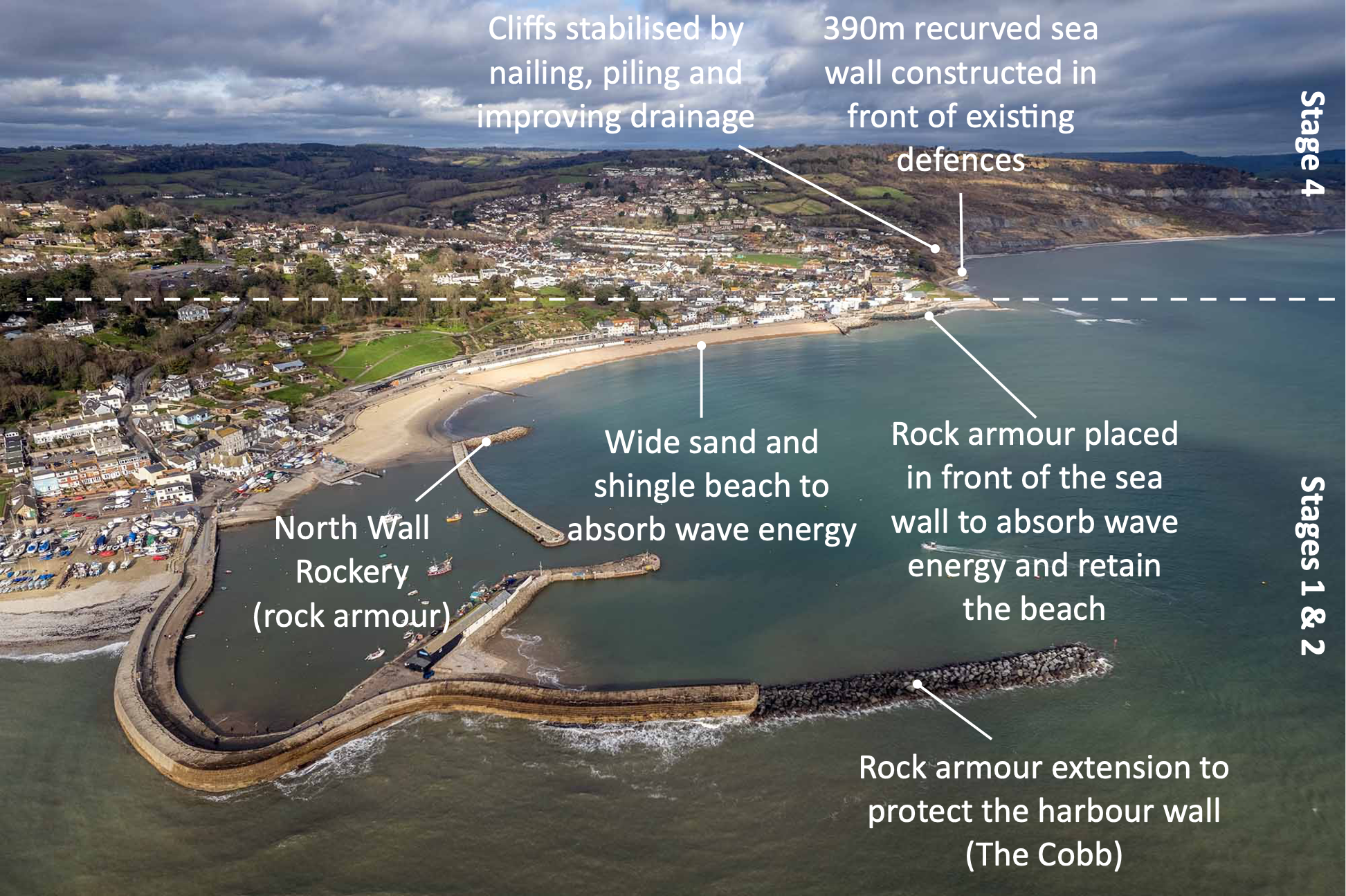
- The Lyme Regis Environmental Improvement Scheme was set up in the early 1990s to provide long-term coastal protection and reduce the threat of landslides.
Note
Phase 1
- New sea wall and promenade constructed to the east of the River Lim.
- In the winter of 2003, a £1.4 million emergency project was completed to stabilise the cliffs. 1000 steel pins were used to hold rocks together.
Phase 2
- Creation of a wide sandy beach (nourishment) to absorb wave energy and increase the use of the shore.
- The beach was nourished with 75,000 tonnes of shingle dredged from the Channel.
Phase 3
- Initial plan to prevent landslips and coastal erosion to the west of the Cobb was shelved.
- Decided to leave this stretch of the coast alone as the costs outweighed the benefits.
Phase 4
- Final phase focused on the coast east of the town.
- Cost £20 million and involved constructing a new 390m sea wall in front of the existing wall.
Note
Advantages
- New beaches have increased visitor numbers and sea front businesses are thriving.
- New defences have stopped up to recent landslides.
- The harbour is now better protected, benefiting boat owners and fishermen.
- Improved amenities can help house insurance.
Note
Disadvantages
- The scheme was very expensive, over £30 million.
- The beach needs to be replenished every 3 years.
- The sea wall will need replacing in 30 years.
- Locals complained about construction noise.
- Sea defences may speed up erosion further down the coastline.