River Landscapes in the UK (AQA GCSE Geography): Revision Notes
📚Revision Notes
3.3.6 River Management - Hard and Soft Engineering - Case Study
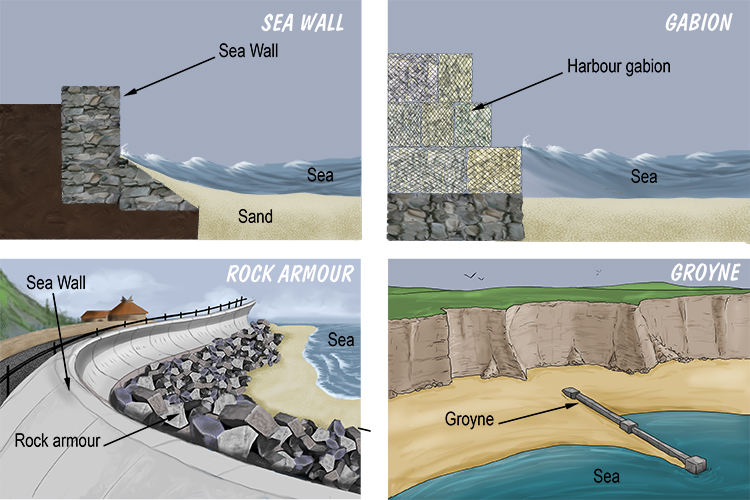
Hard and Soft Engineering
The UK can receive heavy amounts of rainfall and this has caused many floods to different areas. Whilst we obviously cannot stop the rain, many strategies have been implemented to try and prevent floods from occurring or limiting the impacts of them. The 2 main types of preventing flooding are called Hard and Soft Engineering strategies.
Note
Hard Engineering involves using man-made structures to prevent or control natural processes from taking place. This form of flood management is usually very expensive.
Note
Soft Engineering does not involve building artificial structures, but takes a more sustainable and natural approach to managing the potential for river flooding.
| Method | What is it | Advantages | Disadvantages |
|---|---|---|---|
| Dams and reservoirs | The dam traps water, which builds up behind it, forming a reservoir. Water can be released in a controlled way. | • Can be used to produce electricity by passing the water through a turbine within the dam. • Reservoirs can attract tourists. | • Very expensive. • Dams trap sediment which means the reservoir can hold less water. • Habitats are flooded often leading to rotting vegetation. This releases methane which is a greenhouse gas. • Settlements are lost leading to the displacement of people. |
| River straightening and dredging | Straightening the river speeds up the water so high volumes of water can pass through an area quickly. Dredging makes the river deeper so it can hold more water. | • More water can be held in the channel. • It can be used to reduce flood risk in built-up areas. | • Dredging needs to be done frequently. • Speeding up the river increases flood risk downstream. |
| Embankments | Raising the banks of a river means that it can hold more water. | • Cheap with a one-off cost • Allows for flood water to be contained within the river. | • Looks unnatural. • Water speeds up and can increase flood risk downstream. |
| Flood relief channels | The floodwater flows into the relief channel and is taken either to an area where it can be absorbed, or re-enters the river further down its course. | • Removes excess water from the river channel to reduce flooding. | • Expensive to build. • If water levels continue to rise, the relief channel may also flood. |
| Floodplain zoning | Allowing only certain land uses on the floodplain reduces the risk of flooding to houses and important buildings. | • More expensive buildings and land uses are further away from the river, so have a reduced flood risk. • Less damage is caused, leading to fewer insurance claims. | • Not always possible to change existing land uses. • Planners have to decide what type of flood to plan for. |
| Flood Warnings | The Environment Agency warns people in advance | • Warnings give people time to evacuate | • Warnings don't stop a flood from happening. |
Flooding Case Study – Somerset 2014
Location
- Somerset is located in SW England.
- In January 2014, Somerset experienced floods greater than any other in living memory.
- Estimates suggest that 10% of the area was underwater.
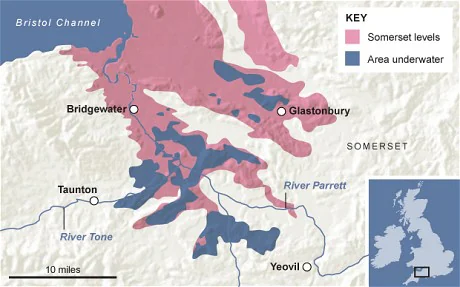
Causes of the Flood
- Quick succession of prolonged Atlantic storms with persistent rainfall and gale-force winds.
- January 2014 was the wettest January since records began with 350mm of rain (100mm above average).
- Storms hit during high tides, causing a storm surge and worsening coastal flooding.
- Rivers hadn't been dredged, reducing their capacity to carry water.
Social Impacts
- 600 houses were flooded, and 16 farms were evacuated.
- Villages were cut-off, and residents needed to be evacuated.
- Power supplies were cut, and phone lines were damaged.
Economic Impacts
- Somerset Council estimated the cost of the flooding to be £10 million.
- 14,000 Ha of agricultural land was lost.
- 1000 livestock were killed.
- Fuel used to power emergency pumps cost £200,000 per week.
- The Somerset floods cost the tourism industry £200 million.
Environmental Impacts
- Floodwaters were contaminated with sewage.
- Stagnant water was toxic and had to be treated before being pumped back into rivers.
- It took over two years to restore the soil before crops could be grown.
Short Term Responses
- 65 pumps were used to drain 65 million m³ of floodwater.
- 40 Royal Marines issued sandbags and distributed food.
- Rescue boats were used to help stranded people by the fire brigade.
- The Government pledged £15 million immediate aid for temporary flood barriers.
- The Environment Agency issued several flood warnings for the area.
Long Term Response – New Flood Defences
- A new Flood Defence scheme was introduced as part of a 20-year plan for the Somerset Levels, costing £100 million.
- Defences included the construction of a tidal barrage and additional permanent pumping stations.
- 8km of the River Tone and Parrett were dredged, increasing capacity.
- Culverts (large drains) were added to major roads, and 4 roads were raised.