Expanding double brackets (AQA GCSE Maths): Revision Notes
📚Revision Notes
Expanding double brackets
Expanding double brackets means multiplying two brackets together to create a single algebraic expression. This is a fundamental skill in algebra that you'll need to master for your GCSE exam. There are three main methods you can use, and it's helpful to know all three so you can choose the one that works best for each situation.
Note
Mastering double bracket expansion is essential for GCSE success. This skill appears frequently in exams and forms the foundation for more advanced algebraic techniques like factorising quadratics and solving equations.
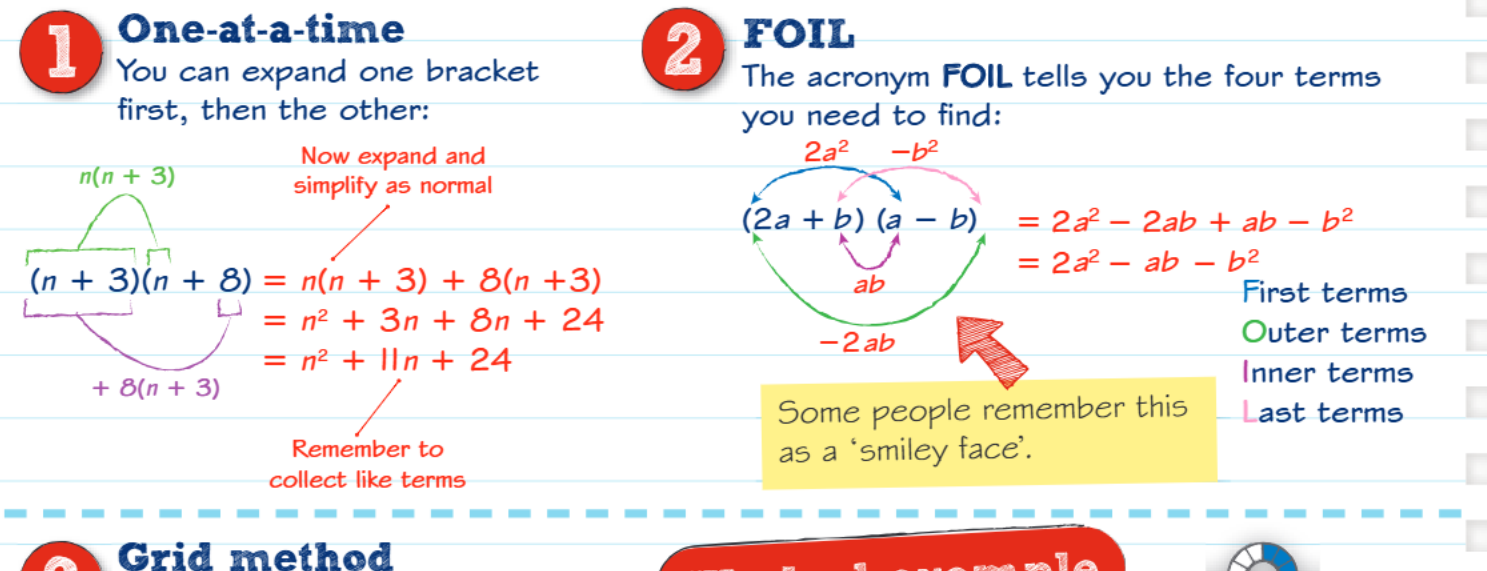
Method 1: One-at-a-time method
The one-at-a-time method involves expanding one bracket first, then dealing with the other. This approach can be easier to understand when you're starting out with double bracket expansion.
How it works:
- Take the first bracket and multiply each term in it by the entire second bracket
- Expand the resulting expression as normal
- Collect like terms to simplify your final answer
Example
Worked Example: Using the One-at-a-Time Method
Expand
Step 1: Multiply by
Step 2: Multiply by
Step 3: Add these together
Step 4: Collect like terms
Remember to always collect like terms at the end to get your expression in its simplest form.
Method 2: FOIL method
The FOIL method uses a systematic approach where you multiply terms in a specific order. FOIL stands for First, Outer, Inner, Last.
How it works:
- First terms: Multiply the first term in each bracket
- Outer terms: Multiply the outer terms (first term of first bracket × second term of second bracket)
- Inner terms: Multiply the inner terms (second term of first bracket × first term of second bracket)
- Last terms: Multiply the last term in each bracket
Example
Worked Example: Using the FOIL Method
Expand
- First:
- Outer:
- Inner:
- Last:
Combine:
Some students find it helpful to think of the FOIL pattern as making a "smiley face" when drawing the connections between terms.
Method 3: Grid method
The grid method uses a table to organise your multiplication systematically. This visual approach can be particularly helpful for avoiding mistakes.
How it works:
- Draw a grid with the terms from the first bracket along the top
- Write the terms from the second bracket down the side
- Multiply each pair of terms and write the result in the corresponding grid square
- Add all the results together and collect like terms
Example
Worked Example: Using the Grid Method
Expand
| × | ||
|---|---|---|
Result:
When using the grid method, be careful with negative signs. Make sure you include them in your grid and apply them correctly when multiplying.
Important
Critical Success Tips
- Always collect like terms at the end to simplify your answer completely
- Watch out for negative signs - they can easily cause mistakes if you're not careful
- Check your work by expanding a different way or substituting simple numbers
- Practice all three methods so you can choose the one that feels most comfortable for different types of problems
When squaring a bracket like , remember that this means , so you're multiplying the bracket by itself.
Summary
Key Points to Remember:
- Expanding double brackets means multiplying two brackets together to get a single expression
- Three methods available: one-at-a-time, FOIL, and grid method - use whichever feels most comfortable
- FOIL stands for First, Outer, Inner, Last - a systematic way to ensure you multiply all terms
- Always collect like terms at the end to get your answer in its simplest form
- Be extra careful with negative signs as they're a common source of errors in expansions