Sequences (AQA GCSE Maths): Revision Notes
📚Revision Notes
Sequences
Introduction to sequences
A sequence is simply a list of numbers that follow a particular pattern. When we talk about finding an expression for the nth term, we're looking for a formula that contains the variable n. This formula acts like a recipe - when you substitute different values for n, it gives you every term in the sequence.
Note
Think of the nth term formula as a mathematical recipe. Just like a recipe tells you how to make any number of cookies by following the same steps, the nth term formula tells you how to find any term in the sequence by substituting different values of n.
Finding the nth term of a linear sequence
Linear sequences are the most straightforward type to work with. These sequences have a constant difference between consecutive terms, which means the terms increase or decrease by the same amount each time. You might also hear these called arithmetic sequences.
The key to finding the nth term of a linear sequence lies in following a systematic three-step approach:
Note
The Three-Step Method for Linear Sequences:
- Find the common difference - This tells you what to multiply n by in your formula
- Work out what to add or subtract - This adjusts your formula to match the actual sequence
- Combine both parts - Put everything together to create your final expression
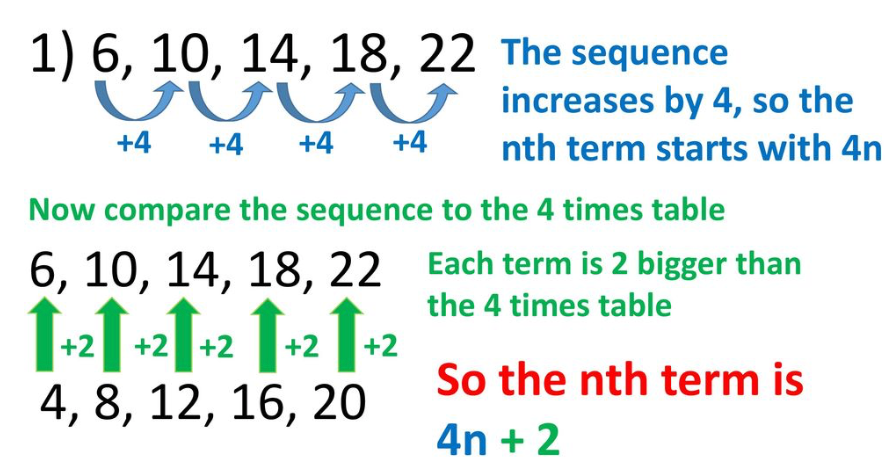
Let's look at how this works in practice. The method involves creating a table to compare your sequence with multiples of n, then identifying what adjustment is needed.
Important
Always remember to check your expression by substituting the first few values of n back into your formula. If n = 1 gives you the first term, n = 2 gives you the second term, and so on, then you know your expression is correct!
Finding the nth term of a quadratic sequence
Quadratic sequences are more complex because they contain an term. The key characteristic of these sequences is that while the difference between consecutive terms changes, the difference between those differences remains constant.
Here's how to tackle quadratic sequences:
- Find the difference between each pair of consecutive terms - These are called first differences
- Find the difference between the first differences - These are called second differences
- The coefficient of is half the second difference - This gives you the part of your formula
- Subtract the component from each term - This reveals the linear pattern underneath
- Find the nth term of this linear sequence and add it to the term - This gives you your complete formula
Note
The method of differences is your most powerful tool for identifying and working with quadratic sequences. The second differences being constant is the telltale sign that you're dealing with a quadratic sequence.
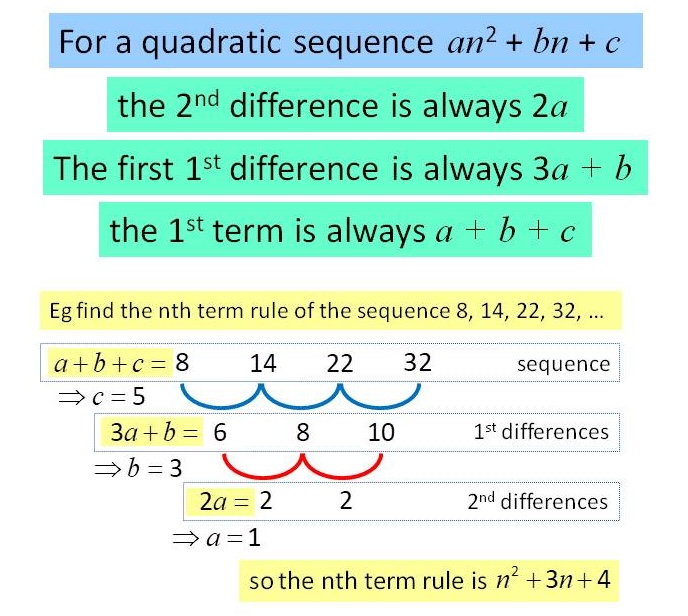
The process might seem complicated at first, but it becomes much clearer with practice.
Important
Again, always verify your expression by substituting values back into your formula to ensure it produces the original sequence. This checking step is crucial and will save you from errors.
Deciding if a term is in a sequence
Sometimes you'll be given a sequence formula and asked whether a specific value appears in that sequence. The approach here is to set your expression equal to the given value and solve for n. If n turns out to be a whole number, then the value is indeed in the sequence.
Important
The key insight is that n must be a positive whole number for the term to actually exist in the sequence. If your calculation gives you a decimal or negative number, then the value you're checking is not part of the sequence.
Other types of sequences
Not all sequences are linear or quadratic. You might encounter sequences that follow different patterns:
- Geometric sequences - where you multiply each term by a constant value to get the next term
- Fibonacci sequences - where each term is the sum of the two previous terms
- Other patterns - sequences might involve more complex rules that require you to look at previous terms
Note
The important thing is to identify the pattern by examining how each term relates to the previous ones. Sometimes sequences use notation like , , to represent the first, second, and third terms respectively.
Using sequences to solve problems
Sequences aren't just academic exercises - they can be used to solve real mathematical problems. You might need to find the sum of consecutive terms, determine specific values, or work backwards from given information.
The key is to set up equations based on the sequence formula and the conditions given in the problem. This often involves substituting specific values of n and then solving the resulting equations.
Note
Problem-solving with sequences often requires you to think creatively about how to apply the nth term formula to the specific situation described in the question.
Remember!
Summary
Key Points to Remember:
- Linear sequences have a constant difference - find this first, then work out what to add or subtract
- Quadratic sequences have changing differences - use the method of differences to find the pattern
- Always check your formula - substitute the first few values of n to verify your expression works
- For checking if a term exists - set your expression equal to the value and solve for n; it must be a whole number
- There are many types of sequences - look for the pattern and work out the rule step by step