Simultaneous Equations (AQA GCSE Maths): Revision Notes
📚Revision Notes
Simultaneous equations
What are simultaneous equations?
Simultaneous equations are a pair of equations that contain two unknown values (usually x and y). Your task is to find the values of both unknowns that satisfy both equations at the same time.
These equations are called "simultaneous" because they must be solved together - the solution you find must work for both equations.
Note
The word "simultaneous" means "at the same time" - this is why we need to find values that work for both equations simultaneously, not just one equation at a time.
Algebraic solution method
The most common way to solve simultaneous equations is using the elimination method. This involves removing one unknown so you can solve for the other.
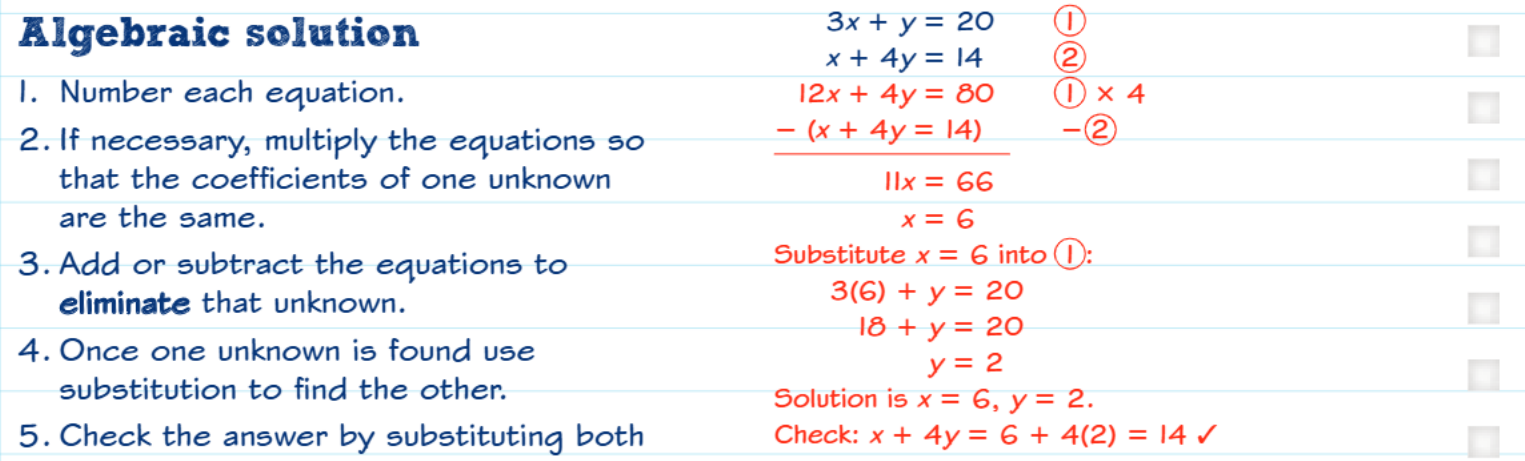
Here's the step-by-step process:
Step 1: Number each equation
Label your equations (1) and (2) to keep track of your working.
Step 2: Make coefficients equal
If necessary, multiply one or both equations by whole numbers so that the coefficients of one unknown are the same in both equations.
Step 3: Add or subtract to eliminate
- If the coefficients have different signs, add the equations
- If the coefficients have the same sign, subtract one equation from the other
This eliminates one unknown completely.
Step 4: Use substitution
Once you've found the value of one unknown, substitute this value back into either original equation to find the other unknown.
Step 5: Check your answer
Substitute both values into both original equations to verify your solution is correct.
Important
Always check your answer! The most common mistakes in simultaneous equations happen during arithmetic operations. Substituting your solution back into both original equations will catch these errors.
Worked example
Example
Worked Example: Solving 3x + y = 20 and x + 4y = 14
Let's solve: and
Step 1: Number the equations:
- ... (1)
- ... (2)
Step 2: Make coefficients equal:
- Multiply equation (1) by 4:
- Keep equation (2):
Step 3: Eliminate y by subtraction:
- This gives:
- Therefore:
Step 4: Find y by substitution:
- Substitute into equation (1):
Step 5: Check: ✓
Solution: x = 6, y = 2
Tips for easier elimination
Choosing the right unknown to eliminate can save you time:
Note
Tip 1: If an unknown appears on its own in one equation (like just 'x' or 'y'), you only need to multiply one equation to eliminate that unknown.
Tip 2: If an unknown has different signs in the two equations (like +y in one and -y in the other), you can eliminate by adding the equations directly.
Graphical solution method
You can also solve simultaneous equations by drawing graphs. Each equation represents a straight line on a coordinate grid.
The point of intersection where the two lines cross gives you the solution to both equations. The x-coordinate and y-coordinate of this point are your values for x and y.
For example, if the lines intersect at point (2, 1), then and .
Note
Why does the intersection point work? Any point on a line satisfies that line's equation. The intersection point is the only point that lies on both lines, so it's the only point that satisfies both equations simultaneously.
Remember!
Summary
Key Points to Remember:
- Simultaneous equations have two unknowns that must be found together
- The elimination method removes one unknown by making coefficients equal and adding/subtracting
- Always check your answer by substituting back into both original equations
- The graphical method finds the solution at the intersection point of two lines
- Choose elimination carefully - look for unknowns that appear alone or have different signs