Solving Equations (AQA GCSE Maths): Revision Notes
📚Revision Notes
Solving equations
Understanding the basic approach
The fundamental principle behind solving equations is straightforward - you need to continue rearranging the equation until you isolate the variable and achieve x = number. This process involves systematic manipulation of the equation while maintaining balance between both sides.
Note
The key to solving equations successfully is understanding that you're always working towards the same goal: getting the variable by itself on one side of the equation with a number on the other side.
The most widely used technique is the "same to both sides" method, where whatever operation you perform on one side of the equation must also be performed on the other side. This ensures the equation remains balanced throughout the solving process.
Rearranging equations step by step
When working with equations that contain a mixture of x-terms and numbers, you should follow a logical sequence. Begin by rearranging the equation so that all terms containing x appear on one side whilst all numerical terms appear on the other side. Once you have achieved this separation, combine any like terms that appear on the same side.
Note
Think of equation solving like organising items - you want to group all the x-terms together on one side and all the numbers together on the other side before doing your final calculation.
The final step involves dividing both sides of the equation by the coefficient of x (the number that multiplies x) to determine the value of x. This systematic approach ensures you reach the correct solution efficiently.
Working with brackets in equations
When your equation contains brackets, you must address these before attempting to rearrange terms. The key principle is to multiply out all brackets first, then proceed with the standard rearranging process.
Important
Always Deal with Brackets First
You must multiply out all brackets before collecting like terms. Attempting to rearrange terms while brackets remain will often lead to errors and missed terms.
This approach prevents confusion and ensures you don't miss any terms during the rearrangement phase. Once the brackets have been eliminated, you can collect like terms and solve the equation using the standard methods as before.
Eliminating fractions from equations
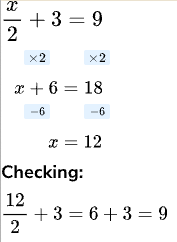
Fractions can make equations appear more complex than they actually are, so it's beneficial to eliminate them early in the solving process. The most effective method is to multiply every term in the equation by the denominator of the fraction.
Note
Clearing Fractions Made Simple
When you multiply every term by the denominator, you're essentially "clearing" the fraction from the equation. This transforms a complex-looking equation into a much simpler form that's easier to work with.
When dealing with equations containing multiple fractions, you'll need to multiply every term by all the denominators present. This process, known as clearing fractions, transforms the equation into a simpler form that's easier to manipulate.
The systematic 6-step method
For more complex equations, following a structured approach can help you avoid errors and work efficiently. This comprehensive method works for virtually any linear equation you might encounter.
Example
The 6-Step Method for Solving Equations
- Get rid of any fractions - Multiply every term by the denominator(s)
- Multiply out any brackets - Expand all bracketed expressions
- Collect all the x-terms on one side and all number terms on the other - Group like terms together
- Reduce it to the form 'Axe = B' - Combine like terms on each side
- Divide both sides by A - This gives you 'x = ' and that's your answer
- If you had 'x² = ' instead - Take the square root of both sides to get 'x = ±'
The process begins by eliminating any fractions present in the equation. Next, multiply out any brackets that appear. Then collect all terms containing x on one side of the equation and all numerical terms on the other side.
Reduce the equation to the standard form where you have a coefficient multiplying x equals a number. Finally, divide both sides by this coefficient to find the value of x. This systematic approach ensures you handle each component of the equation methodically.
Dealing with squared terms
Sometimes during the solving process, you might encounter x² rather than just x. When this occurs, you need to take the square root of both sides to find the value of x. However, there's an important consideration to remember.
Important
Remember Both Solutions for Square Roots
When taking the square root of a number, there are always two possible answers: one positive and one negative. Both values, when squared, give the same result. You must include both solutions unless the problem context suggests only one answer makes sense.
For example, if you're calculating a physical quantity like length or number of objects, negative answers wouldn't be meaningful, so you'd only consider the positive square root.
Checking your solutions
After solving any equation, it's valuable practice to verify your answer by substituting it back into the original equation. This verification process helps catch any computational errors and confirms that your solution is correct.
Note
Verification Process
Simply replace the variable with your calculated value in the original equation and check that both sides equal the same number. If they do, your solution is correct. If not, review your working to identify where an error occurred.
Remember!
Summary
Key Points to Remember:
- The "same to both sides" method ensures equations remain balanced - whatever you do to one side, you must do to the other
- Always eliminate fractions and multiply out brackets before collecting like terms
- When you have x² = number, remember that taking the square root gives both positive and negative solutions
- The 6-step method provides a systematic approach that works for any linear equation
- Always check your answer by substituting it back into the original equation to verify it's correct