3D Shapes — Surface Area (AQA GCSE Maths): Revision Notes
📚Revision Notes
3D shapes — Surface area
Understanding the parts of 3D shapes

When working with three-dimensional shapes, you need to understand the basic components that make up these objects. Every 3D shape is made up of three main elements that you should be able to identify and count.
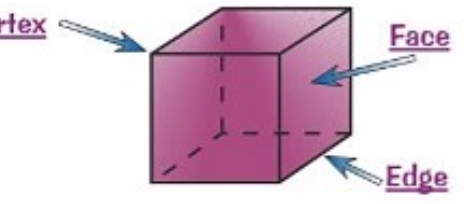
A vertex is a corner point where edges meet. Think of it as a sharp point or corner on the shape. A face is any flat surface on the 3D shape. This could be a square, rectangle, triangle, or circle depending on the shape. An edge is the line where two faces meet - it's like the border between two surfaces.
Note
When counting these elements, remember to include the hidden parts that you cannot see from your viewing angle. For example, a cube has vertices, faces, and edges, even though you cannot see all of them from one direction.
What is surface area?
Surface area is a measurement that only applies to three-dimensional objects. It represents the total area of all the faces added together. Think of it as the amount of material you would need to completely cover the outside of a shape.
One helpful way to understand surface area is to imagine unfolding the 3D shape into a flat pattern called a net. A net shows all the faces of the shape laid out flat. If you calculate the area of each section of the net and add them together, you get the total surface area.
Important
The key concept to remember is that surface area equals the area of the net. This means you can find the surface area by adding up the area of each individual face.
Surface area formulas for common shapes
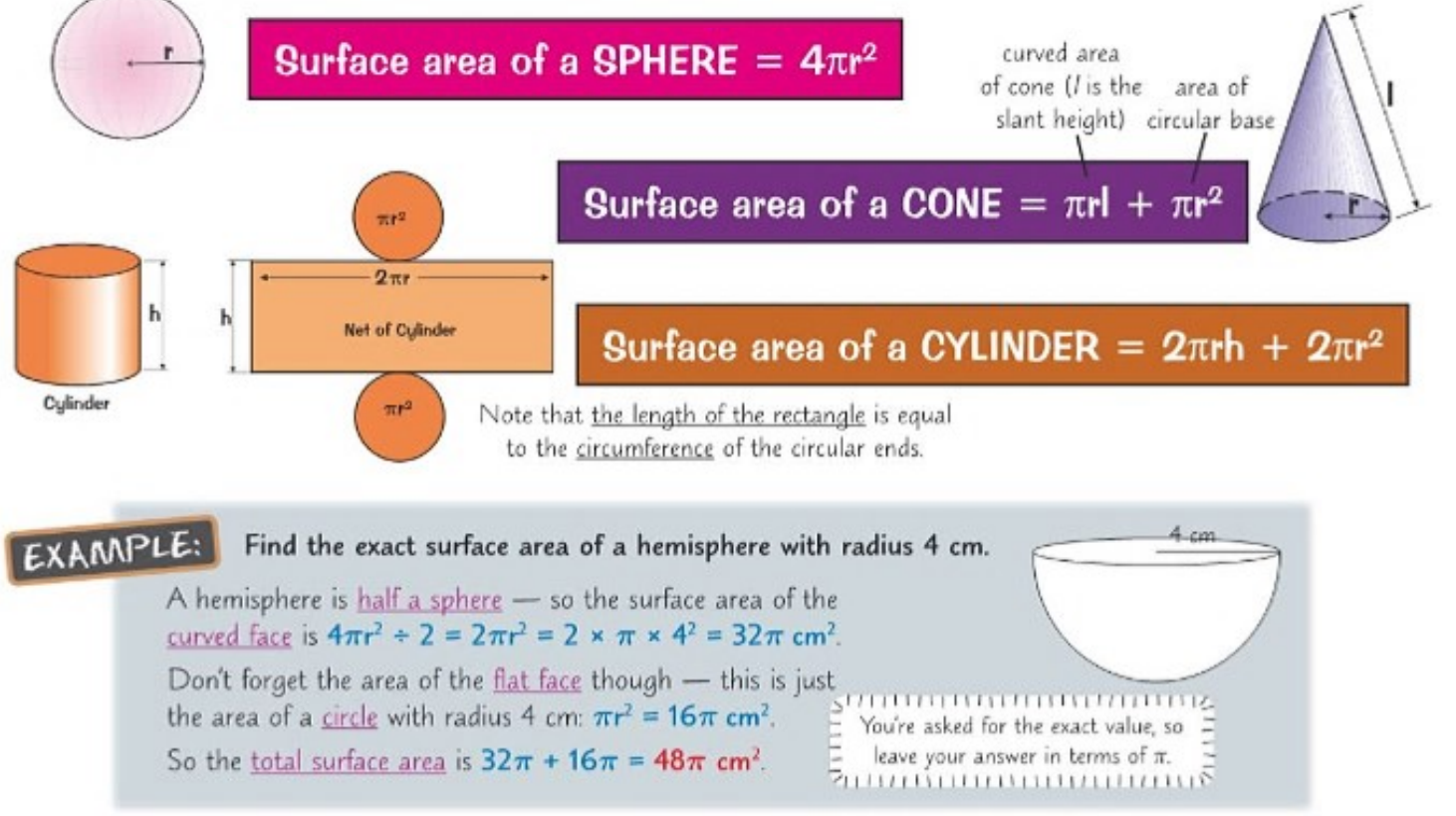 For certain three-dimensional shapes, mathematicians have developed specific formulas that make calculating surface area much easier. Here are the three most important ones you need to know:
Sphere surface area = A sphere is perfectly round like a ball. The formula uses the radius () - the distance from the centre to the edge. You multiply by (pi) by the radius squared.
Cone surface area = A cone has a circular base and comes to a point at the top. The formula has two parts: gives you the curved surface area (where is the slant height), and gives you the area of the circular base.
Cylinder surface area = A cylinder looks like a tin can with circular ends and a curved side. The formula includes for the curved surface (where is the height) and for both circular ends.
Important
Essential formulas to memorise:
- Sphere:
- Cone:
- Cylinder:
Example
Worked Example: Hemisphere Surface Area
Let's work through finding the surface area of a hemisphere with radius cm. A hemisphere is exactly half of a sphere, so we need to think carefully about what surfaces we're measuring.
Step 1: Find the curved surface area For the curved surface, we take half of a sphere's surface area: With cm, this gives us cm²
Step 2: Find the flat circular face area A hemisphere also has a flat circular face where it was "cut" from the full sphere. This flat face has area cm²
Step 3: Calculate total surface area Therefore, the total surface area is cm²
Summary
Key Points to Remember:
- Vertices, faces, and edges are the three main components of any 3D shape - make sure you can identify and count them all, including hidden ones
- Surface area is the total area of all faces added together - imagine wrapping the shape completely
- Use nets to visualise surface area - unfold the shape mentally and add up each section
- Learn the key formulas for sphere (), cone (), and cylinder ()
- Don't forget flat faces when calculating surface area of shapes like hemispheres - they often have both curved and flat surfaces