3D Shapes — Volume (AQA GCSE Maths): Revision Notes
📚Revision Notes
3D shapes — Volume
Understanding volume in 3D shapes
Volume tells us how much space a 3D shape takes up, measured in cubic units like cm³ or m³. Different 3D shapes have different volume formulas, but they all follow logical patterns once you understand the underlying concepts.
Note
Volume is always measured in cubic units because we're measuring three-dimensional space. This is why we see units like cm³, m³, or mm³ rather than just cm or m.
Volumes of prisms
A prism is a 3D shape that maintains the same cross-sectional area all the way through its length. Think of it like a loaf of bread - every slice would be identical in shape and size.
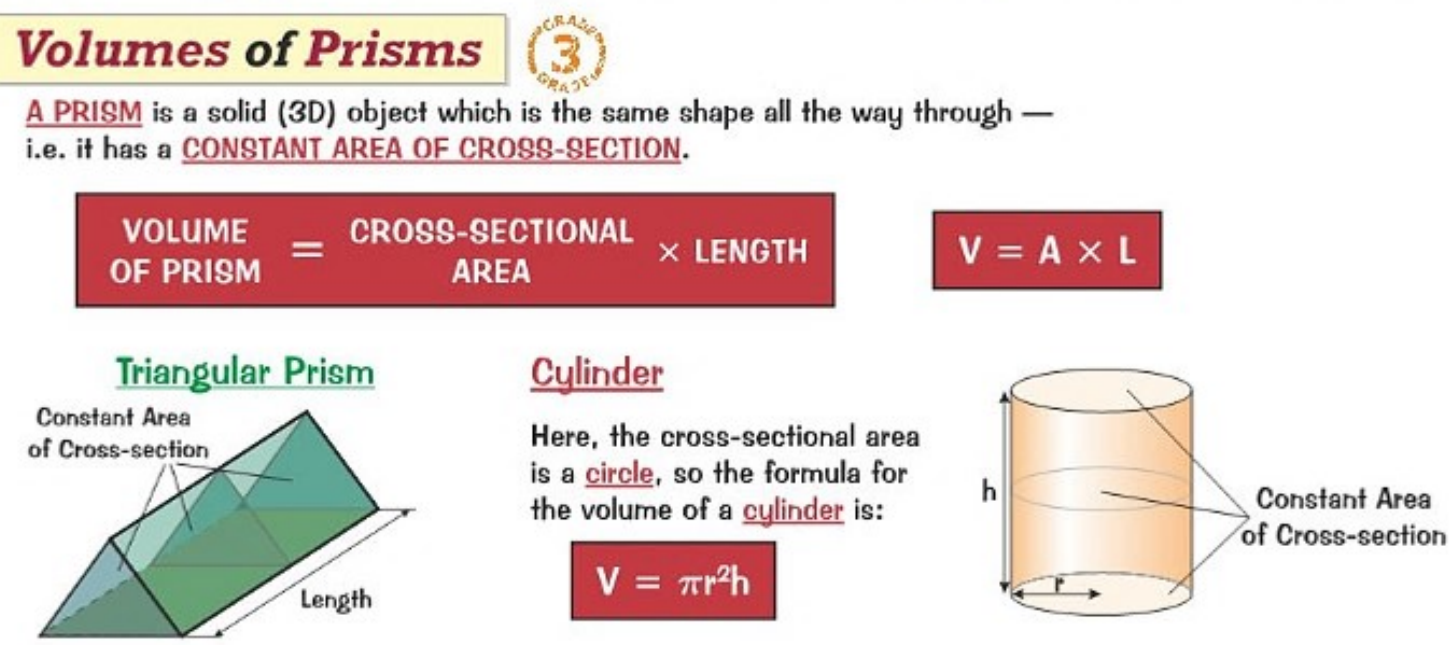 The key formula for any prism is:
Where:
- = Volume
- = Cross-sectional Area
- = Length
This works because you're essentially stacking identical flat shapes on top of each other to create the 3D object.
Triangular prisms
For a triangular prism, you first calculate the area of the triangular cross-section, then multiply by the length of the prism.
Cylinders
A cylinder is actually a special type of prism where the cross-section is a circle. The cross-sectional area is (the area of a circle), so the volume becomes:
where is the radius and is the height.
Practical example with cylinders
Let's look at a real-world application using density and mass calculations.
 When working with cylinders, you can calculate not just volume but also mass if you know the density. The relationship is:
Example
Worked Example: Cylindrical Honey Jar
Given: A cylindrical honey jar with radius 4.5 cm, height 12 cm, and honey density 1.4 g/cm³
Step 1: Calculate volume cm³
Step 2: Calculate mass (to 3 significant figures)
Volumes of spheres
A sphere is a perfectly round 3D shape where every point on the surface is the same distance from the centre.
Note
The factor of might seem strange, but it comes from the mathematical derivation of how spheres fill space. This is a fundamental constant in sphere geometry.
Hemispheres
A hemisphere is exactly half a sphere, so its volume is simply half the sphere's volume:
Volumes of pyramids and cones
These shapes start with a base and taper to a single point at the top. The key insight is that all pyramids and cones have a volume that's one-third of what a prism or cylinder with the same base and height would have.
Important height distinction
Important
Always use the vertical (perpendicular) height in these formulas, not the slant height. The slant height is the distance along the sloping side and is used for surface area calculations, not volume.
Common mistake: Using slant height instead of vertical height will give you an incorrect (larger) volume.
Volumes of frustums
A frustum is what you get when you "chop off" the top of a cone parallel to its base. Think of a bucket or lampshade shape.
To find the volume of a frustum:
Example
Worked Example: Frustum Calculation Process
Step 1: Calculate the volume of the complete original cone Use with the original dimensions
Step 2: Work out the dimensions of the small cone that was removed Use similar triangles to find the height and radius of the removed portion
Step 3: Calculate the volume of the removed cone Use with the removed cone dimensions
Step 4: Subtract to find the frustum volume
When the cones are similar (same shape, different size), you can use scale factors to find the dimensions of the removed cone.
Rates of flow
Volume calculations become practical when dealing with rates of flow - how quickly liquid flows into or out of containers.
Note
Key conversions to remember:
- 1 litre = 1000 cm³
- Rates are often given in litres per minute or cm³/s
Always check your units and convert as needed for consistency in calculations.
Example
Worked Example: Spherical Tank Filling
Problem: A spherical tank needs to be filled to 2/3 of its volume at 4 litres per minute. How long will it take?
Step 1: Find the total volume using
Step 2: Calculate 2/3 of this volume
Step 3: Convert the rate to appropriate units (if needed) 4 litres/min = 4000 cm³/min
Step 4: Calculate time
Key formulas and relationships
Important
Essential formulas you must know:
- Prism:
- Cylinder:
- Sphere:
- Hemisphere:
- Pyramid:
- Cone:
- Mass-density relationship:
Summary
Key Points to Remember:
- Prisms maintain constant cross-sections - multiply cross-sectional area by length
- Cylinders are circular prisms - use
- Spheres use the 4/3 factor -
- Pyramids and cones use 1/3 - one-third of base area times vertical height
- Frustums require subtraction - original cone volume minus removed cone volume
- Always use vertical height for pyramids and cones, not slant height
- Unit conversions matter - especially 1 litre = 1000 cm³ for flow problems
- Check your units - ensure consistency throughout calculations