Area — Circles (AQA GCSE Maths): Revision Notes
📚Revision Notes
Circle areas and calculations
Understanding how to calculate areas related to circles is fundamental in GCSE geometry. This topic builds on basic circle properties and extends to more complex shapes like sectors and segments.
Basic circle formulas
Every circle calculation starts with two fundamental measurements: the radius and diameter. The radius extends from the centre to the edge, while the diameter spans the full width through the centre. Remember that the radius is always half the diameter.
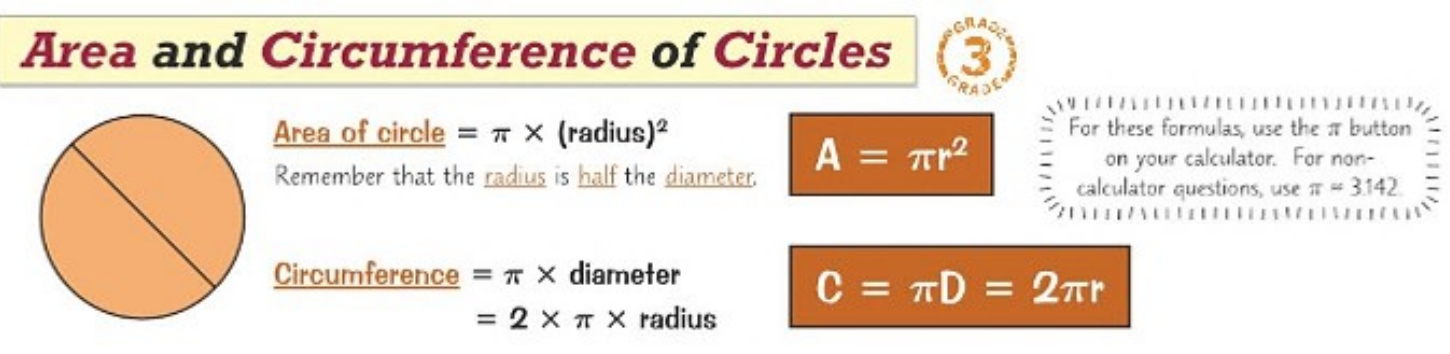 The area of any circle can be found using the formula , where represents the radius. This means you multiply π by the radius squared. For the circumference (the distance around the circle), you can use either (π times the diameter) or (2 times π times the radius).
Note
These two formulas are the foundation of all circle calculations. The area formula tells us that area increases with the square of the radius, while the circumference formulas or show a direct relationship between size and perimeter.
Important
When working with these formulas, use the π button on your calculator for accuracy. For non-calculator questions, you can use the approximation .
Sectors and arcs
A sector is like a slice of pizza - it's a portion of a circle bounded by two radii and an arc. The arc is the curved edge of the sector. Sectors come in two types: minor sectors (less than half the circle) and major sectors (more than half the circle).
 To find the area of a sector, you need to work out what fraction of the full circle it represents. If the central angle is degrees, then the sector represents of the whole circle. Therefore:
Similarly, the length of an arc follows the same proportional relationship:
Note
These formulas work because they're based on the simple idea that if you know what fraction of the circle you're dealing with, you can find that same fraction of the area or circumference. This proportional relationship is key to understanding all sector calculations.
Finding the area of a segment
A segment is the region between a chord (straight line across the circle) and the arc it cuts off. Finding a segment's area requires a two-step process that combines sector and triangle calculations.
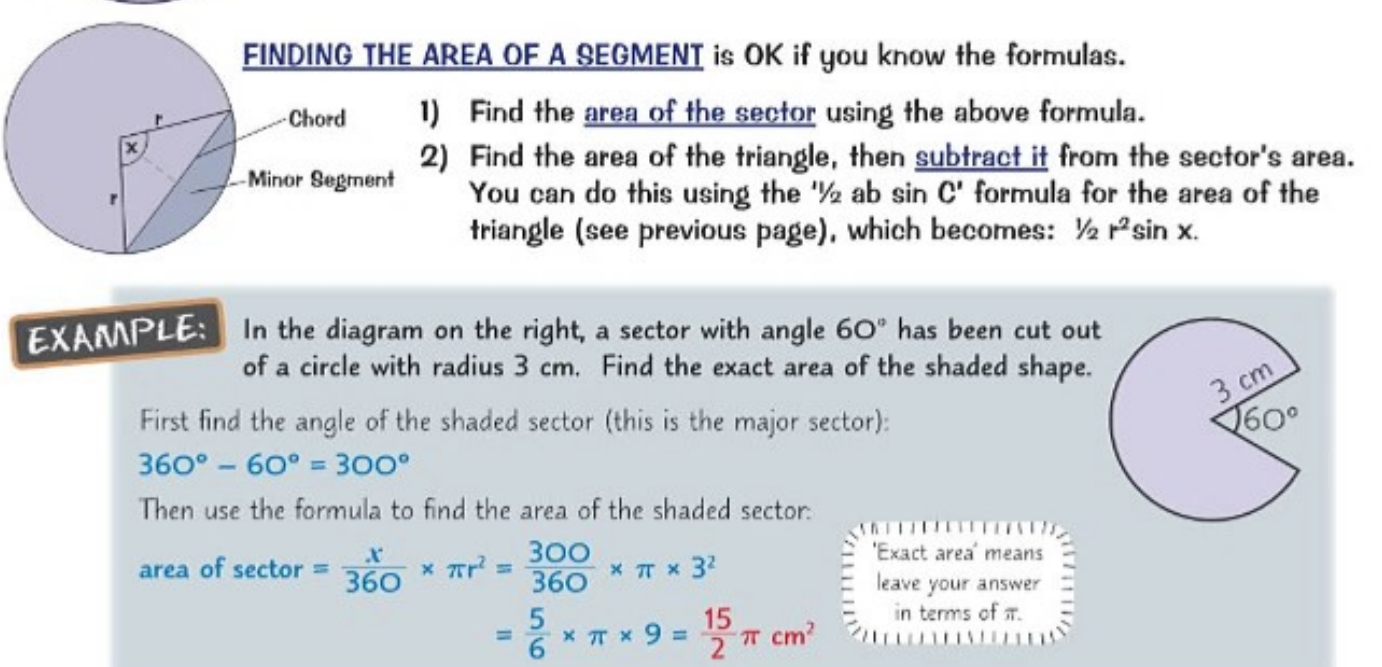 First, calculate the area of the sector using the formula above. Then, find the area of the triangle formed by the two radii and the chord, using the formula (where is the central angle). Finally, subtract the triangle's area from the sector's area to get the segment area.
Example
Worked Example: Finding a Major Sector Area
If a 60° sector is cut out from a circle with radius 3 cm, we need to find the area of the remaining shaded shape (which is actually a major sector).
Step 1: Find the remaining angle Remaining angle = 360° - 60° = 300°
Step 2: Apply the sector formula Area = cm²
Step 3: Notice the exact answer The answer is left in terms of π - this gives an exact value rather than a decimal approximation.
Important
When calculating perimeters of semicircles or quarter circles, don't forget to include the straight edges as well as the curved parts. This is a common mistake that can cost valuable marks in examinations.
For any shape involving part of a circle, always consider whether you're looking for the area, the arc length, or the complete perimeter including straight edges.
Summary
Key Points to Remember:
- The area of a circle is and the circumference is or
- Sector areas and arc lengths use the same proportion:
- To find a segment area, calculate the sector area and subtract the triangle area
- Always leave exact answers in terms of π when asked
- Don't forget to include straight edges when finding perimeters of semicircles or quarter circles