Area — Triangles and Quadrilaterals (AQA GCSE Maths): Revision Notes
📚Revision Notes
Area — Triangles and quadrilaterals
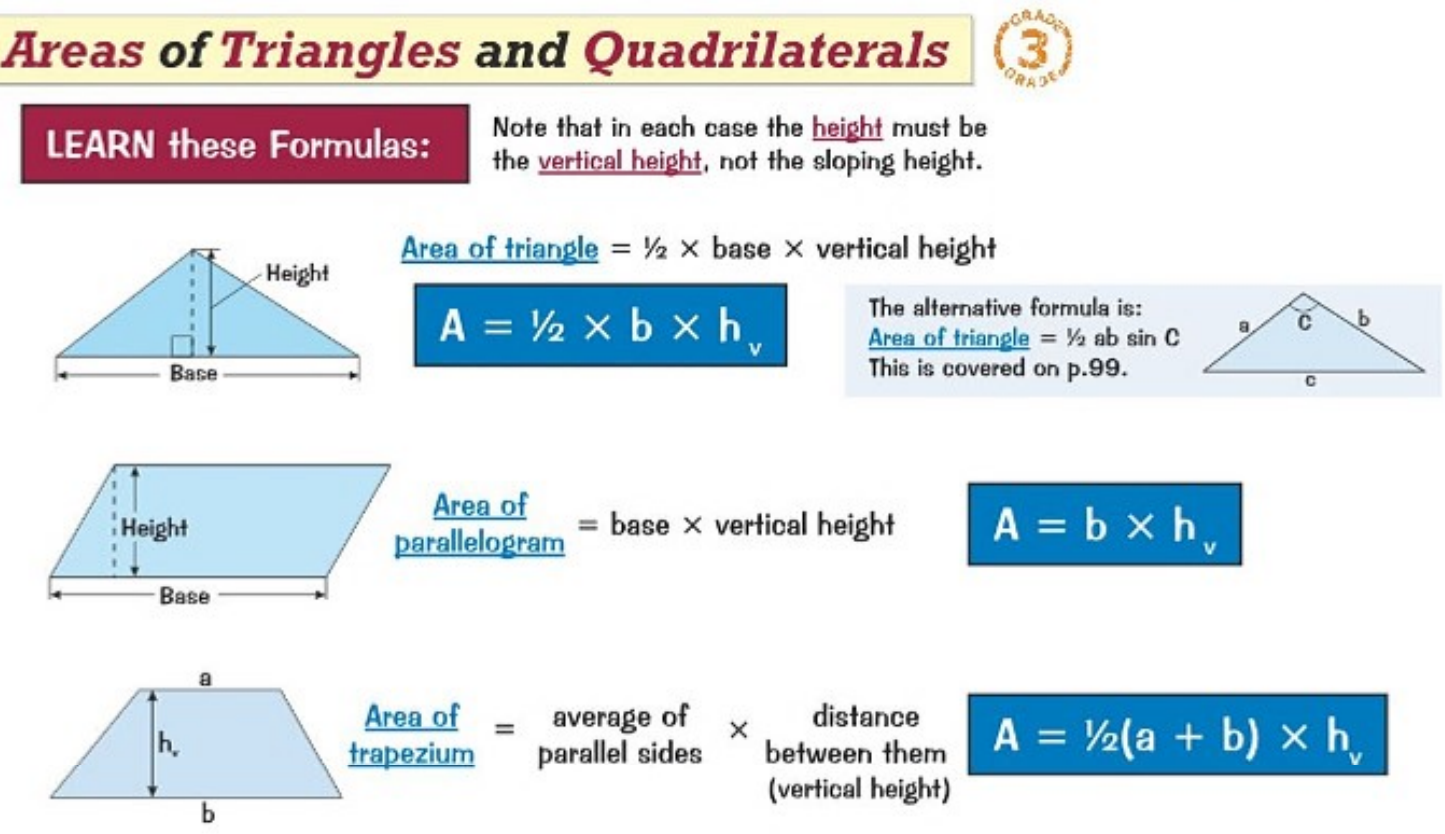
Understanding how to calculate the area of different shapes is a fundamental skill in geometry. This topic focuses on three key shapes: triangles, parallelograms, and trapeziums. Each shape has its own specific formula, but they all share one crucial requirement - you must always use the vertical height, not the sloping height.
Essential area formulas
The three main formulas you need to master are straightforward once you understand the principle behind each one. Let's explore each shape and its corresponding area calculation.
Note
These three formulas form the foundation of area calculations for most geometric problems you'll encounter. Mastering them will make more complex problems much easier to solve.
Triangle area
The area of a triangle is calculated using half the base multiplied by the vertical height. This formula works because a triangle is essentially half of a parallelogram when you imagine duplicating it and flipping it over.
Formula:
The vertical height is the perpendicular distance from the base to the opposite vertex. It's crucial to remember that this is not the length of the side of the triangle - it's the straight-up distance.
Note
Think of the triangle area formula as finding the area of a rectangle and then taking half of it. This visualisation helps explain why we multiply by ½.
Parallelogram area
A parallelogram's area is simply the base multiplied by the vertical height. This makes sense because you can imagine sliding the slanted part of the parallelogram to form a rectangle, which would have the same area.
Formula:
Again, the vertical height is the perpendicular distance between the parallel sides, not the length of the slanted sides.
Trapezium area
A trapezium (also called a trapezoid) has two parallel sides of different lengths. To find its area, you take the average of these two parallel sides and multiply by the vertical height.
Formula:
Where 'a' and 'b' are the lengths of the two parallel sides. Think of this as finding the area of a rectangle with width equal to the average of the parallel sides.
The importance of vertical height
Important
One of the most common mistakes students make is using the sloping height instead of the vertical height. The vertical height is always the perpendicular distance - imagine dropping a line straight down from the top of the shape to the base. This perpendicular line represents the true height needed for area calculations.
Solving area problems
When faced with area problems, you'll often need to rearrange the formulas to find missing measurements. The key is to identify what information you have and what you need to find, then substitute into the appropriate formula.
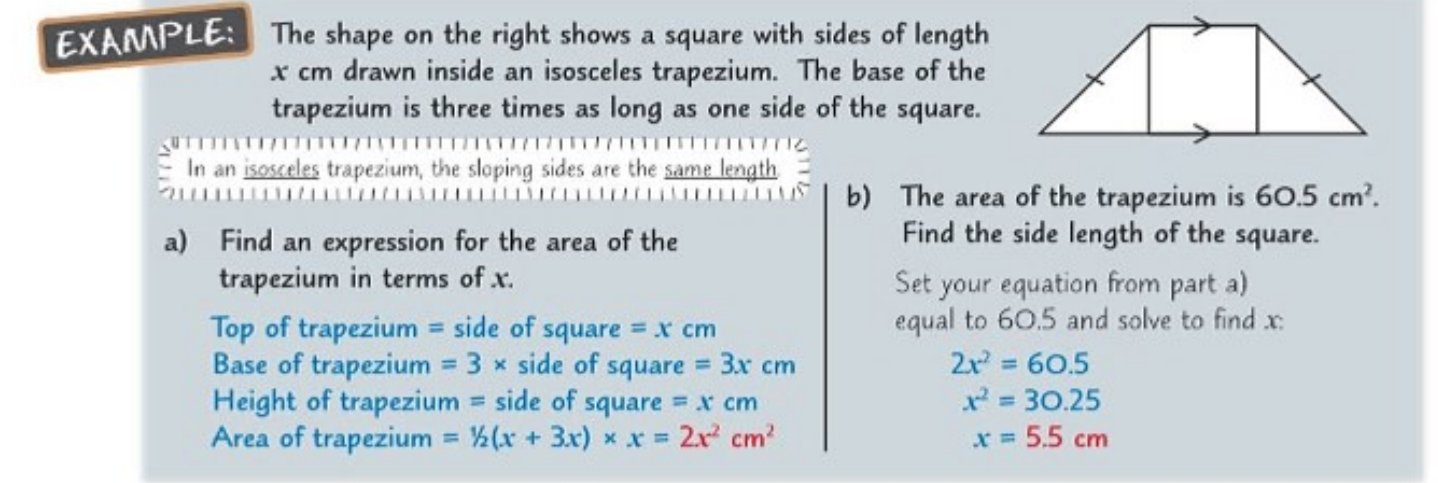 For example, if you know the area of a shape and some of its dimensions, you can work backwards to find the unknown measurement. This typically involves setting up an equation and solving for the missing variable.
Note
Problem-solving strategy:
- Identify what measurements you know
- Determine what you need to find
- Choose the appropriate formula
- Rearrange the formula if necessary
- Substitute known values and solve
Working with composite shapes
Sometimes you'll encounter composite shapes - shapes made up of different geometric figures joined together. The strategy here is to break the composite shape into simpler triangles and quadrilaterals, calculate the area of each part separately, then add them all together.
 When dealing with composite shapes, carefully identify the boundaries of each simple shape within the composite figure. Make sure you don't double-count any areas or miss any sections.
Note
Composite shape strategy:
- Break complex shapes into familiar triangles and quadrilaterals
- Calculate each area separately using the appropriate formula
- Add all individual areas together for the total
- Double-check that you haven't missed any sections or counted any area twice
Remember!
Summary
Key Points to Remember:
- Always use vertical height, never sloping height, in your area calculations
- Triangle area =
- Parallelogram area =
- Trapezium area =
- For composite shapes, break them into simple shapes and add their areas together