Bearings (AQA GCSE Maths): Revision Notes
📚Revision Notes
Bearings
A bearing is a way to describe direction using angles. Understanding bearings is essential for navigation and many real-world applications.

What are bearings?
Bearings are measured clockwise from north. This means you always start facing north and then turn clockwise (like the hands of a clock) to find your direction.
Important
Three-Figure Bearing Rule
Every bearing must be written as a three-figure bearing. This means you need to add zeros if the angle is less than 100°.
For example:
- 48° becomes 048°
- 5° becomes 005°
- 120° stays as 120°
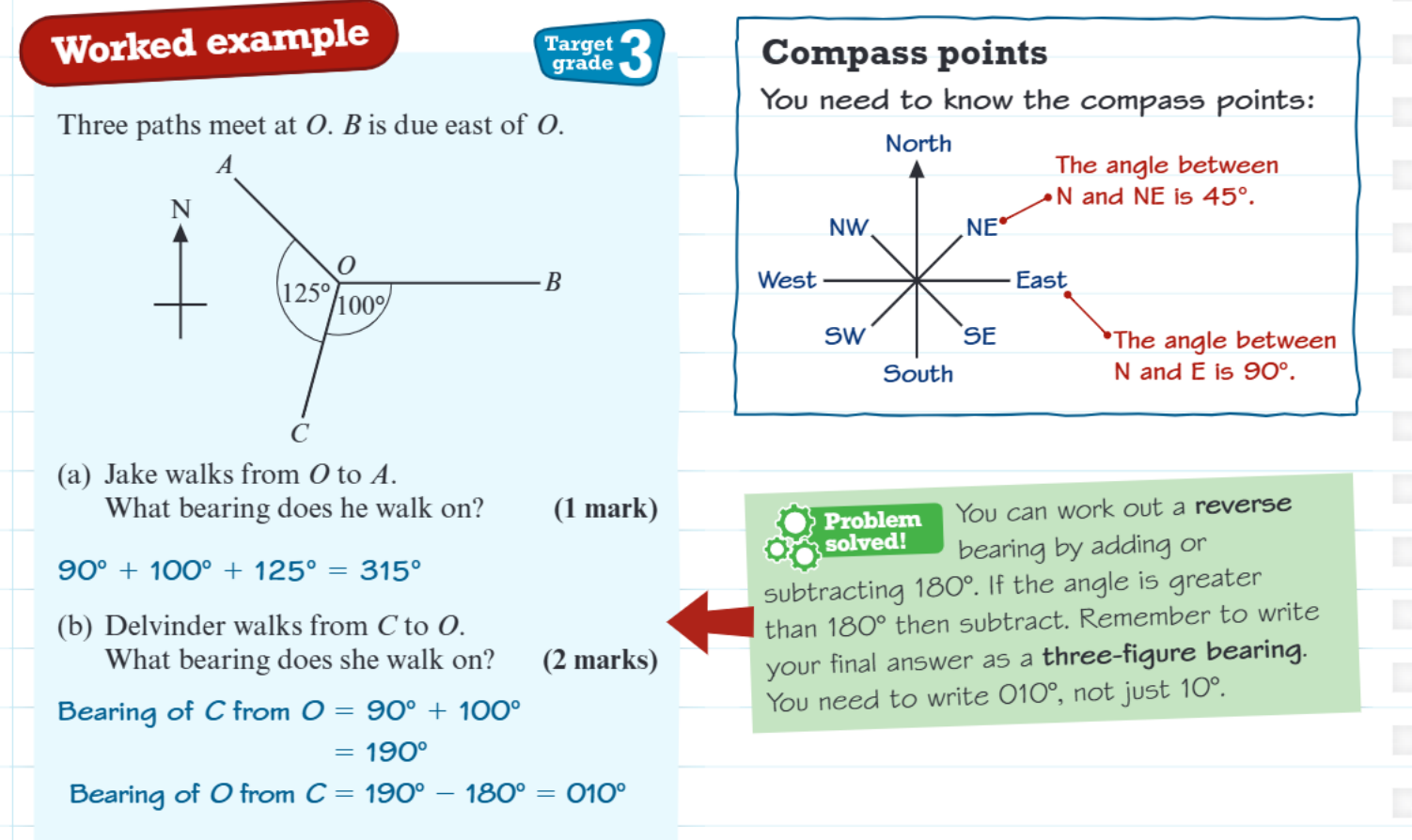
Compass points
You need to know the eight main compass directions and their angles from north:
- North (N) = 000°
- North-East (NE) = 045°
- East (E) = 090°
- South-East (SE) = 135°
- South (S) = 180°
- South-West (SW) = 225°
- West (W) = 270°
- North-West (NW) = 315°
Note
Remember that the angle between north and east is 90°, and the angle between north and north-east is 45°.
How to calculate bearings
When calculating bearings, follow these steps:
- Find north - Look for the north arrow on your diagram
- Measure clockwise - Always turn clockwise from north
- Add up angles - If you need to go through multiple angles, add them together
- Write as three figures - Add zeros at the front if needed
Example
Worked Example: Jake's Journey from O to A
Step 1: Start at north (0°) Step 2: Turn 90° to face east Step 3: Turn another 100° Step 4: Turn another 125° Step 5: Add the angles together
Total bearing = 90° + 100° + 125° = 315°
Reverse bearings
A reverse bearing tells you the direction for the return journey. You can work out a reverse bearing by adding or subtracting 180°:
Important
Reverse Bearing Rules
- If your bearing is less than 180°, add 180°
- If your bearing is greater than 180°, subtract 180°
For example:
- If the bearing from A to B is 048°, then the bearing from B to A is 048° + 180° = 228°
- If the bearing from C to D is 250°, then the bearing from D to C is 250° - 180° = 070°
Working with grids and scales
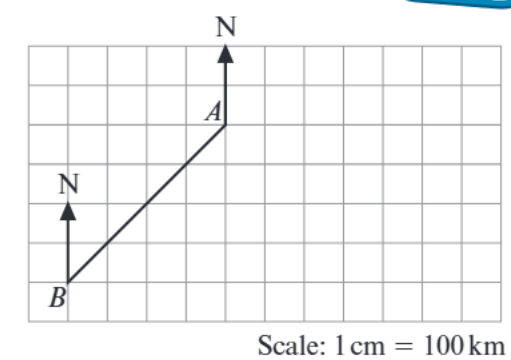
When using coordinate grids for bearing problems:
Note
Grid and Scale Tips
- Use the scale to calculate actual distances (e.g., 1 cm = 100 km)
- Mark north arrows at each point
- Measure angles carefully using a protractor
- Remember that grid lines can help you identify right angles (90°)
Exam tips
Important
Essential Exam Strategies
- Always check your three-figure bearing - Write 010°, not 10°
- Show your working - Add up angles step by step
- Use alternate angles - When lines are parallel, alternate angles are equal
- Draw clear diagrams - Include north arrows and label angles clearly
- Check reverse bearings - Use the add/subtract 180° rule
Remember!
Summary
Key Points to Remember:
- Bearings are always measured clockwise from north
- All bearings must be written as three-figure numbers
- To find a reverse bearing, add or subtract 180°
- The angle between consecutive compass points is 45°
- Show your working clearly in exam questions for full marks