Circle Geometry (AQA GCSE Maths): Revision Notes
📚Revision Notes
Circle geometry
Circle geometry is a fundamental area of mathematics that deals with the properties and relationships of circles, their parts, and the angles formed within them. Understanding these concepts is crucial for solving various geometric problems and proofs.
Note
Circle geometry combines algebraic principles with visual geometric relationships, making it essential to understand both the theoretical rules and their practical applications in problem-solving.
Essential circle theorems
There are nine key theorems that form the foundation of circle geometry. These rules help us understand the relationships between different parts of a circle and solve complex problems step by step.
Tangent and radius relationship
When a tangent line touches a circle, it always meets the radius at exactly 90 degrees. This fundamental relationship occurs because a tangent only touches the circle at one point, creating a perpendicular intersection with the radius drawn to that point. This property is particularly useful when proving that certain lines are tangents or when calculating angles in geometric constructions.
Important
Key Rule 1: A tangent and a radius meet at - this is one of the most frequently used theorems in circle geometry problems.
Isosceles triangles from radii
Any two radii of a circle will always form an isosceles triangle when connected to each other. This happens because all radii of a circle are equal in length by definition. Unlike other isosceles triangles, these triangles formed by radii don't need tick marks to show equal sides - the fact that both lines are radii is sufficient proof of equality.
Perpendicular bisector of chords
The perpendicular bisector of any chord will always pass through the centre of the circle. This means that if you draw a line that cuts a chord exactly in half at a right angle, that line will go directly through the circle's centre. A chord is any line drawn across a circle, and this property is useful for finding the centre of a circle when only a chord is known.
Central and circumferential angles
The angle formed at the centre of a circle is always twice the size of the angle formed at the circumference when both angles are subtended by the same arc. This relationship is fundamental to many circle geometry problems. The angle at the centre is exactly double the angle at the circumference when both angles are formed by the same two points on the circle's edge.
Important
Key Rule 4: The angle at the centre is the angle at the circumference for the same arc. This is mathematically expressed as:
Angles in semicircles
Any angle formed in a semicircle is always 90 degrees. This occurs when a triangle is drawn using a diameter as one side, with the third vertex anywhere on the circle's circumference. No matter where you place the third point on the circle, the angle will always be exactly .
Equal angles in the same segment
All angles formed in the same segment of a circle are equal. This means that if you draw multiple triangles from the same chord, with their third vertices anywhere on the same side of the chord, all the angles touching the circumference will be identical. Additionally, the two angles on opposite sides of the chord will always add up to .
Opposite angles in cyclic quadrilaterals
In a cyclic quadrilateral (a four-sided shape where all corners touch the circle), opposite angles always add up to 180 degrees. This property applies to any quadrilateral that can be inscribed in a circle, making it a powerful tool for solving angle problems.
Note
A cyclic quadrilateral is any four-sided polygon where all four vertices lie on the circumference of a circle. This property makes the sum of opposite angles predictable and useful for calculations.
Equal tangents from external points
When two tangent lines are drawn from the same external point to a circle, these tangents are always equal in length. This creates two congruent right-angled triangles and is particularly useful in calculations involving tangent lengths.
Alternate segment theorem
The alternate segment theorem states that the angle between a tangent and a chord is always equal to the angle in the alternate segment. This is the angle formed on the opposite side of the chord from where the tangent touches the circle.
Applying circle theorems in practice
When solving circle geometry problems, you'll often need to use multiple theorems together. The key is to identify which theorems apply to your specific situation and work through them systematically.
For example, when dealing with a cyclic quadrilateral where you know one angle, you can use the fact that opposite angles sum to to find the opposite angle. Then you might apply the central angle theorem to find other angles in the same problem.
Example
Worked Example: Cyclic Quadrilateral Angles
Consider a problem where points A, B, C and D are on the circumference of a circle, and you know that angle ADC equals .
Step 1: Identify the quadrilateral type Since ABCD has all vertices on the circle, it's a cyclic quadrilateral.
Step 2: Apply the opposite angles rule In a cyclic quadrilateral, opposite angles sum to Therefore:
Step 3: Apply the central angle theorem (if needed) If we need the central angle, it would be:
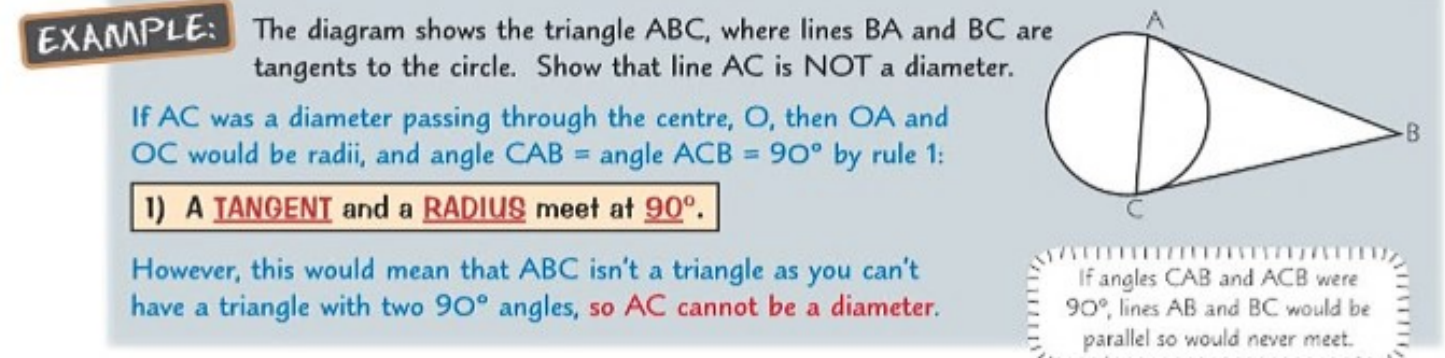 Sometimes you'll need to use proof by contradiction. This involves assuming the opposite of what you want to prove and showing that this leads to an impossible situation. For instance, if you want to prove that a line AC is not a diameter, you might assume it is a diameter and then show that this would create impossible angle relationships.
Note
Proof by Contradiction Strategy:
- Assume the opposite of what you want to prove
- Use known theorems to derive consequences
- Show that these consequences lead to a contradiction
- Conclude that your assumption must be false
The most effective approach is to try different theorems until you find one that works for your specific problem. Don't be afraid to combine multiple rules - this is often necessary for more complex questions.
Summary
Key Points to Remember:
- A tangent and radius always meet at , making this relationship fundamental to many proofs
- The angle at the centre is exactly double the angle at the circumference for the same arc
- All angles in a semicircle are , regardless of where the third vertex is positioned
- In cyclic quadrilaterals, opposite angles always sum to
- Tangents from the same external point are always equal in length, creating useful congruent triangles
- Multiple theorems are often needed to solve complex problems
- Proof by contradiction is a powerful technique when direct proof is difficult