Geometry (AQA GCSE Maths): Revision Notes
📚Revision Notes
Geometry - Fundamental angle rules
Understanding these essential angle rules is crucial for solving geometry problems. These five simple rules form the foundation of most geometric calculations involving angles.
The five essential angle rules
1. Angles in a triangle sum to 180°
The sum of all interior angles in any triangle always equals 180 degrees. This rule applies to all triangles, regardless of their shape or size.
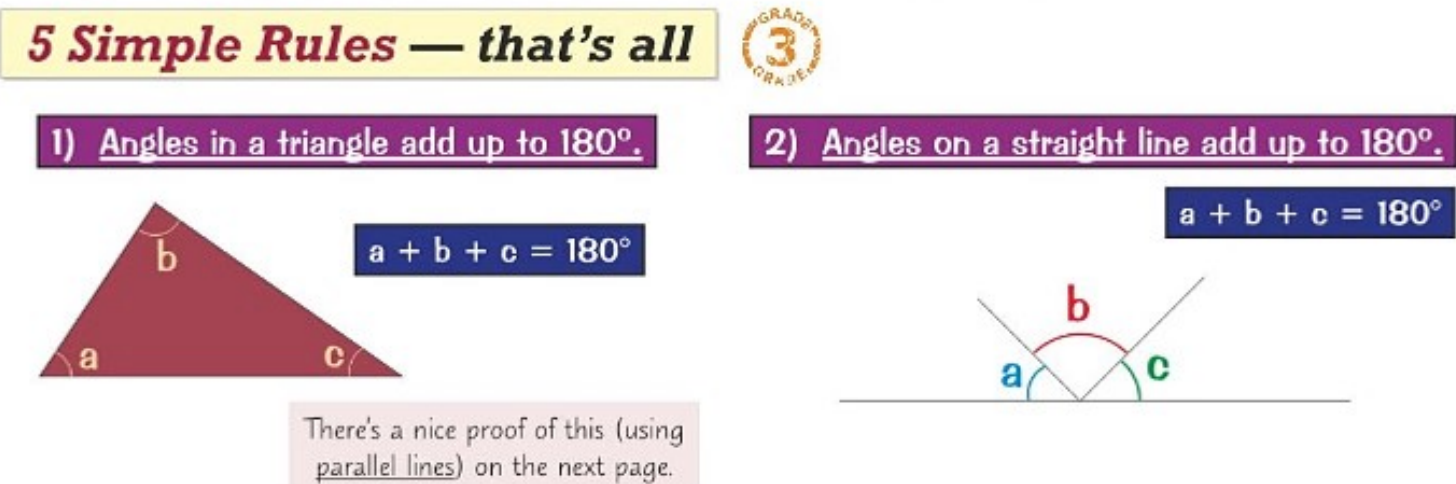
If you have a triangle with angles a, b, and c, then:
Note
This means if you know two angles in a triangle, you can always find the third by subtracting the sum of the known angles from 180°.
2. Angles on a straight line sum to 180°
When you have angles that sit next to each other on a straight line, they will always add up to 180 degrees. This makes sense because a straight line represents half of a full rotation.
Using the same formula:
This rule is particularly useful when dealing with angles formed by intersecting lines or when working with supplementary angles.
3. Angles in a quadrilateral sum to 360°
Any four-sided shape (quadrilateral) has interior angles that total 360 degrees. This includes squares, rectangles, parallelograms, trapeziums, and any other four-sided polygon.
Note
You can understand this rule by imagining that you could split any quadrilateral into two triangles by drawing a diagonal. Since each triangle has angles totalling 180°, the quadrilateral has angles totalling 180° + 180° = 360°.
4. Angles round a point sum to 360°
When several angles meet at a single point, they add up to 360 degrees. This represents a complete rotation around that point.
This rule is useful when dealing with angles formed by multiple lines meeting at a point or when working with sectors of circles.
5. Isosceles triangles have special properties
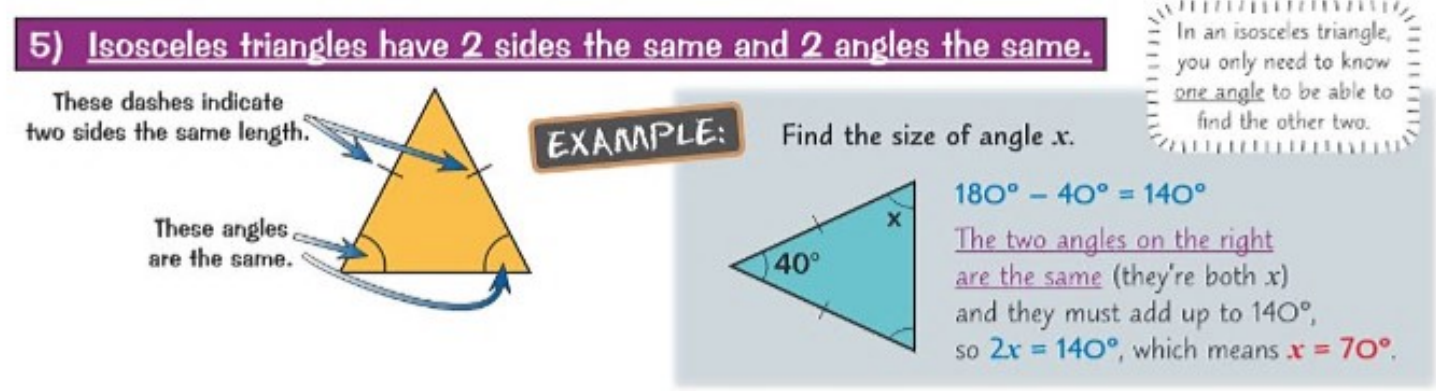
An isosceles triangle has two sides of equal length and two angles of equal size. This special property makes calculations much easier.
Important
In an isosceles triangle, once you know one angle, you can find the other two. The key insight is that the two angles opposite the equal sides are always equal to each other.
Working with isosceles triangles
Let's look at how to solve problems involving isosceles triangles. When you have an isosceles triangle with one known angle, you can find the unknown angles using the triangle angle sum rule.
Example
Worked Example: Finding Unknown Angles in an Isosceles Triangle
If you have an isosceles triangle with a 40° angle at the top:
Step 1: Find the sum of the remaining two angles The remaining two angles must sum to:
Step 2: Use the isosceles property Since these two angles are equal in an isosceles triangle:
Step 3: Solve for x Therefore:
This method works because you combine the isosceles property (two equal angles) with the triangle angle sum rule (all angles total 180°).
Applying the rules effectively
These rules often work together in geometry problems. You might need to use the straight line rule to find one angle, then use the triangle rule to find another. The key is to identify which rule applies to each part of the problem.
Note
Remember that these rules are fundamental - they're not just helpful shortcuts, but mathematical facts that are always true. When you're stuck on a geometry problem, check whether any of these five rules can help you find missing angles.
Summary
Key Points to Remember:
- Triangle angles always sum to 180° - this applies to every triangle
- Straight line angles always sum to 180° - useful for adjacent angles
- Quadrilateral angles always sum to 360° - any four-sided shape
- Angles round a point always sum to 360° - represents full rotation
- Isosceles triangles have two equal sides and two equal angles - once you know one angle, you can find the others