Loci and Construction (AQA GCSE Maths): Revision Notes
📚Revision Notes
Loci and construction
What is a locus?
A locus is essentially a line or region that contains all the points that satisfy a particular rule or condition. Think of it as a path or boundary that follows a specific mathematical pattern. To properly work with loci, you'll need to master using a ruler and compass for accurate constructions.
The four main types of loci
Understanding these four fundamental types of loci will help you tackle most construction problems you'll encounter in your exams.
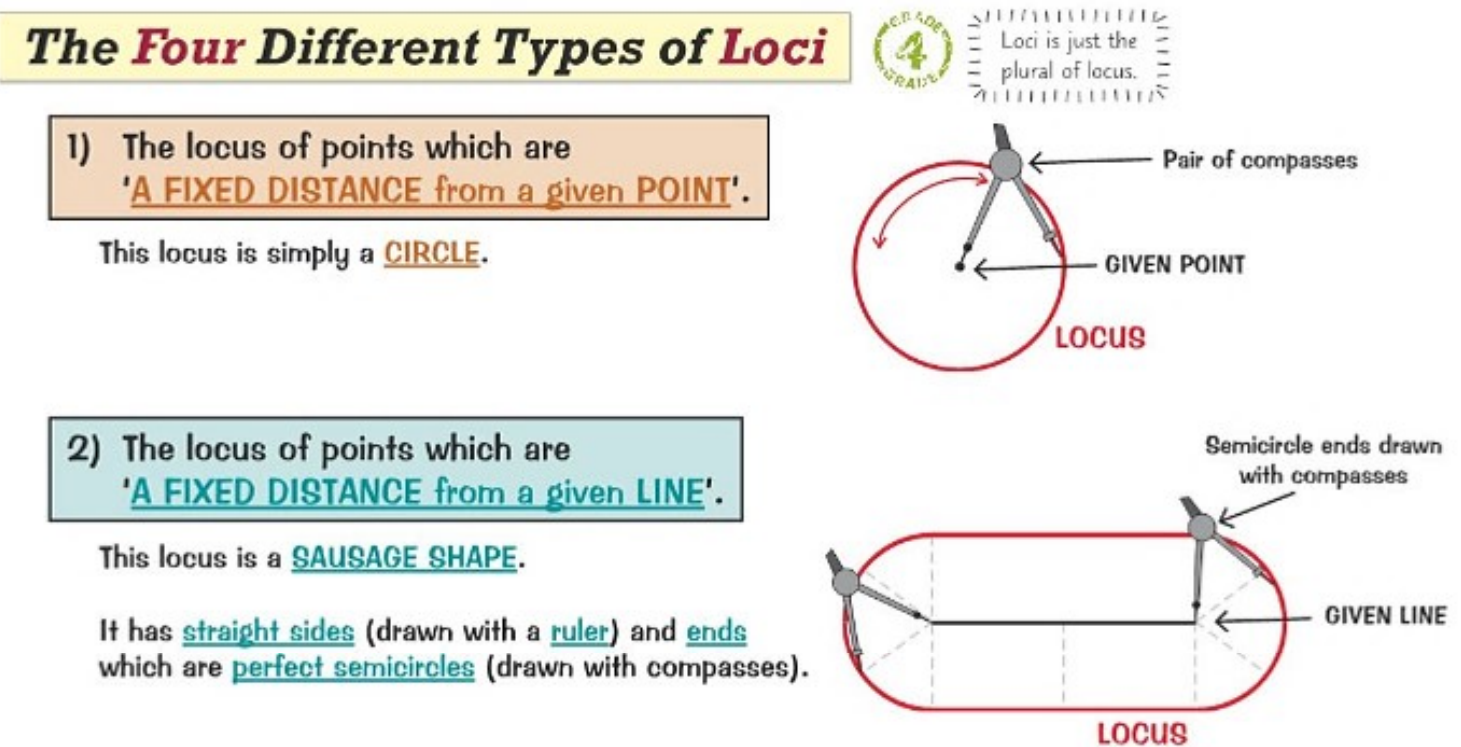
Type 1: Fixed distance from a point
When you need to find all points that are exactly the same distance from a given point, the result is always a circle. The given point becomes the centre of the circle, and the fixed distance becomes the radius.
Note
To construct this locus, you simply place your compass point on the given point, set it to the required distance, and draw a complete circle.
Type 2: Fixed distance from a line
All points that are a fixed distance away from a given line create what's often called a "sausage shape". This shape consists of two straight parallel lines (one on each side of the original line) connected by semicircular ends.
The construction involves drawing parallel lines on both sides of the original line, then using your compass to create the rounded ends where the parallel lines would normally stop.
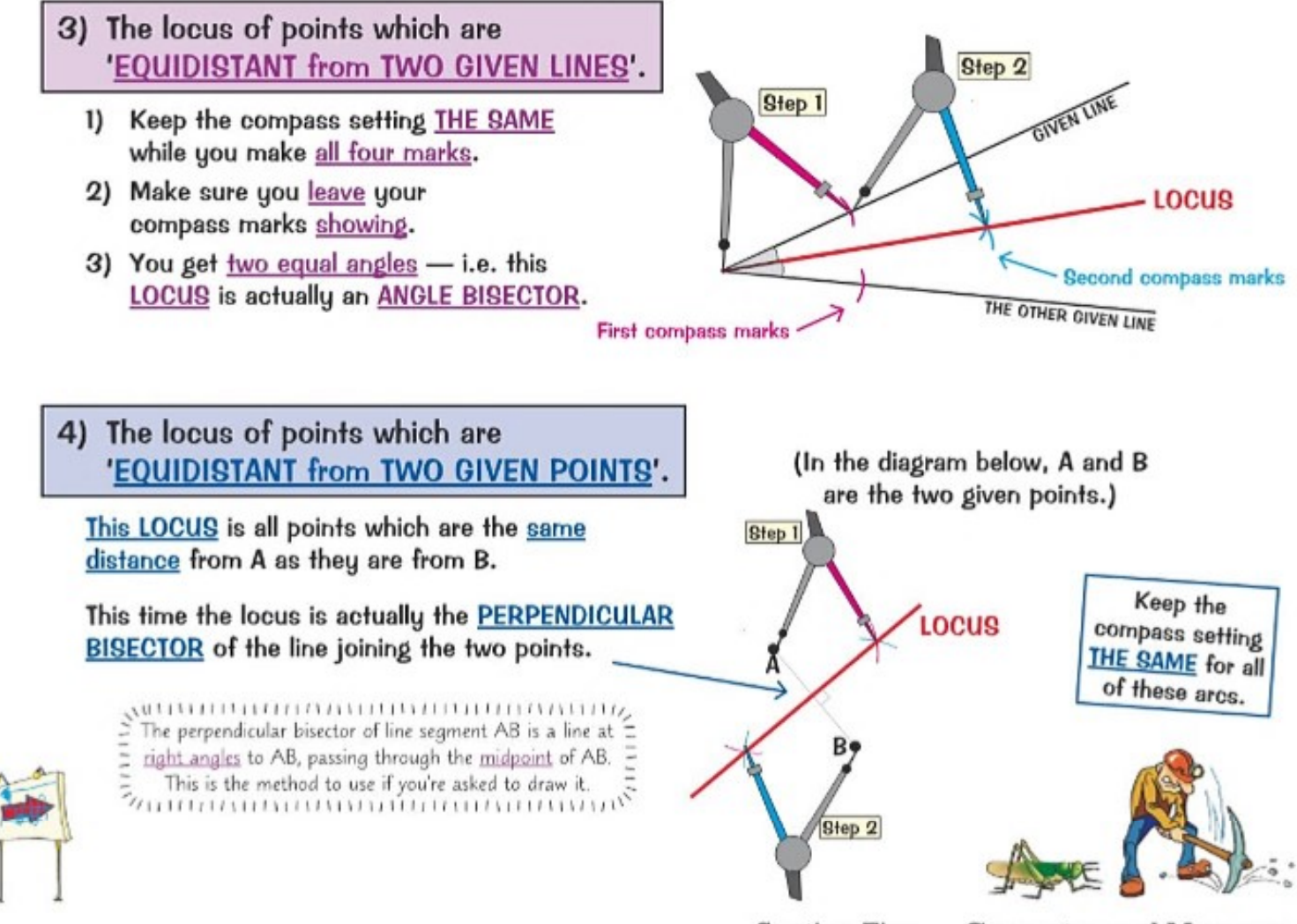
Type 3: Equidistant from two lines
When points are the same distance from two given lines, they form the angle bisector - a line that cuts the angle between the two lines exactly in half.
Example
Construction Method: Creating an Angle Bisector
Step 1: Make compass marks at the same distance from both lines Step 2: Keep your compass setting unchanged throughout Step 3: Connect the intersection points to create the angle bisector
Important
The key to successful angle bisector construction is maintaining a consistent compass setting whilst making marks from both lines.
Type 4: Equidistant from two points
Points that are the same distance from two given points form the perpendicular bisector of the line segment joining those points. This is a straight line that passes through the midpoint of the segment and meets it at a right angle.
The construction involves making compass arcs from both points with the same radius, then connecting where these arcs intersect to form the perpendicular bisector.
Constructing accurate angles
Creating 60° angles
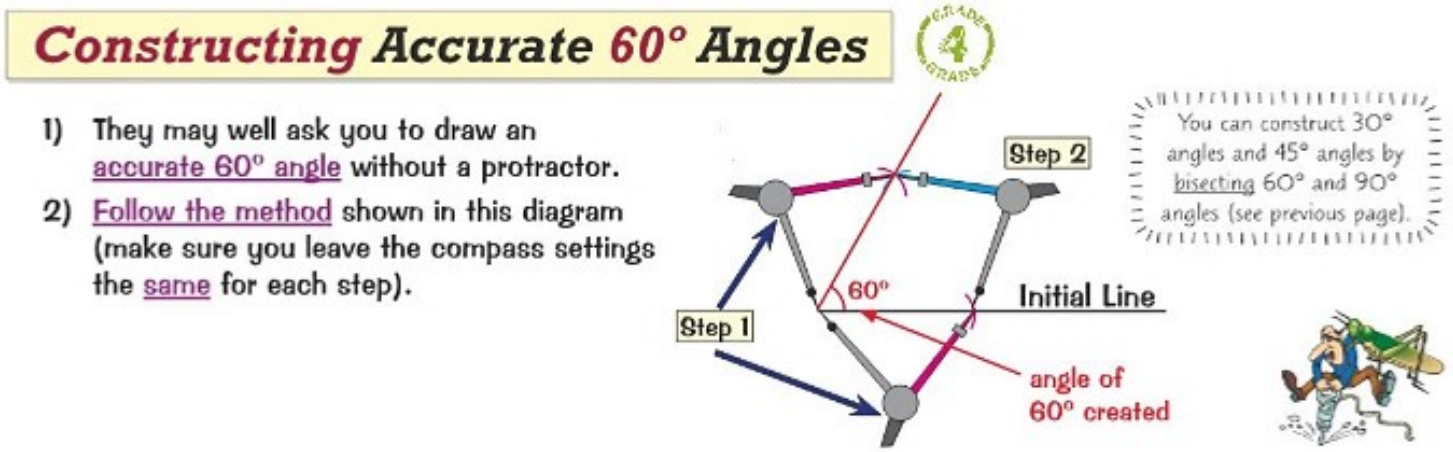
You can construct an accurate 60° angle without using a protractor by following this compass method:
Example
Construction Method: Creating a 60° Angle
Step 1: Start with an initial line Step 2: Use your compass to create an arc from one end of the line Step 3: Keep the same compass setting and make another arc from where the first arc crosses the line Step 4: The angle formed between the original line and the line connecting to this second intersection point will be exactly 60°
Creating 90° angles
For constructing right angles, the process involves creating perpendicular lines using compass arcs:
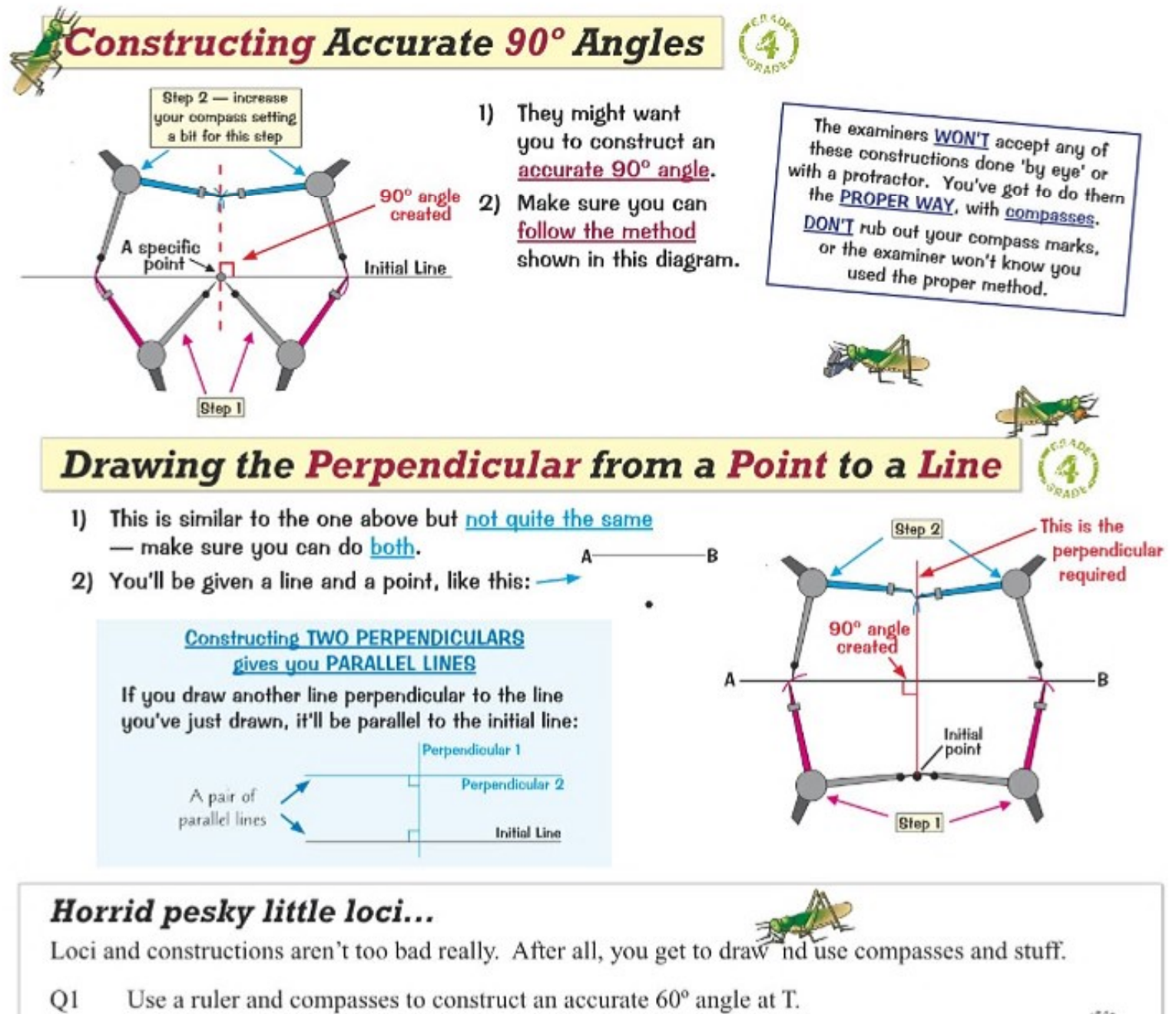 The method requires making arcs from a specific point, then using these intersection points to create a perfect 90° angle. This technique is essential for many geometric constructions.
Drawing perpendiculars from a point to a line
Sometimes you need to draw a line from a given point that meets another line at exactly 90°. This construction is similar to creating a right angle but starts from a point rather than from a line.
Note
The process involves making compass arcs from the given point to intersect the line, then using these intersection points to construct the perpendicular.
Important construction tips
Important
Essential Construction Rules:
- Always use a ruler and compass for accurate constructions
- Keep your compass settings consistent throughout each construction
- Leave your construction marks visible - examiners need to see your working
- Practice these constructions regularly to build muscle memory
- Don't rub out your compass marks, as they show your method
Summary
Key Points to Remember:
- A locus is a line or region showing all points that fit a specific rule
- Fixed distance from a point creates a circle
- Fixed distance from a line creates a sausage shape with straight sides and semicircular ends
- Equidistant from two lines forms an angle bisector
- Equidistant from two points creates a perpendicular bisector