Polygons (AQA GCSE Maths): Revision Notes
📚Revision Notes
Polygons
What is a polygon?
A polygon is a closed shape made up of straight lines that connect to form multiple sides. Think of it as a "many-sided shape" where the sides are all straight lines that meet at corners called vertices. Polygons can be found everywhere around us - from the triangular shape of a roof to the rectangular shape of a door.
Note
Real-world polygon examples:
- Triangular roof structures
- Rectangular doors and windows
- Hexagonal honeycomb patterns
- Octagonal stop signs
- Pentagon-shaped buildings
Polygons come in two main types: regular and irregular. Understanding the difference between these is crucial for solving polygon problems.
Regular vs irregular polygons
Regular polygons are the "perfect" polygons where all sides have exactly the same length and all angles are identical. These shapes have a balanced, symmetrical appearance that makes them particularly useful in mathematics and design.
Irregular polygons are shapes where the sides have different lengths or the angles are different sizes. Most real-world polygons tend to be irregular, but regular polygons are important for understanding mathematical principles and calculations.
Important
Key Difference:
- Regular: All sides equal length AND all angles equal size
- Irregular: Sides or angles (or both) are different sizes
Common regular polygons
Here are the most important regular polygons you need to know, each with their proper mathematical names:
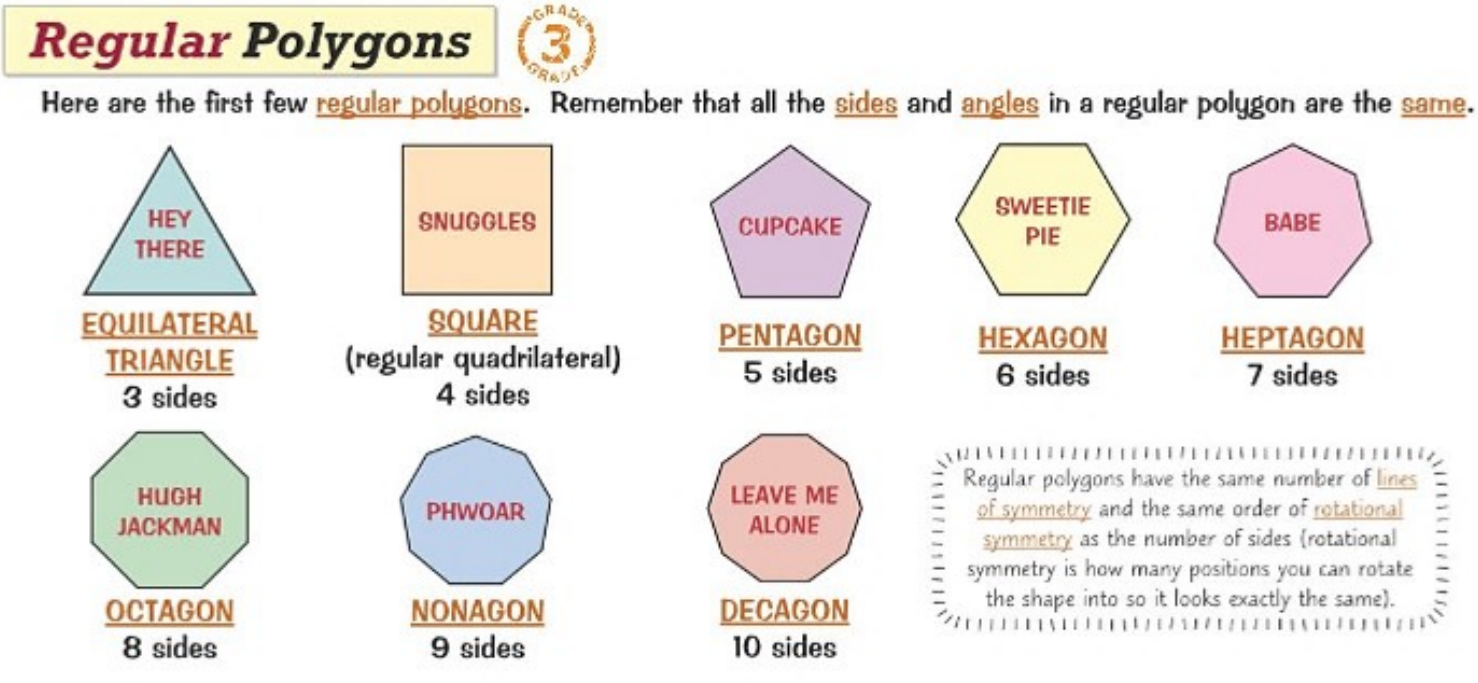
- Triangle (3 sides): Also called an equilateral triangle when regular
- Square (4 sides): A regular quadrilateral with four equal sides and right angles
- Pentagon (5 sides): Like the famous Pentagon building in America
- Hexagon (6 sides): Often seen in honeycomb patterns and nuts and bolts
- Heptagon (7 sides): Less common but still important to recognise
- Octagon (8 sides): Commonly seen in stop signs
- Nonagon (9 sides): Sometimes called an enneagon
- Decagon (10 sides): A ten-sided regular polygon
Regular polygons have special properties including lines of symmetry and rotational symmetry. The number of lines of symmetry equals the number of sides, and the rotational symmetry means you can rotate the shape and it will look exactly the same at regular intervals.
Interior and exterior angles
Understanding angles in polygons is essential for solving many geometry problems. Every polygon has two types of angles that work together in predictable ways.
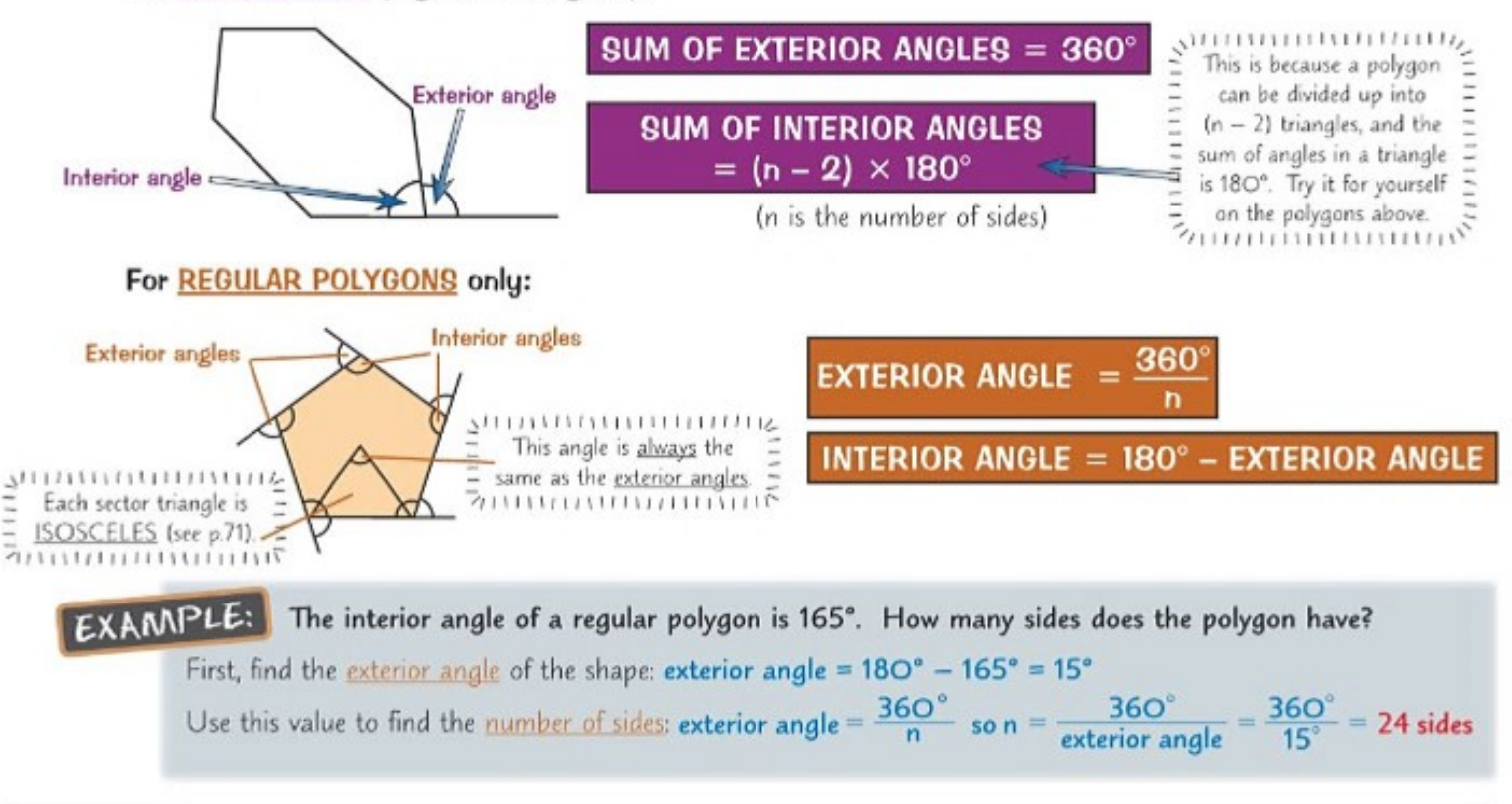
Interior angles are the angles inside the polygon, measured between two adjacent sides. Exterior angles are formed when you extend one side of the polygon outward - they're the angles between this extended line and the next side of the polygon.
Important
Critical Relationship: Interior angle + Exterior angle = (a straight line)
These two types of angles are complementary, meaning they always add up to exactly .
Angle formulas for any polygon
Whether you're dealing with regular or irregular polygons, these fundamental formulas always apply:
Important
Sum of exterior angles =
This is true for any polygon, regardless of how many sides it has. If you walk around the outside of any polygon and measure how much you turn at each corner, those turns will always add up to a complete rotation.
Important
Sum of interior angles =
Where represents the number of sides. This formula works because any polygon can be divided into triangles, and since each triangle contains , we can calculate the total interior angle sum.
Special formulas for regular polygons
When dealing with regular polygons, we can use these additional formulas since all angles are equal:
Note
For Regular Polygons Only:
Exterior angle =
Since all exterior angles are equal in a regular polygon and they must sum to , each individual exterior angle equals divided by the number of sides.
Interior angle = exterior angle
This relationship comes from the fact that interior and exterior angles are supplementary (they add up to ).
Worked example
Example
Worked Example: Finding the Number of Sides
Problem: "The interior angle of a regular polygon is . How many sides does the polygon have?"
Step 1: Find the exterior angle Exterior angle =
Step 2: Use the exterior angle formula Since exterior angle = , we can rearrange to find :
Answer: The polygon has 24 sides.
Summary
Key Points to Remember:
- A polygon is a many-sided shape made of straight lines
- Regular polygons have equal sides and angles; irregular polygons don't
- The sum of exterior angles is always for any polygon
- The sum of interior angles equals where is the number of sides
- For regular polygons: exterior angle = and interior angle = exterior angle
- Interior and exterior angles always add up to