Similar Shapes (AQA GCSE Maths): Revision Notes
📚Revision Notes
Similar shapes
What are similar shapes?
Similar shapes are shapes that have the same angles but different sizes. The shapes look identical but one is larger or smaller than the other. When working with similar shapes, you need to be able to recognise them and find missing lengths and angles.
In GCSE maths, you'll mainly work with similar triangles. These triangles have the same shape but different sizes, with all corresponding angles equal and all corresponding sides in the same ratio.
Conditions for similar triangles
There are three ways to prove that triangles are similar. Understanding these conditions is essential for identifying when triangles share the same shape properties.
Important
Three Conditions for Similar Triangles:
Condition 1: All three pairs of angles are equal (AAA) When all corresponding angles in two triangles are identical, the triangles must be similar.
Condition 2: All three pairs of sides are in the same ratio (SSS) When the ratios of all corresponding sides are equal, the triangles are similar.
Condition 3: Two sides are in the same ratio and the included angle is equal (SAS) When two pairs of corresponding sides have the same ratio and the angle between them is equal, the triangles are similar.
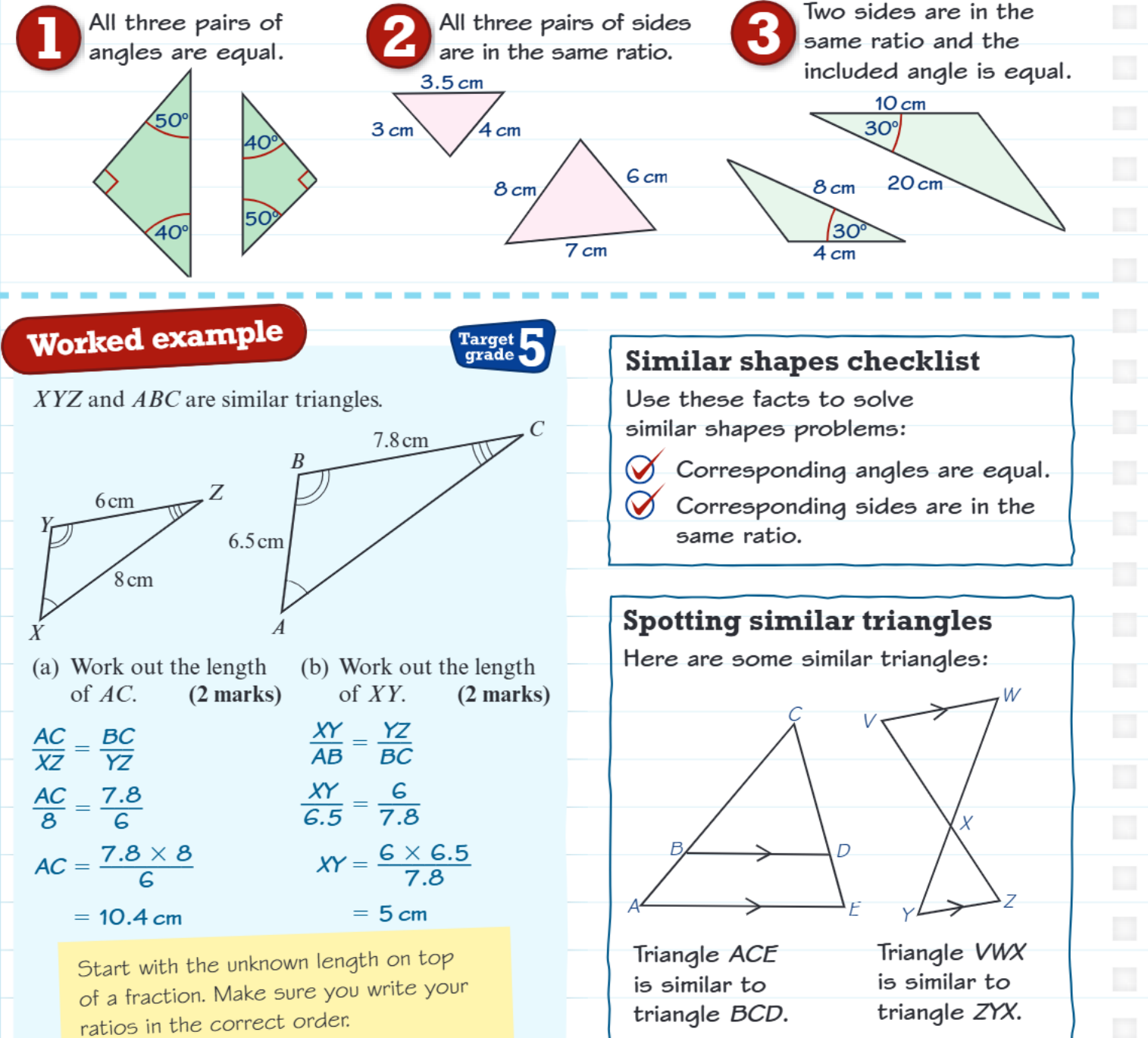
Working with similar triangles
When you know triangles are similar, you can use ratios to find missing lengths. The key principle is that corresponding sides are always in the same ratio.
Example
Worked Example: Finding Missing Length
Given: Triangle ABC is similar to triangle XYZ
- AC = 6 cm, XZ = 9 cm
- BC = 4 cm, YZ = ?
Step 1: Set up the ratio using corresponding sides
Step 2: Substitute the known values
Step 3: Cross multiply
Step 4: Solve for YZ cm
Setting up ratios correctly
The most important step is setting up your ratios in the correct order. Always write corresponding sides in the same position in your fractions.
Note
Ratio Setup Rule:
If you're comparing triangle ABC to triangle XYZ:
- AC corresponds to XZ
- BC corresponds to YZ
- AB corresponds to XY
So you would write:
Remember: Keep corresponding sides in the same order to avoid confusion!
Solving for missing lengths
Once you've set up your ratio correctly, you can solve for the unknown length using cross multiplication:
- Identify which sides correspond to each other
- Set up the ratio with the unknown length on top
- Cross multiply to solve
- Calculate the final answer
Remember that you can use any pair of corresponding sides to find the ratio, then apply this ratio to find other missing lengths.
Spotting similar triangles
Sometimes similar triangles appear within larger, more complex figures. You need to develop skills to identify these hidden relationships.
Note
What to Look For:
- Parallel lines that create similar triangles
- Common angles where triangles share vertices
- Proportional sides that suggest similarity
When triangles overlap or are positioned within other shapes, look carefully at the angle markings and side relationships to identify which triangles might be similar.
The key is to examine the geometric relationships within complex figures and identify triangular shapes that might share the same angle properties or proportional side lengths.
Exam tips and techniques
Understanding the theory is important, but exam success requires specific techniques and awareness of common pitfalls.
Important
Critical Exam Techniques:
Key facts for similar shapes problems:
- Corresponding angles are equal
- Corresponding sides are in the same ratio
Essential technique: Always start with the unknown length on top of your fraction when setting up ratios. This makes your calculation clearer and reduces errors.
Common mistake to avoid: Make sure you write your ratios in the correct order - keep corresponding sides in the same positions in your fractions.
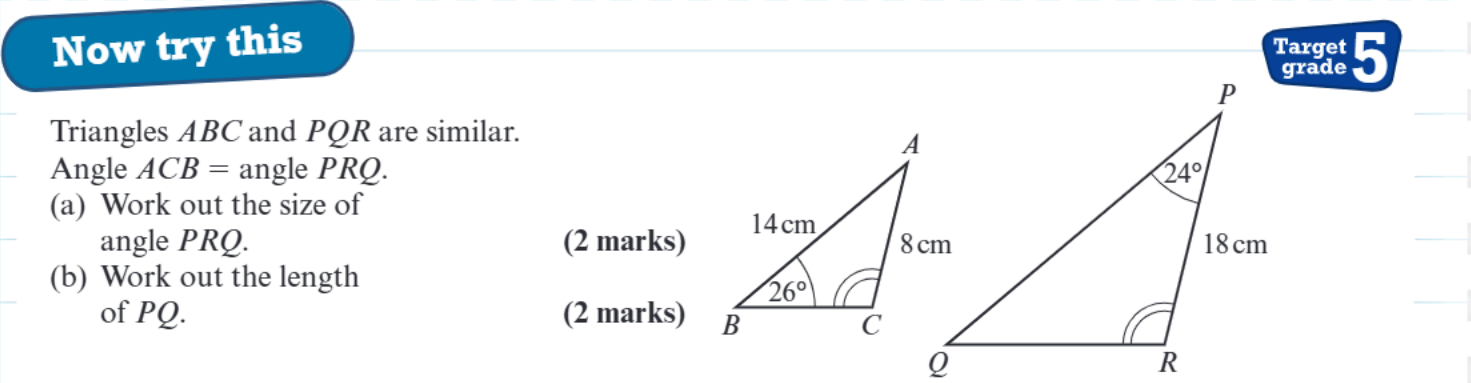
Summary
Practice Approach - Step-by-Step Method:
When tackling similar triangle problems:
- Identify which triangles are similar
- Label corresponding vertices clearly
- Set up your ratio with corresponding sides
- Solve using cross multiplication
- Check your answer makes sense
For angle problems, remember that corresponding angles in similar triangles are always equal.
Summary
Key Points to Remember:
- Similar shapes have the same angles but different sizes
- Three conditions prove triangle similarity: AAA, SSS, or SAS
- Corresponding sides are always in the same ratio
- Set up ratios carefully with corresponding sides in the same order
- Use cross multiplication to solve for unknown lengths