The Four Transformations (AQA GCSE Maths): Revision Notes
📚Revision Notes
The Four Transformations
Understanding geometric transformations is essential for GCSE mathematics. There are four main types you need to master: translation, rotation, reflexion, and enlargement. Each transformation changes the position or size of a shape in different ways, and knowing how to describe and perform these transformations accurately is crucial for your exam success.
What Makes Shapes Congruent
When we perform translations, rotations, and reflections, the shapes remain congruent. This means they keep exactly the same size and shape - only their position and orientation change.
Note
This is an important concept because it helps us understand that these three transformations preserve the fundamental properties of geometric figures. Only enlargements actually change the size of shapes.
Translations
A translation is the simplest transformation where we slide a shape from one position to another without rotating or flipping it. Think of it like moving a piece on a chess board - the piece stays the same, but its position changes.
When describing a translation, we use vector notation. The vector is written as where represents the horizontal movement and represents the vertical movement. If the shape moves to the right, is positive; if it moves left, is negative. Similarly, if the shape moves up, is positive; if it moves down, is negative.
Example
Worked Example: Describing a Translation
If a triangle moves 8 units to the left and 6 units up, we would describe this as a translation by the vector .
The negative sign for the -component indicates leftward movement, whilst the positive -component indicates upward movement.
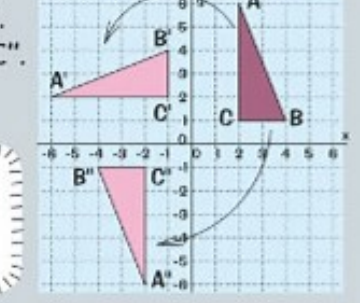 This coordinate plane shows several triangular transformations that help illustrate how shapes can be moved, rotated, and reflected whilst maintaining their essential properties.
Rotations
Rotations involve turning a shape around a specific point, and they require more precision in their description. Unlike translations, you must provide three specific details when describing a rotation:
- Angle of rotation (typically 90° or 180°, though other angles are possible)
- Direction of rotation (clockwise or anticlockwise)
- Centre of rotation (the fixed point around which the shape turns)
Important
The direction of rotation is crucial for accurately describing the transformation. For 90° rotations, the direction is absolutely essential and will give completely different results.
Note
A helpful tip for rotations of 180° is that the direction doesn't matter - whether you rotate 180° clockwise or anticlockwise, you'll end up in the same position.
When working with rotations, tracing paper can be incredibly useful. You can use it to help identify the centre of rotation by finding the point that remains fixed during the transformation.
Reflections
Reflections create mirror images of shapes across a line called the mirror line or line of reflexion. To describe a reflexion completely, you must provide the equation of the mirror line.
Common mirror lines include:
- The x-axis:
- The y-axis:
- Diagonal lines: or
When a shape is reflected, every point on the original shape has a corresponding point on the reflected shape that is the same distance from the mirror line but on the opposite side.
Example
Worked Example: Reflexion Across the y-axis
If shape A is reflected across the y-axis to create shape B, then shape A and shape B are mirror images of each other. The y-axis (equation: ) serves as the line of symmetry between them.
Enlargements
Enlargements are different from the other three transformations because they change the size of the shape, not just its position or orientation. This means that enlarged shapes are similar to the original, but not congruent.
Important
Enlargements are the only transformation that changes the size of shapes. This means enlarged shapes are similar to the original shape, but not congruent like the other three transformations.
To describe an enlargement, you need two pieces of information: the scale factor and the centre of enlargement. The scale factor tells us how much bigger or smaller the new shape is compared to the original. We calculate this using the formula:
The centre of enlargement is the fixed point from which the enlargement takes place. To find the centre of enlargement, you can draw lines connecting corresponding vertices of the original and enlarged shapes - these lines will all pass through the centre of enlargement.
When performing an enlargement, you can draw lines from the centre of enlargement through each vertex of the original shape. The distance from the centre to each new vertex is the scale factor multiplied by the distance from the centre to the corresponding original vertex.
Understanding Scale Factors
Scale factors have several important properties that are worth memorising:
Note
Key Facts About Scale Factors:
- If the scale factor is greater than 1, the shape becomes bigger
- If the scale factor is less than 1 (such as ), the shape becomes smaller
- When the scale factor is negative, the shape appears on the opposite side of the centre of enlargement
- A scale factor of -1 is particularly special because it produces the same result as a 180° rotation
The scale factor also helps you determine the relative distances between corresponding points. This is extremely useful when drawing enlargements because you can use the scale factor to calculate exactly where each new vertex should be positioned.
Working with Transformations Step by Step
When working with transformation problems, it's helpful to approach them systematically. For enlargements with negative scale factors, start by drawing lines from the centre of enlargement through each vertex of the original shape. Then multiply the distance from each vertex to the centre by the scale factor, and measure this distance on the opposite side of the centre to find the new vertex positions.
Note
Helpful Strategy for Multiple Transformations:
If you need to perform multiple transformations, you should complete them one at a time in the correct order. Each transformation uses the result of the previous one as its starting point.
Remember that if you need to perform multiple transformations, you should complete them one at a time in the correct order. Each transformation uses the result of the previous one as its starting point.
Summary
Key Points to Remember:
- Translation moves shapes using vectors - shapes stay congruent
- Rotation needs three details: angle, direction, and centre of rotation
- Reflection creates mirror images across a line - you must give the line's equation
- Enlargement changes size using scale factors and centres - shapes become similar, not congruent
- Scale factors greater than 1 make shapes bigger, less than 1 make them smaller, and negative values flip them to the opposite side