Decimals and place value (AQA GCSE Maths): Revision Notes
📚Revision Notes
Decimals and place value
Understanding place value in decimals
Place value tells you what each digit in a number is worth based on its position. This concept becomes especially important when working with decimal numbers.
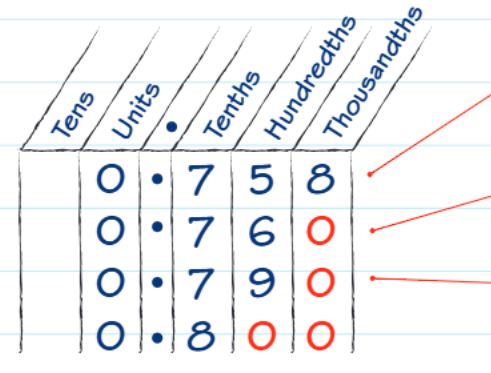
In decimal numbers, each position has a specific value:
- Tens - worth 10 times more than units
- Units - the whole number part
- Tenths - the first decimal place (0.1)
- Hundredths - the second decimal place (0.01)
- Thousandths - the third decimal place (0.001)
Important
A key point to remember is that having more digits doesn't automatically make a decimal number larger. For example, is actually greater than because the tenths place is more significant.
Comparing decimal numbers
When comparing decimals, you need to look at each place value column systematically, starting from the left.
Note
To compare decimal numbers effectively:
- Start with the tenths column
- If the tenths are the same, move to the hundredths
- Continue this process until you find a difference
- The number with the larger digit in the first different place is greater
For instance, when comparing and :
- Both have 7 in the tenths place
- Both have 6 in the hundredths place
- has no digit in the thousandths (equivalent to 0), while has 8
- Since , we have
Wait, that's incorrect based on the image. Let me reconsider: , and because in the thousandths place, is wrong - actually means 6 hundredths and 0 thousandths, while means 5 hundredths and 8 thousandths. Since in the hundredths place, .
Ordering decimal numbers
When putting decimal numbers in order, follow a systematic approach:
Note
Method for ordering decimals:
- Write out all the numbers clearly
- Compare the tenths place first
- If tenths are equal, compare hundredths
- Continue comparing place values until you can order them
- Cross out each number as you place it to avoid confusion
Example
Worked Example: Ordering Decimal Numbers
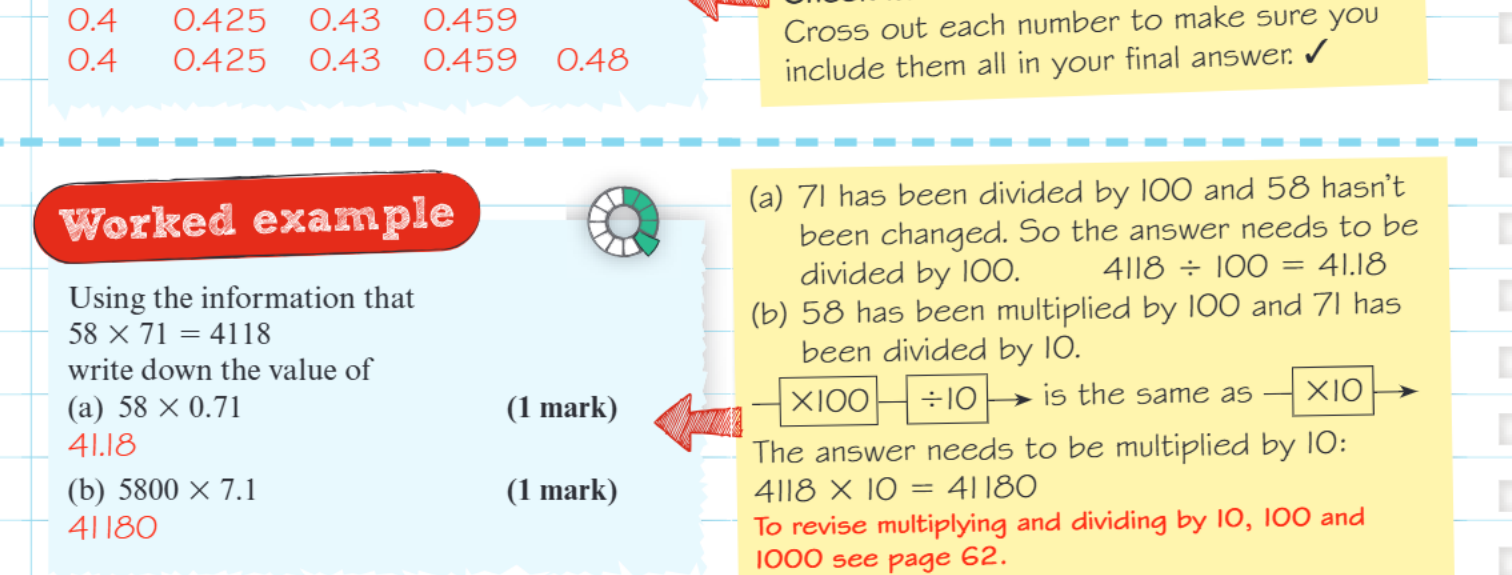
Order , , , , from smallest to largest
Solution:
- (smallest - only 4 tenths)
- (next - 4 tenths, 2 hundredths, 5 thousandths)
- (4 tenths, 3 hundredths)
- (4 tenths, 5 hundredths, 9 thousandths)
- (largest - 4 tenths, 8 hundredths)
Working with powers of 10
Understanding how decimal numbers change when multiplied or divided by 10, 100, or 1000 is crucial for many calculations.
Note
Key rules:
- Multiplying by 10 moves the decimal point one place right
- Multiplying by 100 moves the decimal point two places right
- Dividing by 10 moves the decimal point one place left
- Dividing by 100 moves the decimal point two places left
Example
Worked Example: Using Powers of 10
If , find: (a) (b)
Solution: (a) 71 has been divided by 100, so the answer must be divided by 100
(b) 58 has been multiplied by 100, so the answer must be multiplied by 100
Wait, let me check this again. Looking at the image: (b) shows , which means 58 was multiplied by 100 and 71 was divided by 10, so the overall effect is multiplication by 10: .
Summary
Exam Tips:
- Always write trailing zeros to help compare decimals (e.g., write as )
- Cross out numbers as you order them to keep track
- Check your work by ensuring your ordered list makes sense
- Remember that fewer decimal places doesn't mean a smaller number
Summary
Key Points to Remember:
- Place value determines the worth of each digit in a decimal number
- When comparing decimals, start from the leftmost place value and work right
- More digits doesn't necessarily mean a bigger number
- Adding zeros after the last decimal place doesn't change the value ()
- Moving decimal points follows predictable patterns when multiplying or dividing by powers of 10