HCF and LCM (AQA GCSE Maths): Revision Notes
📚Revision Notes
HCF and LCM
What are HCF and LCM?
Highest Common Factor (HCF) is the largest number that divides exactly into two or more given numbers without leaving a remainder.
Lowest Common Multiple (LCM) is the smallest number that is a multiple of two or more given numbers.
Note
Understanding these definitions is crucial - HCF looks for the biggest shared divisor, while LCM finds the smallest shared multiple. They represent opposite approaches to comparing numbers.
Prime factorisation method
To find HCF and LCM effectively, you need to express numbers as products of their prime factors first. This method provides the most systematic approach for complex calculations.
Breaking down numbers into prime factors
Start by creating a factor tree to find all prime factors of a number.
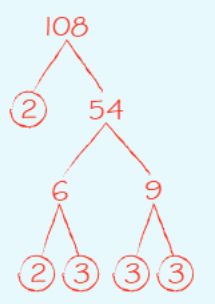
For example, 108 can be broken down as:
Note
Prime factorisation forms the foundation for both HCF and LCM calculations. Always ensure your factorisation is complete before proceeding to the next steps.
Once you have the prime factorisation, you can easily find HCF and LCM.
Using Venn diagrams to find HCF and LCM
A Venn diagram helps organise prime factors when working with two numbers, providing a clear visual method for identifying common and unique factors.
Steps to use the Venn diagram method:
- Write the prime factorisation of both numbers
- Draw two overlapping circles - one for each number
- Place common prime factors in the overlapping section (intersection)
- Place remaining factors in the separate parts of each circle
Finding HCF using Venn diagrams
The HCF equals the product of all prime factors in the intersection (the overlapping part).
Finding LCM using Venn diagrams
The LCM equals the product of all prime factors shown in the entire Venn diagram (both circles combined).
Important
Critical Understanding:
- HCF uses ONLY the intersection (shared factors)
- LCM uses EVERYTHING in the diagram (all factors needed)
- Missing this distinction is a common source of errors
Worked example
Example
Worked Example: Finding HCF and LCM of 108 and 240
Step 1: Express both numbers as products of prime factors
Step 2: Create a Venn diagram
- Common factors (intersection):
- Factors only in 108:
- Factors only in 240:
Step 3: Calculate results
- HCF =
- LCM =
Exam tips
Important
Essential Exam Strategies:
- Always express your final answers using index notation (powers) when the question asks for it
- Check your work by verifying that HCF × LCM = product of the two original numbers
- Remember that you don't need to calculate the actual numerical values - you can leave answers in prime factor form
- Make sure you include all prime factors when finding the LCM
Key processes summary
Summary
Step-by-Step Process:
- Prime factorise both numbers completely
- Identify common factors for HCF (intersection)
- Combine all factors for LCM (everything in the Venn diagram)
- Express answers using appropriate notation
Remember!
Summary
Key Points to Remember:
- HCF is found from the intersection of prime factors (what's common)
- LCM is found from all prime factors combined (everything needed)
- Prime factorisation is the foundation for both calculations
- Venn diagrams provide a clear visual method for organising factors
- Always double-check your prime factorisations before proceeding