Indices (AQA GCSE Maths): Revision Notes
📚Revision Notes
Indices
Indices are a mathematical way to represent repeated multiplication. They include square roots, cube roots and powers. Understanding the index laws is essential for simplifying mathematical expressions and solving complex problems.
What are indices?
Indices (also called powers or exponents) show how many times a number is multiplied by itself. In the expression , 'a' is called the base and 'n' is called the index or power.
Note
The terminology is important: in , the number 6 is the base (the number being multiplied), and 5 is the index/power/exponent (telling us how many times to multiply 6 by itself).
For example:
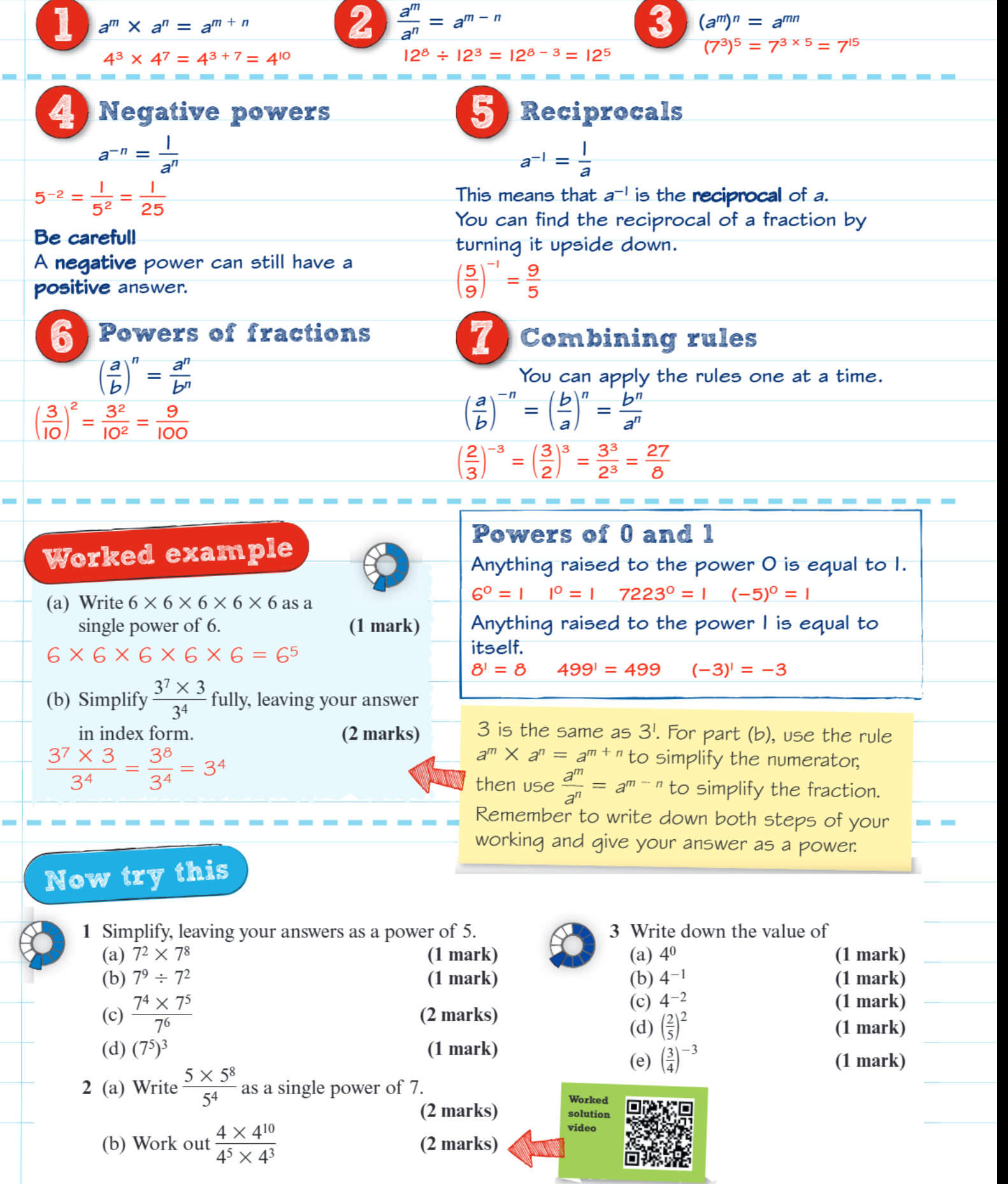
The seven index laws
Law 1: Multiplying powers with the same base
When you multiply powers that have the same base, you add the indices.
Formula:
Example:
This works because you're combining all the repeated multiplications together.
Law 2: Dividing powers with the same base
When you divide powers that have the same base, you subtract the indices.
Formula:
Example:
This works because division cancels out some of the repeated multiplications.
Note
A helpful memory aid: "Add when multiplying, subtract when dividing" - this helps you remember which operation to perform on the indices.
Law 3: Power of a power
When you raise a power to another power, you multiply the indices.
Formula:
Example:
This happens because you're repeating the original power multiple times.
Law 4: Negative powers
A negative power creates a reciprocal (fraction with 1 on top).
Formula:
Example:
Important
Be careful - a negative power can still give a positive answer depending on the base number. The negative sign in the power doesn't necessarily make the final answer negative.
Law 5: Reciprocals
The power of -1 gives you the reciprocal of the number.
Formula:
This means that is the reciprocal of a. You can find the reciprocal of a fraction by turning it upside down.
Example:
Law 6: Powers of fractions
When you raise a fraction to a power, you apply the power to both the numerator and denominator.
Formula:
Example:
Law 7: Combining rules
You can apply multiple rules in the same calculation, working through them one step at a time.
Example:
More complex example:
Note
When combining rules, work through them systematically, applying one rule at a time. This reduces the chance of making errors in complex calculations.
Powers of 0 and 1
These have special properties that you need to remember:
Power of 0
Important
Any number raised to the power 0 equals 1.
Examples:
Power of 1
Important
Any number raised to the power 1 equals itself.
Examples:
Worked example
Example
Worked Example: Simplifying Index Expressions
Question: Simplify , leaving your answer in index form.
Solution:
Step 1: Use law 1 to simplify the numerator
Step 2: Use law 2 to simplify the fraction
Answer:
Remember to write down both steps of your working and give your answer as a power when asked.
Exam tips
Note
Exam Success Tips:
- Always show your working clearly in exam questions
- When asked for index form, leave your answer as a power (don't calculate the final number)
- Check your signs carefully with negative powers
- Remember that 3 is the same as when applying the laws
- Use the rules one at a time for complex expressions
Summary
Key Points to Remember:
- Multiplying powers: Add the indices ()
- Dividing powers: Subtract the indices ()
- Power of a power: Multiply the indices ()
- Negative powers: Create reciprocals ()
- Special cases: Any number to power 0 equals 1, any number to power 1 equals itself