Operations on fractions (AQA GCSE Maths): Revision Notes
📚Revision Notes
Operations on fractions
This topic covers the four main operations you can perform with fractions: adding, subtracting, multiplying and dividing. Understanding these operations is essential for GCSE maths, and you need to be able to perform them accurately without a calculator.
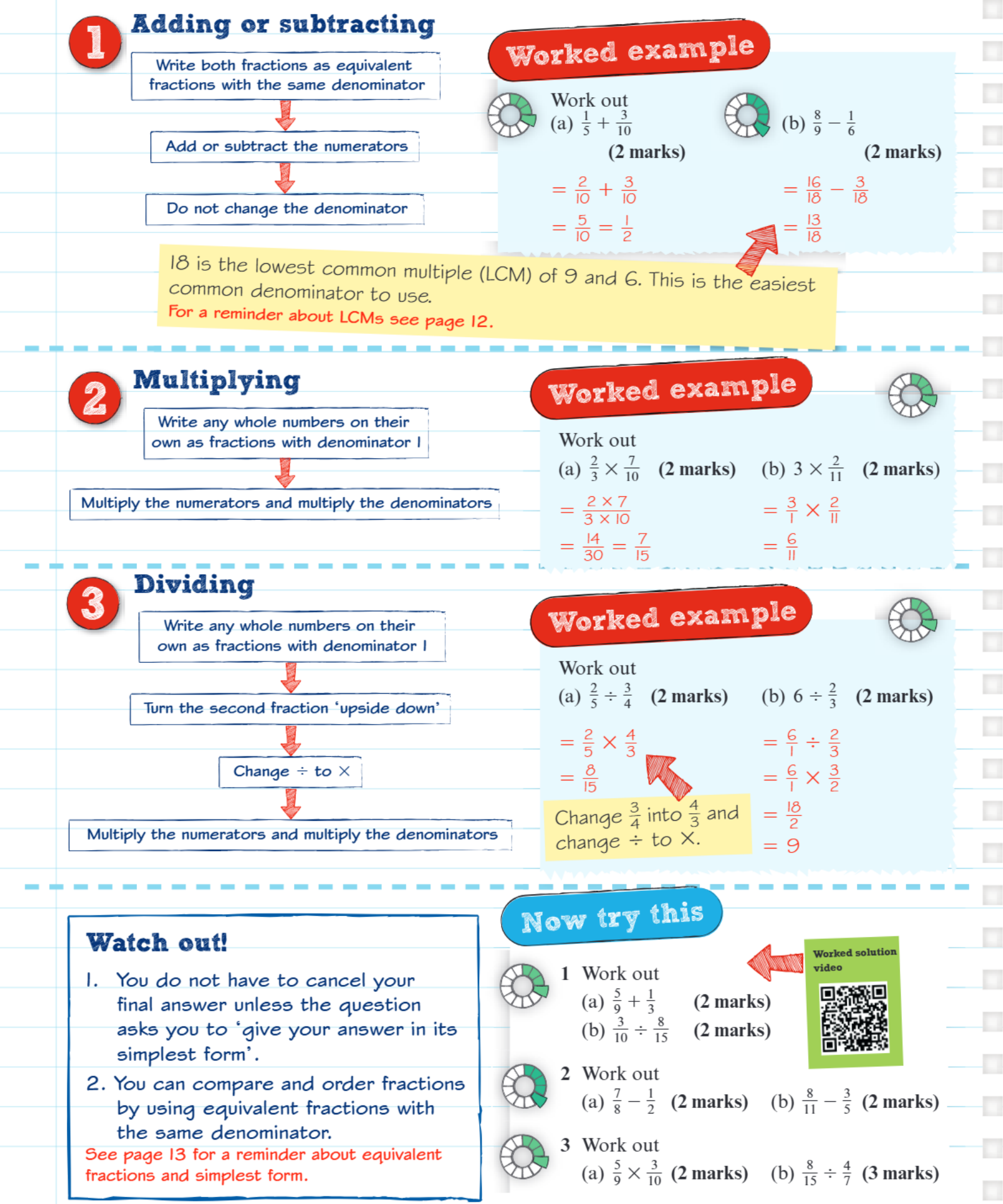
Adding or subtracting fractions
When adding or subtracting fractions, the key principle is that both fractions must have the same denominator before you can combine them.
Note
The denominator is the bottom number of a fraction, while the numerator is the top number. Having the same denominator means the fractions represent parts of the same-sized whole, making them possible to add or subtract directly.
Method for adding or subtracting fractions
-
Write both fractions as equivalent fractions with the same denominator
- Find the lowest common multiple (LCM) of the denominators
- This becomes your common denominator
-
Add or subtract the numerators only
- The numerators are the numbers on top of the fractions
- Keep the common denominator unchanged
-
Simplify your answer if possible
- Check if your answer can be written in its simplest form
Example
Worked Example: Adding fractions
To work out :
Step 1: Find the LCM of 2 and 10 The LCM of 2 and 10 is 10
Step 2: Convert to equivalent fractions
Step 3: Add the numerators
Step 4: Simplify
Example
Worked Example: Subtracting fractions
To work out :
Step 1: Find the LCM of 9 and 6 The LCM of 9 and 6 is 18
Step 2: Convert to equivalent fractions and
Step 3: Subtract the numerators
Multiplying fractions
Multiplying fractions is more straightforward than adding or subtracting because you don't need to find a common denominator.
Note
Unlike addition and subtraction, multiplication of fractions doesn't require equivalent fractions with the same denominator. This makes the process much simpler once you understand the method.
Method for multiplying fractions
-
Write any whole numbers as fractions
- Put the whole number over 1 (e.g., 3 = 3/1)
-
Multiply the numerators together
- Multiply all the top numbers
-
Multiply the denominators together
- Multiply all the bottom numbers
-
Simplify the result
- Cancel down to the simplest form if possible
Example
Worked Example: Multiplying fractions
To work out :
Step 1: Multiply numerators
Step 2: Multiply denominators
Step 3: Form the result
Step 4: Simplify (dividing both by 2)
Example
Worked Example: Multiplying with whole numbers
To work out :
Step 1: Write 3 as a fraction
Step 2: Multiply
Dividing fractions
Division of fractions uses a special technique that transforms the division into multiplication.
Note
The key to dividing fractions is remembering the phrase "flip and multiply". You flip the second fraction (find its reciprocal) and then multiply instead of dividing.
Method for dividing fractions
-
Write any whole numbers as fractions
- Put the whole number over 1
-
Turn the second fraction 'upside down'
- This means swap the numerator and denominator
- This is called finding the reciprocal
-
Change the division sign (÷) to multiplication (×)
-
Multiply the numerators and multiply the denominators
- Follow the same method as multiplying fractions
Example
Worked Example: Dividing fractions
To work out :
Step 1: Turn upside down Reciprocal of is
Step 2: Change ÷ to ×
Step 3: Multiply
Step 4: Simplify
Example
Worked Example: Dividing with whole numbers
To work out :
Step 1: Write 6 as a fraction
Step 2: Flip to get
Step 3: Multiply
Important exam tips
Important
Watch out for common mistakes!
- You don't have to simplify your final answer unless the question specifically asks for the answer in its simplest form
- You can compare and order fractions by converting them to equivalent fractions with the same denominator
- Always check your working - it's easy to make arithmetic errors with fractions
Summary
Key Points to Remember:
- For addition/subtraction: find a common denominator first
- For multiplication: multiply straight across
- For division: flip the second fraction and multiply
- Always look for opportunities to simplify your answer
Remember!
Summary
Essential Fraction Operations Summary:
- Adding and subtracting fractions requires finding a common denominator using the lowest common multiple (LCM) of the denominators
- Multiplying fractions is done by multiplying numerators together and denominators together - no common denominator needed
- Dividing fractions involves flipping the second fraction upside down and then multiplying
- Equivalent fractions with the same denominator make it easier to compare and order fractions
- Practice these operations regularly as they form the foundation for more complex fraction work in GCSE maths