Squares, cubes and roots (AQA GCSE Maths): Revision Notes
📚Revision Notes
Squares, cubes and roots
Squares and square roots
Square numbers are created when a number is multiplied by itself. You can write square numbers using index notation, where the small ² shows that the number is squared.
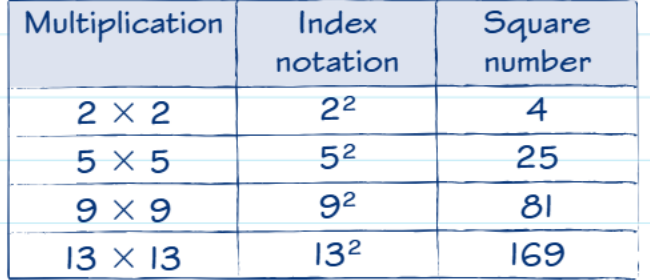
For example, . This means that 25 is a square number.
Square numbers have a practical meaning in the real world - they represent the areas of squares with whole number side lengths. A square with sides of 5 cm has an area of 25 cm².
Note
Real-world connection: Square numbers aren't just abstract mathematical concepts. Every time you calculate the area of a square room, garden, or any square shape, you're working with square numbers!
Square roots are the opposite operation of squaring. The square root symbol √ is used to show this. When you find the square root of a number, you're asking "what number multiplied by itself gives this result?"
Example
Worked Example: Finding Square Roots
- (because )
- (because )
- (because )
Important
You need to memorise the square numbers up to and their corresponding square roots for your exam. This is essential knowledge that cannot be looked up!
Cubes and cube roots
Cube numbers are created when a number is multiplied by itself twice. You can write cube numbers using index notation with a small ³.
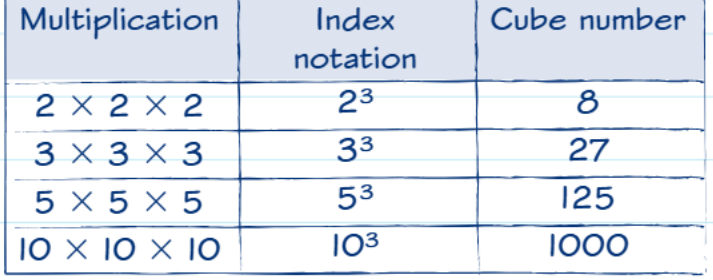
For example, . This means that 27 is a cube number.
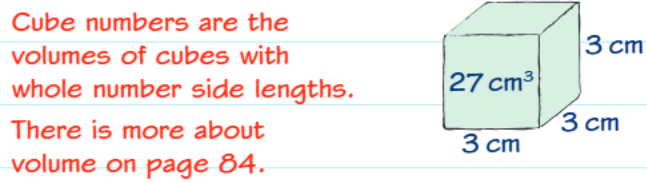
Cube numbers represent the volumes of cubes with whole number side lengths. A cube with sides of 3 cm has a volume of 27 cm³.
Note
Visual understanding: Just like square numbers relate to flat areas, cube numbers relate to 3D volumes. Think of building blocks or dice - their volumes are cube numbers when their sides are whole numbers.
Cube roots are the opposite operation of cubing. The cube root symbol ∛ is used to show this. When you find the cube root of a number, you're asking "what number multiplied by itself twice gives this result?"
Example
Worked Example: Finding Cube Roots
- (because )
- (because )
- (because )
Important
You need to memorise the cubes of 2, 3, 4, 5, and 10, along with their corresponding cube roots. These appear frequently in exam questions.
Working with squares, cubes and roots
Understanding the connection to prime numbers
Square numbers can never be prime numbers (except for some special cases). This is because a square number must have a factor other than 1 and itself - namely, its square root. For instance, 9 has factors 1, 3, and 9, so it cannot be prime.
Note
Why squares aren't prime: Think about it logically - if is a square number, then is always a factor of (other than 1 and the number itself). This automatically disqualifies it from being prime!
Common exam questions
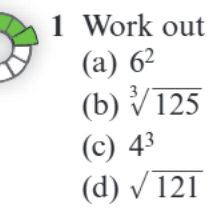
You should be able to calculate squares, cubes, and roots without using a calculator for the basic values you've memorised. Practice questions typically ask you to:
Example
Typical Exam Questions
- Work out squares like
- Find cube roots like
- Calculate cubes like
- Find square roots like
Exam tips
Important
Essential Exam Strategy
- Learn your square numbers up to
- Memorise cube numbers: , , , ,
- Remember that square roots and cube roots are the inverse operations
- When explaining your reasoning, use phrases like "Yes because..." or "No because..." and give mathematical justification
- Always check if your answer makes sense by working backwards
Remember!
Summary
Key Points to Remember
- Square numbers are formed by multiplying a number by itself ()
- Cube numbers are formed by multiplying a number by itself twice ()
- Square roots (√) and cube roots (∛) are the opposite operations of squaring and cubing
- Square numbers relate to areas of squares, cube numbers relate to volumes of cubes
- You must memorise key square and cube numbers for your GCSE exam - practice them regularly!