Standard form 2 (AQA GCSE Maths): Revision Notes
📚Revision Notes
Standard form 2
Standard form calculations allow you to work with very large or very small numbers efficiently. This topic covers the four basic operations (multiplication, division, addition, and subtraction) when working with numbers written in standard form.
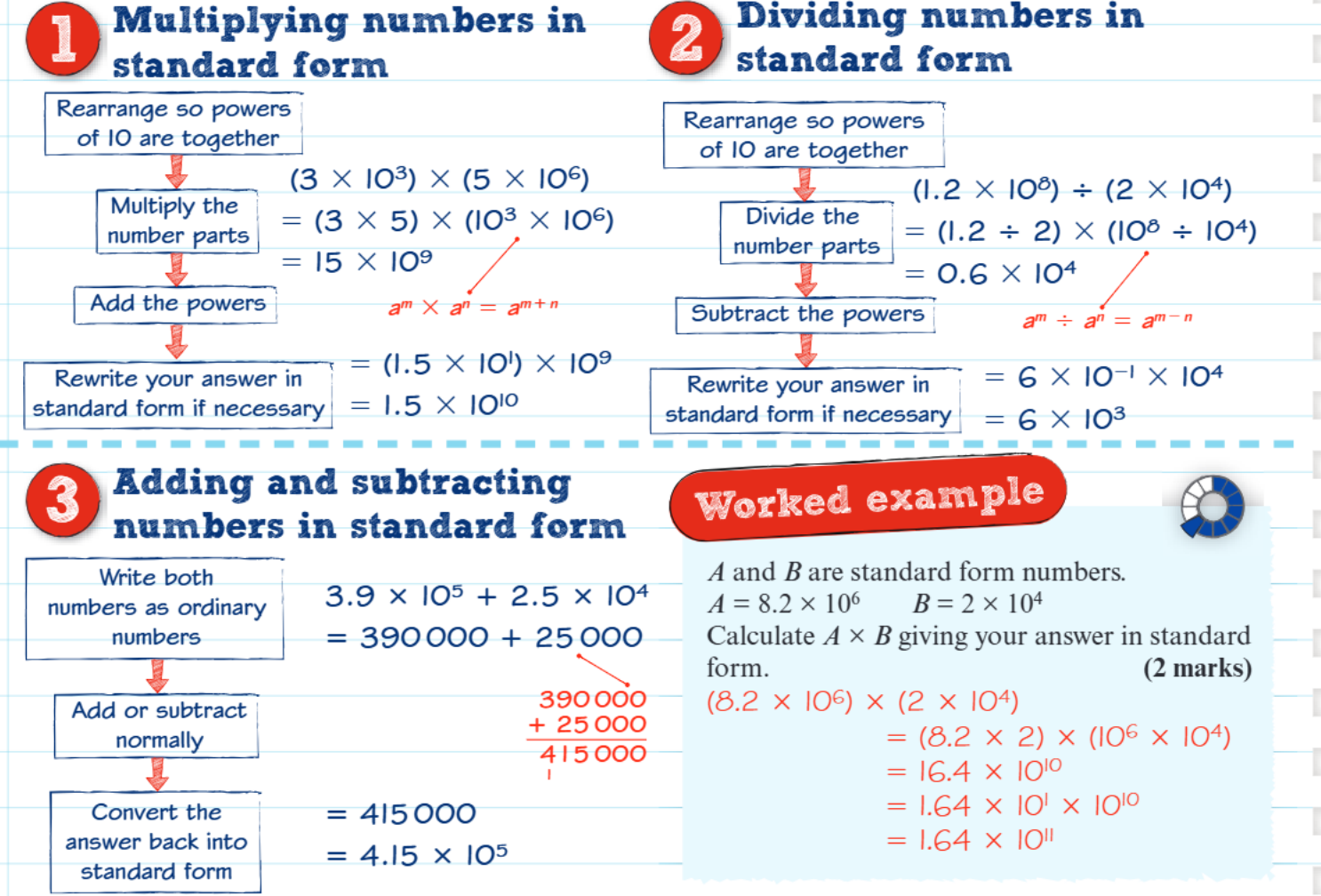
Multiplying numbers in standard form
Multiplication in standard form follows a systematic approach that makes complex calculations manageable.
The process involves three key steps:
- Rearrange the expression so that all powers of 10 are grouped together
- Multiply the number parts (the decimal numbers) separately
- Add the powers of 10 using the index law:
- Check your answer is in proper standard form (if necessary, adjust)
Note
The key to multiplication in standard form is treating the number parts and power parts separately, then combining them using index laws.
Example
Worked Example: Multiplying Standard Form Numbers
Calculate :
Step 1: Rearrange the expression
Step 2: Multiply the numbers
Step 3: Add the powers using
Step 4: Combine and check standard form (rewritten in proper standard form)
Dividing numbers in standard form
Division in standard form uses a similar systematic approach but with one key difference in handling the powers.
The process involves these steps:
- Rearrange the expression so powers of 10 are grouped together
- Divide the number parts (the decimal numbers)
- Subtract the powers of 10 using the index law:
- Check your answer is in proper standard form and adjust if needed
Example
Worked Example: Dividing Standard Form Numbers
Calculate :
Step 1: Rearrange the expression
Step 2: Divide the numbers
Step 3: Subtract the powers using
Step 4: Combine and check standard form (rewritten in proper standard form)
Adding and subtracting numbers in standard form
Important
Addition and subtraction require a completely different approach because you cannot directly add or subtract numbers with different powers of 10.
The method involves:
- Convert both numbers to ordinary form (regular decimal notation)
- Perform the addition or subtraction normally
- Convert the result back into standard form
Example
Worked Example: Adding Standard Form Numbers
Calculate :
Step 1: Convert to ordinary numbers
Step 2: Add normally
Step 3: Convert back to standard form
Note
This method ensures accuracy because it avoids the complexity of working with different powers of 10 directly. Always convert to ordinary form first when adding or subtracting.
Problem-solving with standard form
When tackling word problems involving standard form, use these strategies:
Note
Start simple: If you're unsure which operation to use, try working with simpler numbers first to understand the relationship.
Identify the operation needed: Look for keywords like "total" (addition), "difference" (subtraction), "times" (multiplication), or "how many times" (division).
Work systematically: Break complex problems into smaller steps, handling one operation at a time.
For real-world applications, standard form helps with:
- Scientific measurements (atomic masses, distances in space)
- Large quantities (population figures, financial calculations)
- Very small measurements (microscopic distances, molecular weights)

Exam tips
Important
Essential Exam Strategies:
- Show your working clearly - marks are often awarded for method even if the final answer is incorrect
- Check your final answer is in proper standard form ()
- Practise with your calculator to verify non-calculator methods
- Read questions carefully to identify which operation is required
Summary
Key Points to Remember:
- Multiplication: Multiply the numbers, add the powers
- Division: Divide the numbers, subtract the powers
- Addition/Subtraction: Convert to ordinary form first, then convert the answer back
- Always check your final answer is in proper standard form
- Use systematic approaches rather than trying to do everything in your head at once