Fractions and Recurring Decimals (AQA GCSE Maths): Revision Notes
📚Revision Notes
Fractions and recurring decimals
What are recurring and terminating decimals?
When you convert a fraction to a decimal, you'll get one of two types of results. Understanding the difference between these is crucial for your GCSE maths success.
Recurring decimals are decimals where a pattern of digits repeats endlessly. For example, where the 3 keeps repeating forever. We show this repetition using dot notation - so where the dot above the 3 shows it repeats.
Terminating decimals are decimals that come to an end. For example, - there are no more digits after the 5, so it terminates.
Note
The repeating pattern doesn't have to be just one digit. You might see patterns like (which we'd write as ) where the entire sequence "142857" repeats.
The prime factor rule
Here's the key rule that determines whether a fraction will give you a terminating or recurring decimal:
Important
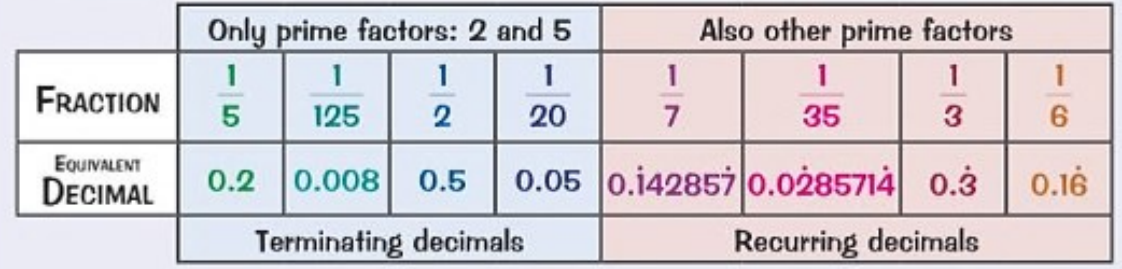
The Prime Factor Rule: If the denominator of a fraction (in its simplest form) contains only the prime factors 2 and 5, the decimal will terminate. If it contains any other prime factors, the decimal will recur.
Let's see this rule in action:
Converting recurring decimals to fractions
Converting a recurring decimal back to a fraction might seem tricky at first, but there's a systematic method that works every time. The approach depends on whether the recurring part starts immediately after the decimal point or not.
Basic method (immediate recurrence)
When the recurring part starts straight after the decimal point, like , the algebraic method provides a reliable solution:
Example
Worked Example: Converting to a fraction
Step 1: Let
Step 2: Multiply by 1000 (since the recurring part has 3 digits):
Step 3: Subtract the original equation to get rid of the decimal part:
Step 4: Solve for : (after simplifying)
The method works by using algebra to eliminate the decimal part through strategic multiplication and subtraction.
Trickier method (delayed recurrence)
When there's a non-repeating part before the recurring section, like , you need an extra step:
Example
Worked Example: Converting to a fraction
Step 1: Let
Step 2: Multiply by 10 to move past the non-repeating part:
Step 3: Multiply by 10 again to move past one complete recurring cycle:
Step 4: Subtract the equation from Step 2 to get rid of the decimal part:
Step 5: Solve for : (after simplifying)
Note
The key insight is that you need two multiplications - one to handle the non-repeating part and another to handle the recurring part.
Converting fractions to recurring decimals
Sometimes you'll need to go the other way - from fractions to recurring decimals. There are two main approaches:
Method 1: Find an equivalent fraction with all 9s on the bottom If you can make the denominator consist entirely of 9s, the numerator will tell you the recurring part directly. For example, can be rewritten as , which equals .
Method 2: Use division You can simply divide the numerator by the denominator. If you're allowed a calculator, this is straightforward. If not, you can use long division, though this can be time-consuming.
Note
Exam Tips and Reminders:
- Always check if a fraction is in its simplest form before applying the prime factor rule
- When converting recurring decimals to fractions, remember to cancel down your final answer if possible
- In non-calculator papers, you might be asked to show that a fraction equals a specific recurring decimal - use the algebraic method to prove this
- Pay careful attention to the notation - dots above numbers indicate which digits repeat
- If you're unsure whether a decimal terminates or recurs, think about the prime factors of the denominator
Summary
Key Points to Remember:
- Only fractions with denominators containing just prime factors 2 and 5 give terminating decimals
- All other fractions give recurring decimals
- Use the algebraic method: multiply, subtract, divide to convert recurring decimals to fractions
- For delayed recurrence, multiply twice - once for the non-repeating part, once for the recurring part
- Always simplify your final fraction answer