Fractions, Decimals and Percentages (AQA GCSE Maths): Revision Notes
📚Revision Notes
Fractions, decimals and percentages
Understanding proportion
The key to mastering fractions, decimals, and percentages is understanding that they are simply three different ways of expressing the same thing: proportion. Think of them as three different languages that all describe the same mathematical relationship. Once you grasp this concept, you'll see how these three formats are closely related and can be easily converted between each other.
Important
Critical Concept: Fractions, decimals, and percentages are not separate mathematical concepts - they are three different ways of expressing the same proportion. This understanding is the foundation for all conversions.
Essential conversions to memorise
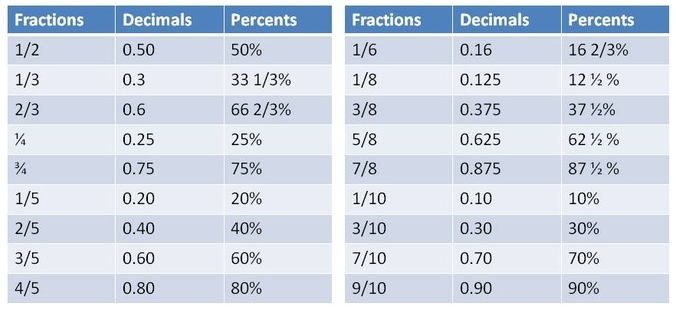
Rather than working out conversions from scratch every time, there are some really common equivalents that you should know immediately. Learning these by heart will save you time and help you spot patterns in more complex problems.
Note
The more of these conversions you learn, the better your mathematical fluency will become. Focus on memorising the most common ones first: , , and .
However, for those conversions you don't know by heart, you need to understand the systematic methods for converting between the three types.
Conversion methods
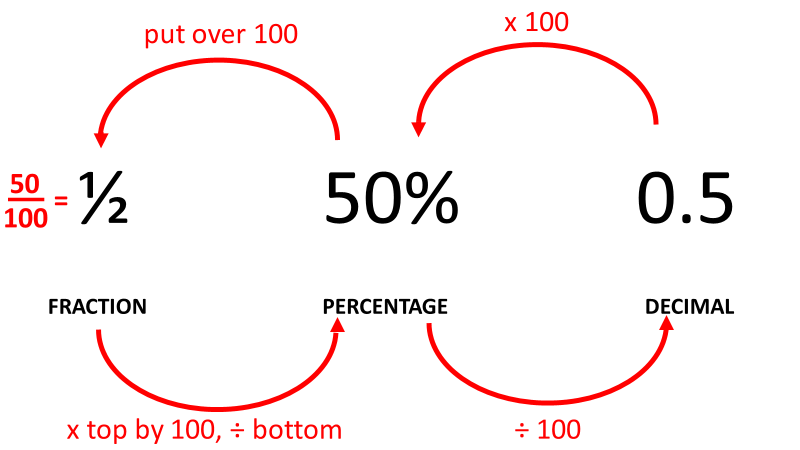
Understanding how to convert between fractions, decimals, and percentages is crucial for solving problems efficiently. Each conversion has its own method, and some are more straightforward than others.
From fraction to decimal
To convert a fraction to a decimal, simply divide the numerator (top number) by the denominator (bottom number).
Example
Worked Example: Converting Fraction to Decimal
Convert to a decimal:
Step 1: Divide the numerator by the denominator
Therefore:
From decimal to percentage
Converting from decimal to percentage is straightforward: multiply by 100.
Example
Worked Example: Converting Decimal to Percentage
Convert to a percentage:
Step 1: Multiply by 100
Therefore:
From percentage to decimal
To go from percentage to decimal, divide by 100. This is the reverse of the previous conversion.
From decimal to fraction
Converting decimals to fractions can be trickier because there are different methods for different types of decimals. The method depends on whether you're dealing with terminating or recurring decimals.
Converting terminating decimals to fractions
Terminating decimals are decimals that end (like , , or ). Converting these to fractions is actually quite straightforward once you understand the pattern.
Important
Key Rule for Terminating Decimals: The digits after the decimal point become the numerator (top number), and the denominator (bottom number) is a power of 10 with the same number of zeros as there were decimal places.
Example
Worked Example: Converting Terminating Decimals
Convert the following terminating decimals to fractions:
Example 1:
- One decimal place, so denominator is
- (simplified)
Example 2:
- Two decimal places, so denominator is
- (simplified)
Example 3:
- Three decimal places, so denominator is
- (simplified)
Note
Remember that these fractions can often be simplified to their simplest form by cancelling down common factors. Always check if you can simplify your answer!
Recurring decimals
Converting recurring decimals to fractions is more complex and requires a different approach. Recurring decimals are those that have digits that repeat forever, like or These conversions involve more advanced techniques that require careful algebraic manipulation.
Important
Important to Know: Recurring decimal conversions use different methods than terminating decimals. These require algebraic techniques and are typically covered in more advanced topics.
Building your confidence
The key to success with fractions, decimals, and percentages is practice and familiarity. Start by memorising the common conversions, then practise the systematic methods for other conversions. With time, you'll develop the confidence to tackle any conversion problem that comes your way.
Remember that these three formats are just different ways of expressing the same mathematical ideas. Once you see the connections between them, you'll find that problems involving fractions, decimals, and percentages become much more manageable.
Summary
Key Points to Remember:
- Fractions, decimals, and percentages are three different ways of expressing proportion
- Learn common conversions by heart to save time in exams
- To convert fraction to decimal: divide the top by the bottom
- To convert decimal to percentage: multiply by 100
- To convert percentage to decimal: divide by 100
- To convert terminating decimals to fractions: digits after decimal point go on top, power of 10 goes on bottom
- Always simplify fractions to their simplest form when possible
- Practice regularly to build confidence and speed