Multiples, Factors and Prime Factors (AQA GCSE Maths): Revision Notes
📚Revision Notes
Multiples, factors and prime factors
Understanding multiples, factors and prime factors is fundamental to working with numbers in mathematics. These concepts help us understand the relationships between different numbers and form the basis for many mathematical operations.
Note
These three concepts are interconnected and build upon each other. Mastering them will make more advanced topics like fractions, algebra, and number theory much easier to understand.
What are multiples?
A multiple of a number is simply what you get when you multiply that number by any whole number. Think of it as working through a number's times table - each result is a multiple of your original number.
For example, if we want to find the multiples of 13, we multiply 13 by 1, then by 2, then by 3, and so on. This gives us the sequence: 13, 26, 39, 52, 65, 78, 91, 104, and the pattern continues infinitely.
Example
Finding Multiples of 13:
The multiples of 13 are: 13, 26, 39, 52, 65, 78, 91, 104, ...
The key thing to remember is that multiples go on forever - you can always find the next multiple by adding the original number to your current multiple.
What are factors?
Factors are quite different from multiples. A factor of a number is any whole number that divides into it exactly, leaving no remainder. In other words, if you can divide one number by another and get a whole number answer, then the second number is a factor of the first.
Finding all factors systematically
There's a reliable method to ensure you find all the factors of any number:
- Start by writing down the number itself
- Then try what gives you the original number
- Continue with , , , and so on, writing down the multiplication pairs
- Stop when you start getting repeated numbers
- All the numbers you've written down are the factors
Example
Finding All Factors of 24:
Step 1: Step 2: Step 3: Step 4:
We stop here because 5 doesn't divide evenly into 24, and would repeat what we already have.
Therefore, the factors of 24 are: 1, 2, 3, 4, 6, 8, 12, and 24.
Prime numbers
Prime numbers are special numbers that have exactly two factors: 1 and themselves. They're the building blocks of all other numbers because every number can be made by multiplying prime numbers together.
The first few prime numbers are: 2, 3, 5, 7, 11, 13, 17, 19, 23, 29, 31, 37, 41, 43, and so on.
Important
1 is NOT a prime number! Even though it might seem like it should be, 1 is not considered prime because it only has one factor (itself), not two. Prime numbers must have exactly two factors.
Note
The number 2 is unique among prime numbers because it's the only even prime number. All other even numbers have at least three factors: 1, 2, and themselves.
Prime factorisation using factor trees
Every whole number greater than 1 can be expressed as a product of prime numbers. This process is called prime factorisation, and the factor tree method is an excellent way to find these prime factors.
How to use the factor tree method
- Start with your number at the top of the tree
- Split it into any two factors and write them as branches below
- Look at each branch - if it's a prime number, circle it and stop working with that branch
- If a branch isn't prime, split it further into two more factors
- Continue until every branch ends in a prime number
- The circled prime numbers are your prime factors
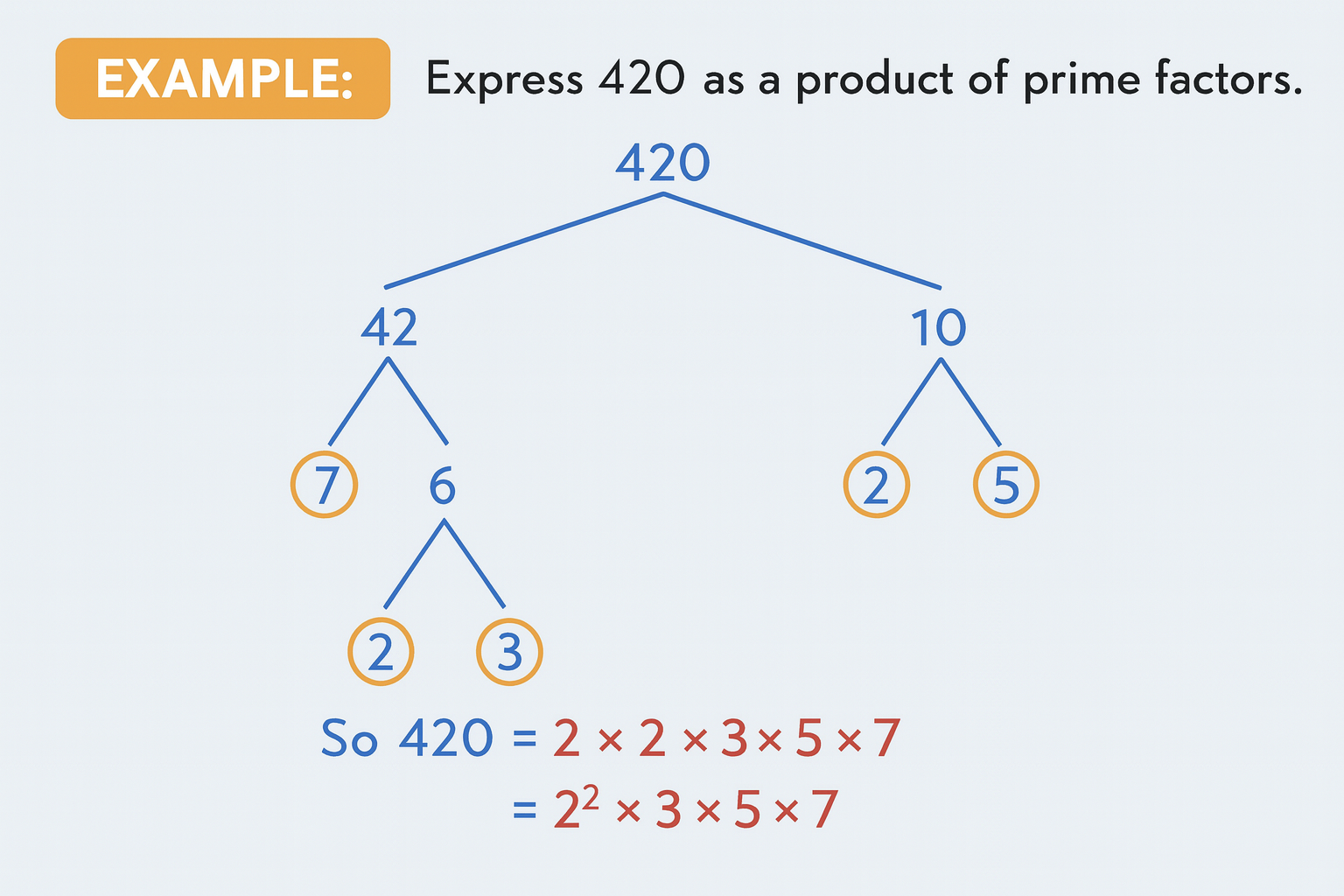
Example
Factor Tree for 420:
Step 1: Start with 420 at the top Step 2: Split 420 into Step 3: Split 42 into (7 is prime, so circle it) Step 4: Split 6 into (both are prime, so circle them) Step 5: Split 10 into (both are prime, so circle them)
Prime factors: 2, 2, 3, 5, 7
Final answer:
When writing the final answer, we group identical prime factors using powers. So .
Important
Unique Prime Factorization: The beauty of prime factorization is that every number has a unique prime factorization - there's only one way to break down any number into its prime factors (apart from changing the order).
Summary
Key Points to Remember:
- Multiples are what you get from a number's times table - they go on forever
- Factors are numbers that divide exactly into another number - use the systematic pairing method to find them all
- Prime numbers have exactly two factors: 1 and themselves (remember, 1 is not prime!)
- Every number can be broken down into prime factors using the factor tree method
- Prime factorization is unique for each number - there's only one correct way to do it